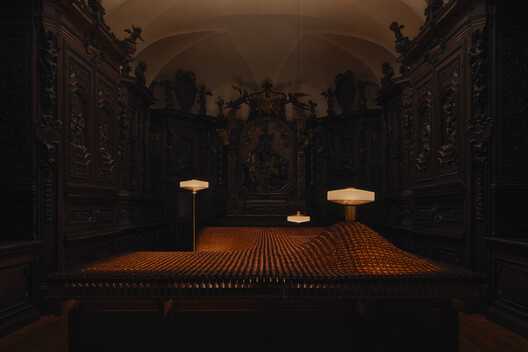
Each spring, Milan Design Week 2026 transforms the city into a distributed platform for design culture, where prototypes, product launches, and research-driven explorations coexist across multiple scales, including a growing presence of architect-designed objects. Held from April 20 to 26, the 2026 edition once again centered around the 64th Salone del Mobile.Milano at Fiera Milano, complemented by a network of independent venues and exhibitions throughout the city, an expanded landscape that is further reflected in ArchDaily's accompanying selection of installations and exhibitions from this year's program.
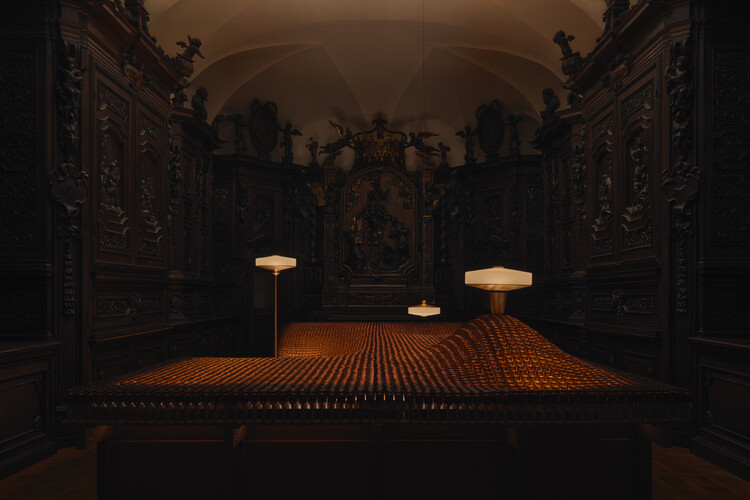
Within this context, architects continue to expand their practice into the realm of product and industrial design, engaging with questions of material performance, fabrication processes, and domestic environments. The objects presented during the week, ranging from lighting elements and modular furniture systems to surface treatments and small-scale accessories, reflect an ongoing interest in precision, adaptability, and the translation of architectural thinking into tactile, human-scaled interventions. Rather than standalone gestures, many of these pieces operate as extensions of broader design research, often developed in collaboration with manufacturers and craftspeople.
Among the numerous launches presented this year, the ArchDaily team has curated a selection of architect-designed lighting, objects, and furniture pieces unveiled during Milan Design Week 2026.
Erosion Collection for Neutra / Zaha Hadid Architects
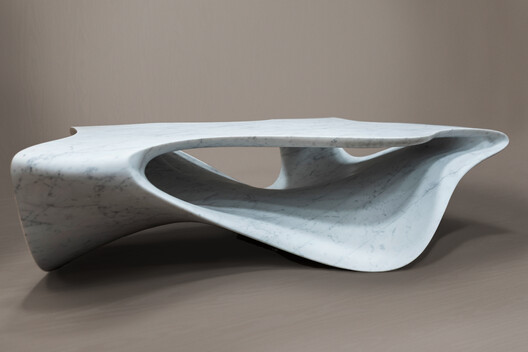
Developed by Zaha Hadid Architects for Neutra, the Erosion Collection continues the studio's investigation into the relationship between material behavior and form. Initially introduced through the MINERA Table and BRANCH Console, the series draws on geological processes, translating erosion into carved geometries that foreground the material qualities of stone. Presented at the 64th Salone del Mobile.Milano, the collection expands with new pieces, including the STRATA Bench, DELTA Coffee Table, and AER Low Chair, introducing additional materials such as carbon fiber, leather, and textiles. These additions establish a contrast between weight and lightness, combining dense marble elements with more flexible surfaces.
Aeris Collection for Citco / Zaha Hadid Architects
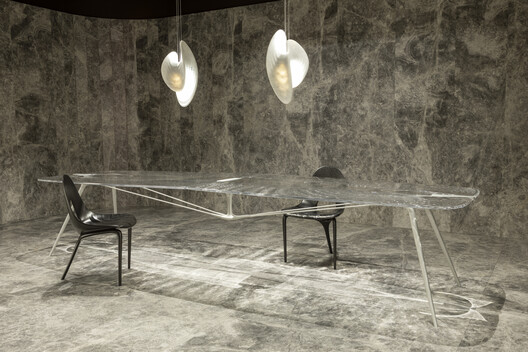
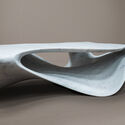
Also presented by Zaha Hadid Architects and engineered in collaboration with Richter, the Aeris Collection for Citco explores the structural potential of form through a series of furniture pieces that challenge conventional perceptions of mass and stability. Unveiled at the 64th Salone del Mobile.Milano, the collection includes the Arcus table, Vires chair, and Aura lamp, each developed through principles of load distribution and force flow. The Arcus table, in particular, references bridge engineering, with a hollowed underside articulated through lattice-like geometries that reduce weight while maintaining structural integrity. Rather than relying on applied ornament, the collection derives its formal language from structural logic, resulting in objects that appear simultaneously solid and lightweight, situating the work between architecture and product design.
OLTRE for Veneta Cucine / CRA-Carlo Ratti Associati
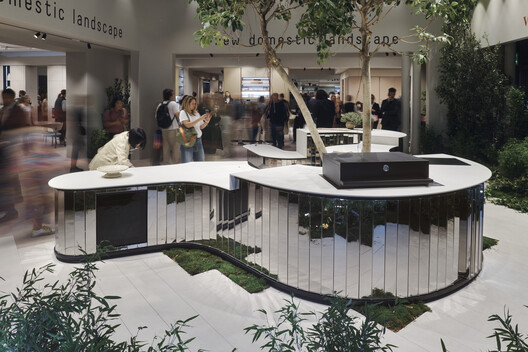
OLTRE, developed by CRA-Carlo Ratti Associati for Veneta Cucine, reconsiders the kitchen as an adaptable domestic system extending beyond interior boundaries. Presented at Eurocucina, the project departs from conventional linear layouts, proposing a continuous, curvilinear configuration capable of responding to varied environments. Conceived as an "all-terrain" kitchen, it incorporates a movable outer layer that opens to reveal cooking and washing functions. Its mirrored stainless steel surface reflects the surrounding context, reducing visual boundaries between object and environment. The project aims to position the kitchen as an interface between interior and exterior conditions.
BEAM and COLUMN for Punt / Foster + Partners
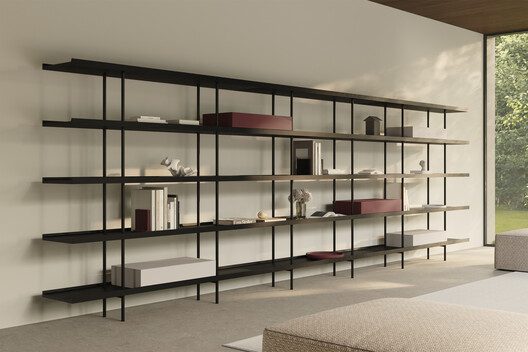
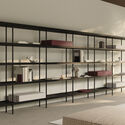
BEAM and COLUMN mark the first collaboration between Punt and Foster + Partners Industrial Design, translating architectural principles into a system of timber furniture. Conceived as complementary collections, both operate through a shared logic in which furniture functions as a spatial framework rather than as isolated objects. BEAM draws directly from the section of a structural beam, reinterpreting it as a modular shelving system defined by metal uprights and adaptable configurations, while COLUMN extends this language into a series of tables that emphasize clarity, proportion, and integrated functionality. Across both systems, sustainability is highlighted through FSC-certified oak, water-based finishes, and design strategies that support disassembly, repair, and material reuse, positioning the collections within a broader architectural approach to longevity and circularity.
Square and Weaving for Casa Mutina / Neri & Hu and Josef & Anni Albers Foundation
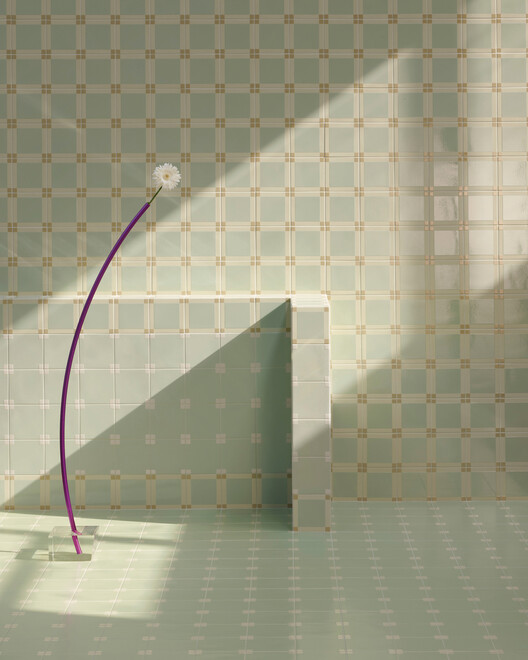
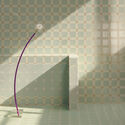
Presented within Casa Mutina, the two collections developed by Neri & Hu and the Josef & Anni Albers Foundation for Mutina explore form and colour as complementary design systems translated into ceramic surfaces. Weaving, by Neri & Hu, draws from the structural logic of bamboo weaving, abstracting interlaced patterns into modular ceramic compositions that emphasize rhythm, repetition, and the interplay between solid and void. In parallel, Homage to the Square, developed with the Albers Foundation, revisits Josef Albers' studies on colour perception through layered chromatic fields, where subtle variations in tone and finish generate optical depth and shifting visual effects. Rather than functioning as decorative surfaces, both collections position ceramics as tools for spatial and perceptual investigation, extending material research into the realm of architectural language and everyday use.
CORE for SEM / Hannes Peer
Presented by SEM during Milan Design Week 2026, CORE by Hannes Peer is a furniture collection developed through a direct engagement with solid wood as both structure and surface. Unveiled at Spotti Milano within the installation HARDCORE, the project avoids veneers and applied surfaces, instead working directly with material mass. Informed by Peer's background as both architect and carpenter, the collection emphasizes construction logic and material integrity, translating tectonic principles into essential geometries. Subtle bas-relief incisions introduce rhythm and depth across otherwise restrained volumes, positioning carving as a structural operation rather than a decorative gesture, and reinforcing the collection's focus on permanence, material behavior, and direct fabrication processes.
FACES for Jaipur Rugs / Kengo Kuma
FACES is a collaboration between Kengo Kuma and Jaipur Rugs that translates Kuma's architectural approach into a series of textile works conceived as spatial conditions rather than decorative objects. Drawing from his broader practice, in which architecture is understood as porous and responsive to its environment, the collection approaches the rug as a medium that shapes atmosphere through light, material density, and visual rhythm. Rather than relying on explicit patterning, the designs emphasize gradation and material depth, positioning textiles as components that contribute to spatial definition.
La Stanza / Studio David Chipperfield
La Stanza, designed by David Chipperfield for Kasthall, explores how a modular system can organize space through repetition and proportion. Developed for a hospitality context, the project is based on a 6×6 structural grid that translates into a minimal, adaptable interior unit where functions are integrated within a consistent spatial framework. Furnishings are treated as part of an overall system rather than discrete elements. Within this configuration, the Lav rug is incorporated as a spatial component, contributing to the definition of surfaces and boundaries.
MTM – Made to Measure for UniFor / Herzog & de Meuron Objects
MTM – Made to Measure, developed by Herzog & de Meuron Objects for UniFor, extends a system-based approach to furniture derived from architectural prototyping. Originating as a standing table for the studio's own office, the collection evolves into a modular framework that accommodates multiple typologies, including tables, benches, sofas, sideboards, consoles, and even a ping-pong table, through a shared structural logic. Defined by a twelve-degree geometry derived from woodworking traditions, each element is assembled through intersecting beams that reference the logic of the castle joint, allowing for stability without visual excess. Material combinations such as solid wood, glass, stone inlay, polished steel, and cork leather further highlight the system's adaptability, positioning the collection as an extension of architectural thinking applied across different uses.
Giuditta for UniFor / Herzog & de Meuron Objects
Giuditta by Herzog & de Meuron Objects for UniFor is a seating collection developed for leisure and dining contexts, originally conceived for Villa Roccabruna at the Mandarin Oriental Lago di Como. The design references regional furniture traditions and the building's walnut millwork, translating these influences into a reduced formal language that emphasizes structure and proportion. Classical Italian typologies are distilled into essential components, resulting in a robust yet refined profile defined by a continuous S-shaped armrest that carries through both indoor and outdoor versions, including a variant in polished stainless steel.
Macaron - Modular Sofa System for bert plantagie / Mecanoo
The Macaron modular sofa system is a collaboration between Mecanoo and Bert Plantagie that applies architectural thinking to a flexible seating infrastructure designed for contemporary living and working environments. Conceived as a layered system, base, seat, and backrest, the design operates as a modular framework rather than a fixed object, allowing users to configure multiple spatial arrangements such as islands, clusters, or linear sequences. This adaptability extends across office, hospitality, and educational contexts, where the system responds to different modes of use and patterns of interaction. Developed through research into user behavior and spatial dynamics, Macaron positions furniture as an adjustable landscape, with modular components designed for reconfiguration over time, supporting both functional longevity and material efficiency through a focus on circular use and durable construction.
Revisiting Richter for Prostoria / Vjenceslav Richter
Revisiting Richter by Prostoria reintroduces the unrealised furniture designs of Vjenceslav Richter through contemporary production, translating archival drawings and prototypes into a series of functional objects. Developed in collaboration with design studios and based on systematic research into Richter's original concepts, the collection spans multiple typologies, including seating and table systems. The resulting pieces are defined by lightweight construction, geometric precision, and an emphasis on structural efficiency, reflecting Richter's broader approach to design as a systematic practice.
Aposē by Aesop
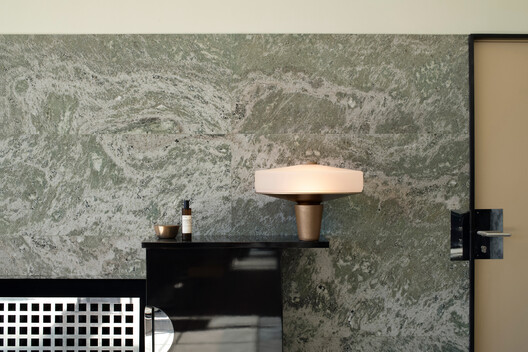
Aposē by Aesop is the brand's first lighting object, developed in-house by Aesop's architects as a limited-edition table lamp and unveiled within the "Factory of Light" installation designed by Australian architect Rodney Eggleston, founder of March Studio. Conceived as a reinterpretation of an everyday industrial form, the lamp derives from the geometry of an aluminium tube expanded into a cylindrical volume with unconventional proportions that foreground material presence through reduction. Produced through a combination of European craft processes, including a sand-cast brass base, a machined aluminum body, and a mouth-blown glass diffuser. Its composition emphasizes material contrast and controlled illumination, extending the brand's approach to atmospheric lighting into a domestic context.
We invite you to check out ArchDaily's coverage of Milan Design Week and Salone del Mobile 2026.