In Latin America, the ground is rarely just a surface to build on. It can be a river edge, a steep slope, a humid forest floor, a floodable landscape, or a territory under ecological pressure, and in many cases, it carries a history of communities that already knew how to respond to it, building on stilts, on platforms, over water, long before contemporary architecture asked the same questions.
These projects continue that conversation. They engage with conditions that move, absorb, erode, and grow, rather than treating the ground as something to level or control. Elevation allows architecture to adapt without fully taking over: water can pass below, vegetation can remain, and slopes can keep their original condition. In each case, the decision to rise is tied to something specific: water, humidity, topography, vegetation, or ecological recovery, and the knowledge of how to build within it and not against it.
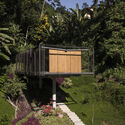
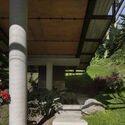
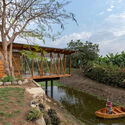
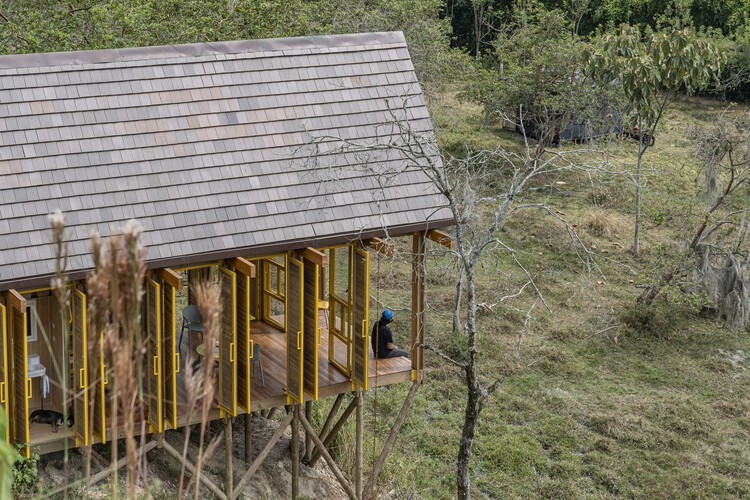
Water and humidity define the logic of Tea Room by Natura Futura, in Babahoyo, Ecuador, where elevation is tied to the conditions of a humid city shaped by water. The project works as a small wooden room open to its surroundings, where the raised floor, roof, and light structure create a shaded place for pause and gathering. Instead of separating the architecture from the site, the slight distance from the ground helps it deal with moisture while keeping vegetation, air, and everyday use close. It is a modest gesture, but one that shows how elevation can support both climate response and social life.
Related Article
On International Mother Earth Day: Urban Rewilding, Aquatic Ecosystems, and Ancestral Practices for Biodiversity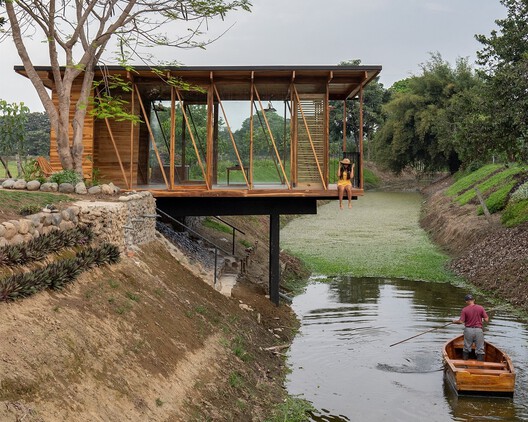
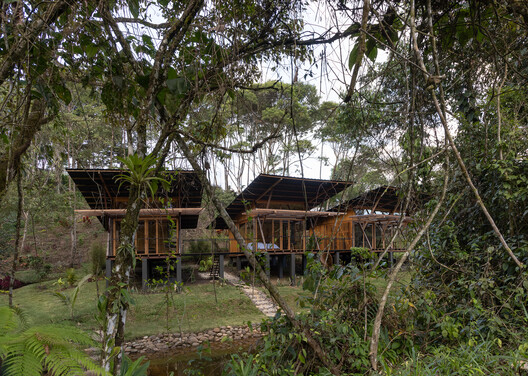
Humidity, slope, and the presence of water define Hoguera de Madera Refuge by Mestizo Estudio Arquitectura. Here, water appears through another condition: the ravine. Located near Puyo, in the Ecuadorian Amazon, building directly on the ground would mean dealing with constant moisture, uneven terrain, and a fragile edge along the ravine. The house is therefore divided into three wooden modules connected by an elevated walkway that follows the riverbed, reducing contact with the soil and allowing water and vegetation to remain active below. This distance is not formal; it is a way to adapt to a site that is wet, sloped, and in constant movement. The use of a local palm known as the "steel of the jungle" reinforces this response, linking elevation to both climate and available materials.
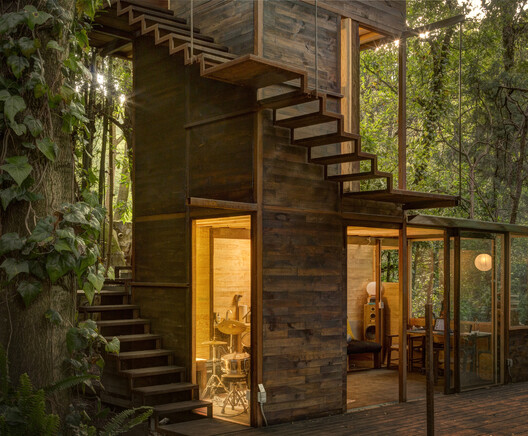
Topography becomes the main condition in Floating House by Talleresque, in Mexico City. Built on a steep site and supported by nine vertical elements, the house avoids turning the slope into a flat platform. Its "floating" quality is not related to water, but to the way the structure reduces cuts into the terrain and keeps the surrounding trees present in the experience of the house. The slope is not corrected; it becomes part of how the project is accessed, perceived, and inhabited.
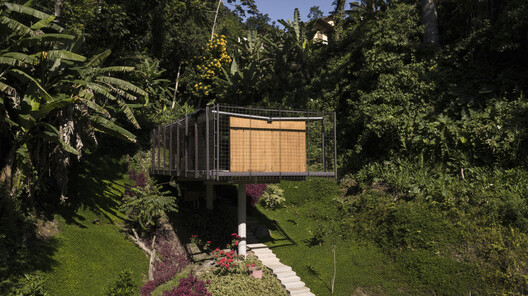
Slope and moisture also shape Elevated House by Venta Arquitetos, in Petrópolis, Brazil. The house is raised to reduce earthworks and avoid humidity from the ground, resting on two T-shaped concrete supports. This makes elevation a practical response to construction impact, terrain, and climate. The structure does not need to occupy the site heavily to make it habitable; it creates enough distance for the house to work with the conditions of the place.
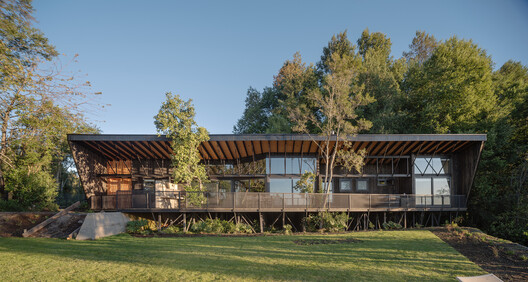
Miradores House by Lucas Maino Fernández uses elevation to organize its relationship with a much larger geography: forest, volcano, and lake. In Villarrica, Chile, the house sits on a single platform where two independent volumes open toward different landscape references. The view is not treated as a decorative backdrop. It helps organize orientation, domestic life, and the position of the house within a territory shaped by strong natural elements.
These examples also show that elevation is not only a response to difficult terrain, but a way of changing the intensity of contact between architecture and site. A raised floor, a walkway, a platform, or a small set of supports can define how much ground is touched, how much vegetation remains, and how water or air continues to move below. In that sense, the space underneath is not leftover space. It becomes part of the project's environmental logic.
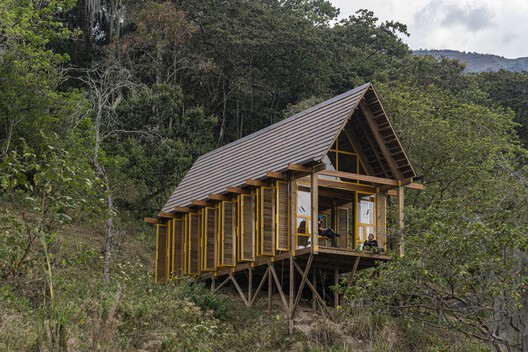
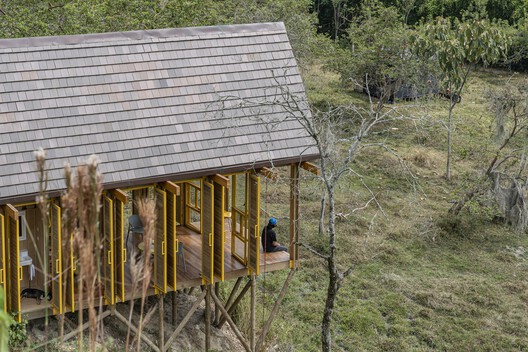
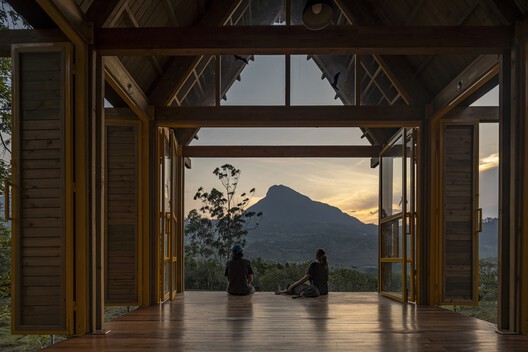
In Lamarilla Reforestation House by Quena Margarita González Escobar + Juan David Hoyos Taborda, elevation is connected to recovery rather than only climate or topography. Located in Fredonia, Colombia, the house is part of a broader reforestation process in a landscape marked by agriculture and extraction. Raising the architecture reduces pressure on a site still in transformation: soil can absorb water, vegetation can grow, and small ecosystems can remain in motion. The house does not complete the landscape; it supports a process of planting, maintenance, observation, and care.
What these projects share is not a technique, but an attitude, one that is inseparable from where they are built. Across Latin America, the ground can take many forms: rivers that flood and shift, slopes that resist leveling, forests under pressure, soils in recovery, and climates shaped by humidity, rainfall, altitude, or seasonal change. The ground is rarely neutral. It has its own conditions, and architecture must learn how to work with them.
This negotiation also has a long history in the region. Long before contemporary architecture, many communities built on water, stilts, and platforms, not as a stylistic choice, but as a practical response to the landscapes they inhabited. These projects continue that conversation with updated tools and a sharper environmental awareness, at a moment when the pressure on Latin American ecosystems is increasingly visible.
To build above the ground, then, is to recognize that the site is already active: water moves, vegetation grows, soil absorbs, and ecosystems slowly recover. Elevation becomes a way to stay without taking over, to occupy without erasing.
This article is part of the ArchDaily Topic: Light, Lighter, Lightest: Redefining How Architecture Touches the Earth, proudly presented by Vitrocsa, the original minimalist windows since 1992.
Vitrocsa designed the original minimalist window systems, a unique range of solutions, dedicated to the frameless window boasting the narrowest sightline barriers in the world. Manufactured in line with the renowned Swiss Made tradition for 30 years, Vitrocsa's systems "are the product of unrivaled expertise and a constant quest for innovation, enabling us to meet the most ambitious architectural visions."
Every month we explore a topic in-depth through articles, interviews, news, and architecture projects. We invite you to learn more about our ArchDaily Topics. And, as always, at ArchDaily we welcome the contributions of our readers; if you want to submit an article or project, contact us.