

Modernism in architecture was perhaps the first truly global building design philosophy. Established at the beginning of the twentieth century, its early proponents were heavyweights from Europe, such as Le Corbusier, Walter Gropius, and Mies van der Rohe. In 1923, Le Corbusier published his seminal written work, usually translated into English as Towards a New Architecture. Newness, and a rejection of history, was one of the central tenets of modernism. This manifested itself in the use of new materials such as steel and concrete, which gave rise to an unprecedented freedom of formal expression.
By the middle of the twentieth century, Modernism was adopted across the world by countries recovering from the Second World War and overcoming the legacy of colonialism. It became the language of reconstruction and of nation-building, reinforced by its rejection of the past. Its emphasis on technology suited this brave new world of industry, large-scale development, and new building types. Fast-forwarding to a century after its birth, Modernism itself has become the legacy. As buildings progressively become obsolete or reach the end of their design lives, there is an appreciation of the heritage value of these structures, both as designed items and as symbols of the spirit of the age in which they were built. Here, we look at five Modernist buildings from five regions going through adaptive reuse proposals. Where form once followed function, here, the function must follow the form.

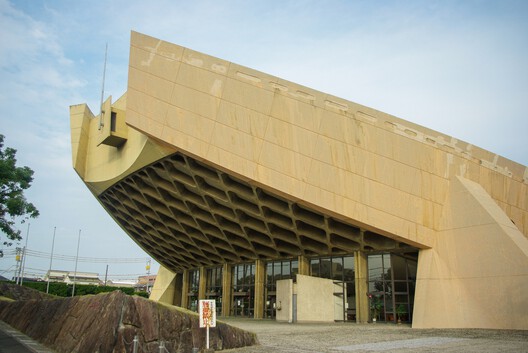
Citizen-Led Campaign Proposes New Use for Kenzo Tange's Kagawa Gymnasium, Facing Demolition
Related Article
Lacaton & Vassal and Emmanuelle Delage to Transform Administrative Center into Mixed-Use Housing and Offices in Vannes, FranceThe Kagawa Prefectural Gymnasium was built between 1961 and 1964 as part of Japan's building spree towards the 1964 Tokyo Olympics. It is regarded as one of the country's fine examples of brutalist structures of this period and a precursor to Tange's more recognized Yoyogi National Stadium. Its elongated, curved structure earned it the nickname 'boat gymnasium', especially due to its location by the Seto Inland Sea. In 2014, it was permanently closed after a roof leak caused damage to its interior, and in August 2025, it was marked for demolition. Efforts to save it included a campaign to designate it as a UNESCO World Heritage Site in 2021. More recently, a citizen-led campaign launched a competition for proposals for alternative uses. They include a "tourism exchange hub" combining art and architecture with a hotel function.
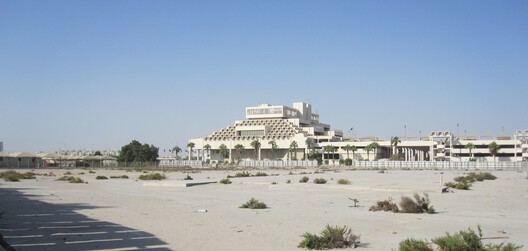
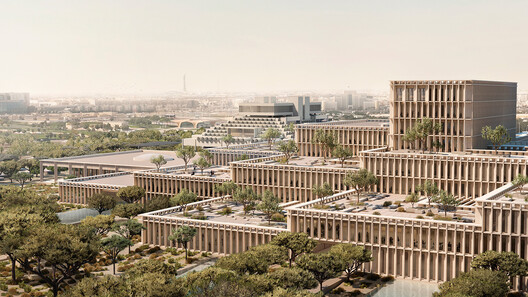
Frida Escobedo to Design Qatar's New Ministry Building with Adaptive Reuse of a Modernist Landmark in Doha
The General Post Office, known for its distinctive modernist "pigeonholes," was constructed in Qatar's capital in 1985. It is an example of Modernism's longer life in the region where buildings continued to be designed in its principles late in the twentieth century. In December 2025, the State of Qatar announced the selection of a team led by Frida Escobedo Studio to design the new headquarters for the Ministry of Foreign Affairs. The project for the Ministry intends to establish a more civic presence for the Qatari diplomatic service on the city's waterfront and public-facing facilities. The design team's proposals include courtyard-centered new constructions and the adaptive reuse of the General Post Office building as a venue for public programming associated with the Ministry's cultural initiatives.
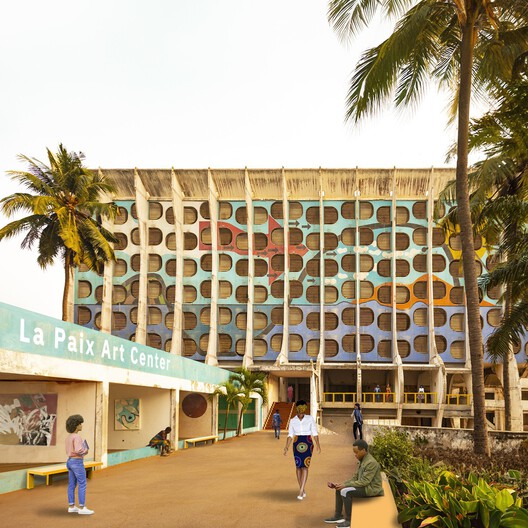
Hôtel de la Paix: An Alternative Approach to Modern Heritage in Togo
As one of four hotels built with state funding along the capital's coastline, the Hôtel de la Paix sits in a visible location on Lomé's waterfront. It was designed by French architect Daniel Chenut, working with Raphaël Ekoué Hangbonon, and completed in 1975 as part of a government ambition to boost tourism. The severe economic downturn in the 1990s strained the hotel's fortunes, and it eventually closed in 2006. Of the four hotels, Hôtel de la Paix can be described as the most sculptural. The rooms are contained in two 6-story volumes sitting on top of a 2-story plinth. Efforts to revive the hotel since its closure never got off the ground. The 9 m² rooms are deemed too small for modern hotel requirements, while the concrete walls make modifications unfeasible. In 2022, the building was marked for demolition, despite being a make-shift site for youth activities and an appearance in music videos. This informal activity led Studio NEiDA to consider an alternative proposal to convert the structure into an educational hub, where the rooms can be used as studios or as student accommodation.
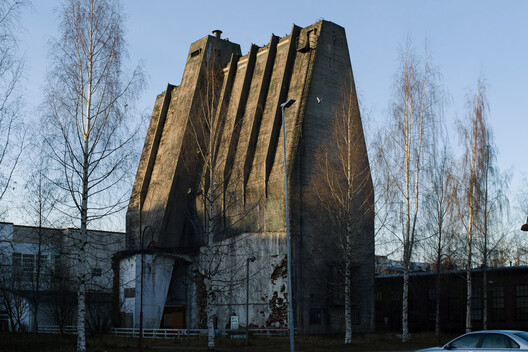
Alvar Aalto's Silo to be Transformed into Research Centre Promoting Architectural Preservation in Oulu, Finland
The Toppila Silo was designed by Alvar and Aino Aalto in 1931 as part of a factory close to the Arctic Circle in Oulu, Finland, that produced cellulose. The factory was made famous when it was photographed by Bauhaus member László Moholy-Nagy shortly after completion. Along with its silo that used to store wood chips, the Toppila Factory has been out of use for decades. In 2020, Skene Catling de la Peña and Factum Foundation purchased the site with the view to transforming the silo into a research center promoting architectural preservation and re-use. It would become a center for digitizing and demonstrating the industrial architecture of the north. The project envisions the restoration of the silo structure as an example for the restoration of similar concrete structures.
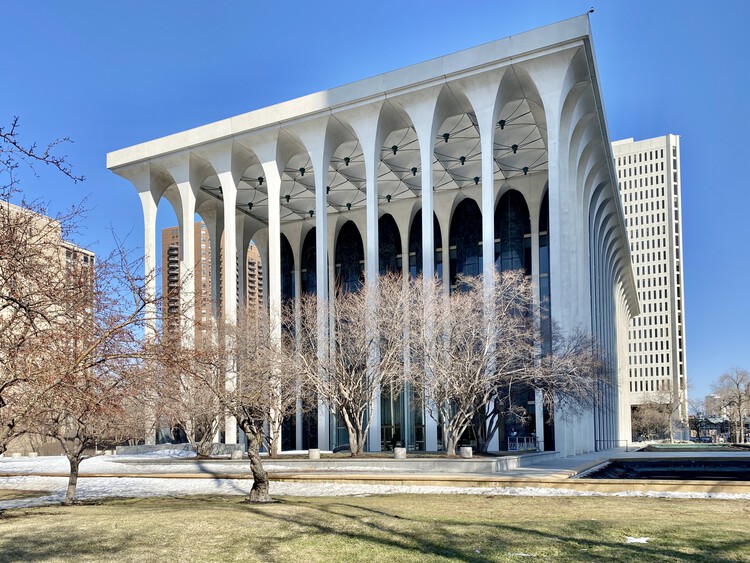
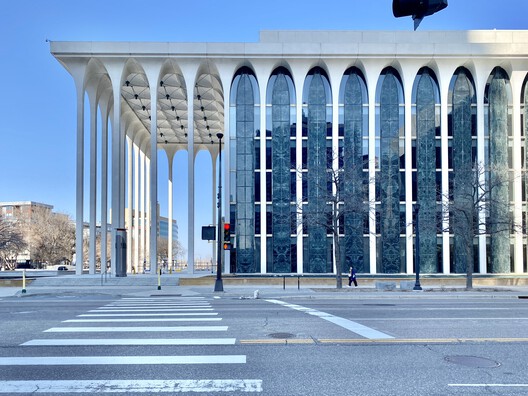
Minoru Yamasaki's Northwestern National Life Building in Minneapolis to Be Converted Into Hotel
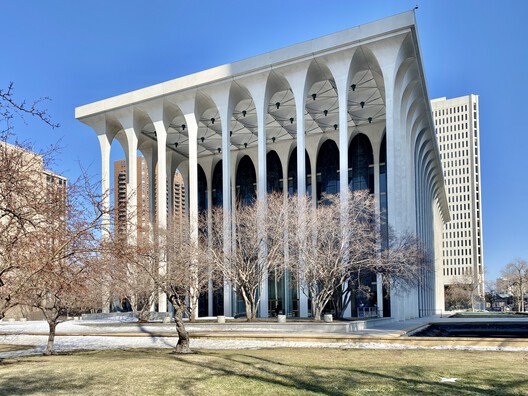
The Northwestern National Life Building in Minneapolis was completed in the early 1960s, conceived as a corporate headquarters for 500 employees. It is a lesser-known work of American architect Minoru Yamasaki, although it is formally distinctive, with its regular grid of slender piers that extends to form a portico of columns. It was designed as a building with a park, a light-weight monument surrounded by an urban landscape accessible to the public, although the building itself was for private use. It became vacant in 2023, and proposals have been drawn up to convert it into a hotel with public-facing functions. The building's defining features and marble cladding would be retained.
This article is part of the ArchDaily Topic: 20th Century Design in Flux: A Global Reinterpretation of Architectural History. Every month we explore a topic in-depth through articles, interviews, news, and architecture projects. We invite you to learn more about our ArchDaily Topics. And, as always, at ArchDaily we welcome the contributions of our readers; if you want to submit an article or project, contact us.


