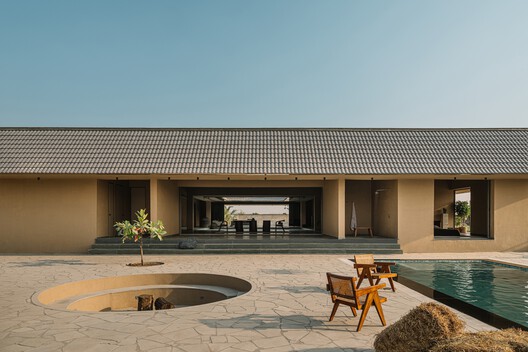
The courtyard is often remembered as a figure from the past, an inward-looking space of nostalgia, culture, and domestic ritual. But this framing misses its primary role. Before it was symbolic, the courtyard was operational. It organized air, moderated light, and absorbed heat. It did not decorate architecture; it made it habitable. In contemporary housing, these functions are normally delegated to mechanical systems, applied after form is fixed. In courtyard houses, they are resolved spatially, before a wall is even built.
What appears as a recurring typology across regions is, in fact, a set of highly specific responses to climate. The courtyard in Egypt does not behave like the courtyard in Morocco, nor like the courtyard in India. Each is calibrated to a different environmental problem, using the same spatial device. To read them as a single type is to flatten their intelligence. To compare them is to understand how climate can be embedded directly into form.



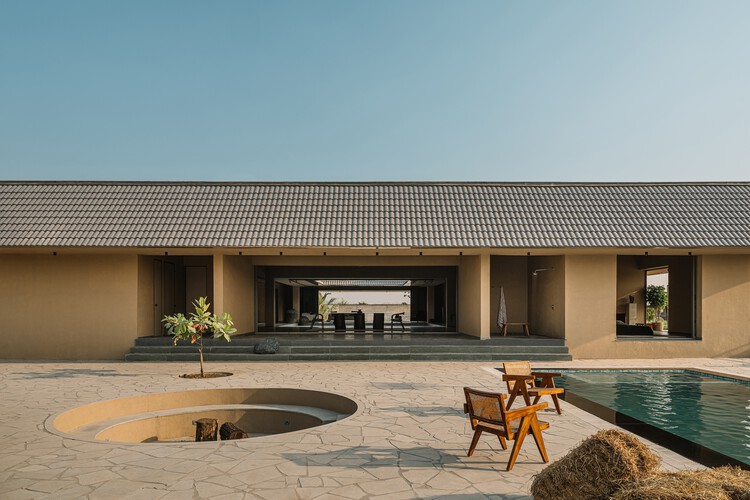
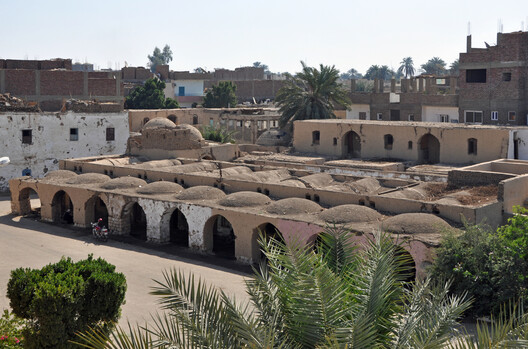
In Egypt's hot-arid regions, the courtyard operates as a thermal engine. Its primary task is not social gathering, but heat management. The geometry is intentional: deep, enclosed courts limit solar penetration, keeping most surfaces in shade for the majority of the day. Thick earthen walls absorb heat slowly, delaying its transfer into interior spaces. As temperatures drop at night, stored heat is released back into the open court, allowing cooler air to settle and circulate. This cycle of absorption, delay, and release is what reduces indoor temperatures by several degrees, a phenomenon documented in studies where courtyard houses recorded reductions of up to 5–7°C compared to external peaks.
Related Article
Polished, Private, and Passive: Traditional Courtyard Houses and their Timeless Architectural Features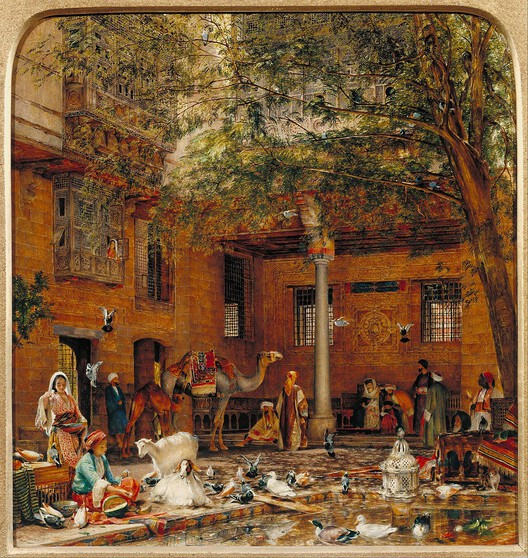
This is not passive in the sense of being inert; it is passive in the sense of being embedded. In Hassan Fathy's New Gourna Village, this logic is made explicit. Adobe walls, shaded courtyards, and controlled openings work together to create a stable internal climate without mechanical cooling. The courtyard is not an empty void at the center of the house, it is the space that makes the rest of the house possible. Remove it, and the thermal system collapses.
If Egypt's courtyard is driven by heat, Morocco's is driven by light. In the dense medinas of Fez and Marrakech, the challenge is not only temperature but exposure. Streets are narrow, plots are compact, and external openings are limited. Here, the courtyard becomes the primary interface between interior and environment. It acts as a vertical light well, drawing daylight into the depth of the house while filtering its intensity. Surfaces like plaster, tile, carved wood are not ornamental additions but instruments that reflect and diffuse light, reducing glare and creating a soft, even illumination.
The Moroccan riad is defined by this inward orientation. At Dar Seffarine, rooms open entirely toward the central court, with almost no reliance on the exterior façade. Light enters from above, modulated by proportion and surface rather than by glass. Studies have shown how such courtyards improve daylight distribution while minimizing overheating, particularly in climates where direct solar exposure can quickly become excessive. The courtyard here is not primarily used to cool the air, it is shaping how light is experienced, turning brightness into atmosphere.
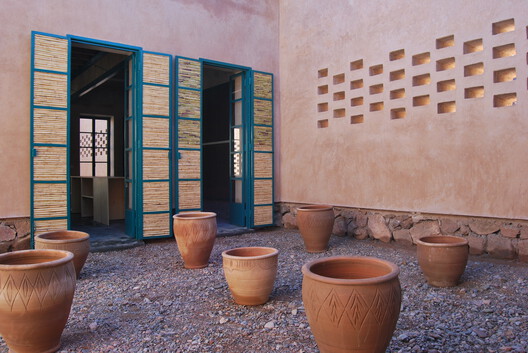
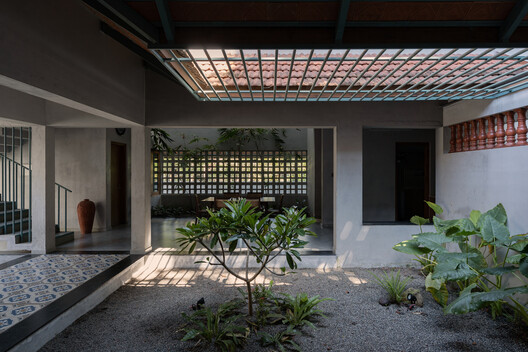
Water and vegetation reinforce this effect. A small fountain or planted court introduces evaporative cooling, subtly lowering temperatures while also dampening sound. The result is not just environmental control, but spatial calm. In a dense urban fabric, the courtyard creates an interior world that is climatically stable and visually controlled. It is less a thermal device than a mediator of sensory conditions.
In India, the courtyard shifts again, responding not to a single dominant condition but to seasonal variation. In composite and monsoon climates, buildings must perform differently across the year, allowing heat to dissipate in summer, allowing sunlight in winter, and managing heavy rainfall during the monsoon. The courtyard becomes a system of adjustment, capable of accommodating these changes through its configuration.
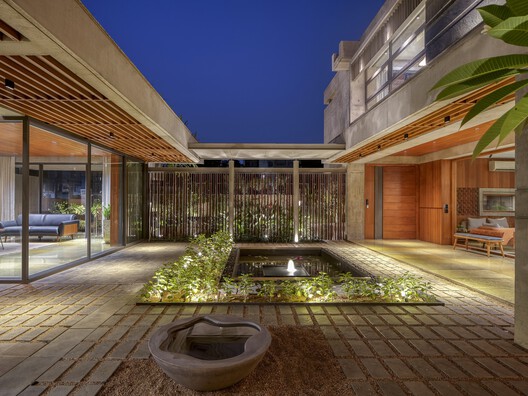
Ventilation is central to this role. As air warms within enclosed rooms, it rises and escapes through the courtyard, drawing cooler air in from lower openings, a process known as the stack effect. This continuous movement increases indoor air velocity, improving thermal comfort even when temperatures remain high. Research has shown how such configurations significantly enhance cross ventilation compared to single-sided openings.
At the same time, the courtyard negotiates sunlight. In Rajasthani havelis, shaded edges and perforated screens filter harsh summer radiation while allowing winter sun to penetrate deeper into the plan. In Chettinad houses in Tamil Nadu, large central courts admit light while also functioning as drainage surfaces during heavy rains, collecting and channeling water without compromising indoor usability. In Kerala's nalukettu houses, the open court becomes a point where rain, light, and air converge, integrated rather than excluded. The courtyard here is not optimized for a single condition; it is tuned to variation.
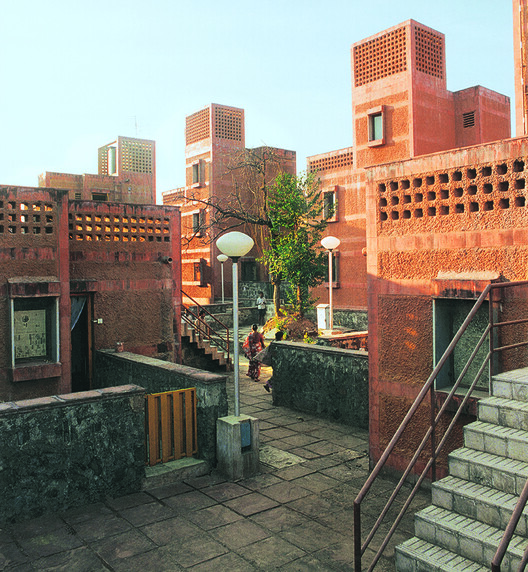
Seen together, these examples resist the idea of the courtyard as a fixed type. What remains consistent is the underlying logic. Across Egypt, Morocco, and India, the courtyard operates as an environmental device, but its performance depends on proportion, orientation, material, and context. As Courtyard Housing: Past, Present and Future notes, there is no universal courtyard model, only a framework that adapts to climate. The same spatial move produces different effects because it is calibrated differently.
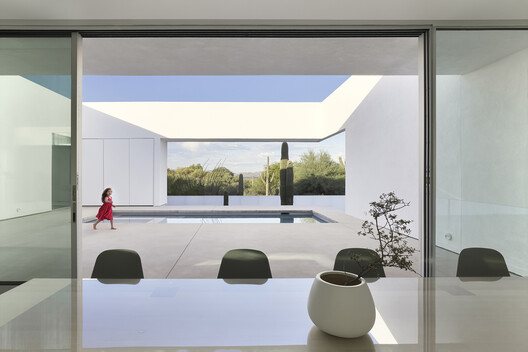
This distinction carries forward into contemporary housing. Today's models prioritize standardization: repeated plans, sealed envelopes, and mechanical systems that compensate for environmental conditions rather than engaging with them. Cooling demand, according to the International Energy Agency, is projected to triple by 2050, driven largely by buildings that rely on air-conditioning to achieve basic comfort. In this context, the courtyard is often dismissed as inefficient or outdated, a form that consumes space without contributing to performance.
But this assessment reverses cause and effect. The courtyard appears inefficient only when evaluated within a system that externalizes environmental control. In the examples above, space is not separate from performance; it is the means through which performance is achieved. The courtyard does not add cost, it offsets it, reducing dependence on energy-intensive systems over time.
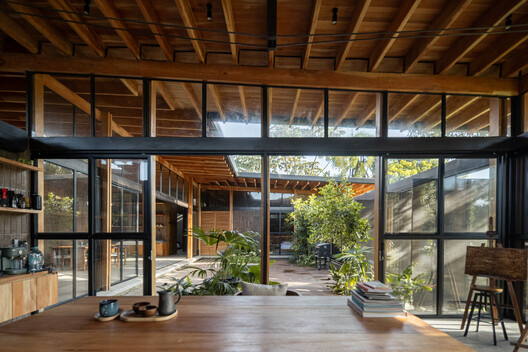
The issue, then, is not that courtyard houses have disappeared, but that their intelligence has not been translated. Contemporary housing borrows their image, an open void, a central space, without recalibrating the underlying logic. Without attention to proportion, orientation, or material, the courtyard becomes decorative rather than operative. Its environmental role is lost, even as its form persists.
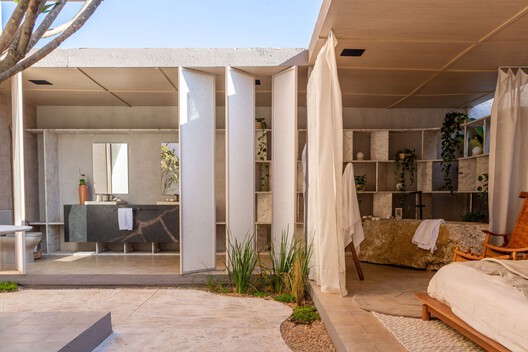
To return to the courtyard is not to return to the past. It is to reconsider how architecture engages with climate at a fundamental level. The examples from Egypt, Morocco, and India do not offer a template to replicate, but a method to interpret. They show that performance can be spatial, that comfort can be constructed through form, and that climate is not a problem to solve after design, but a condition to design with from the beginning.
This article is part of the ArchDaily Topic: Light, Lighter, Lightest: Redefining How Architecture Touches the Earth, proudly presented by Vitrocsa, the original minimalist windows since 1992.
Vitrocsa designed the original minimalist window systems, a unique range of solutions, dedicated to the frameless window boasting the narrowest sightline barriers in the world. Manufactured in line with the renowned Swiss Made tradition for 30 years, Vitrocsa's systems "are the product of unrivaled expertise and a constant quest for innovation, enabling us to meet the most ambitious architectural visions."
Every month we explore a topic in-depth through articles, interviews, news, and architecture projects. We invite you to learn more about our ArchDaily Topics. And, as always, at ArchDaily we welcome the contributions of our readers; if you want to submit an article or project, contact us.