
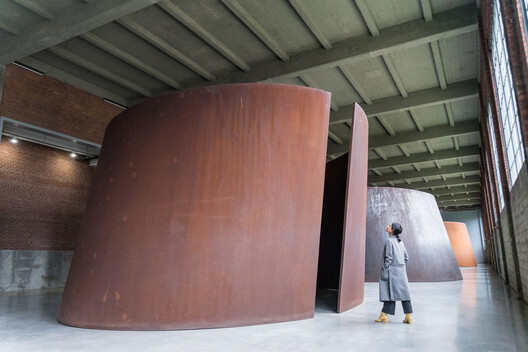
Using massive s plates, often several centimeters thick and weighing tons, Richard Serra's sculptures convey an almost improbable sense of lightness. This effect does not result from a reduction of mass, but from how that mass is organized: large curved surfaces tilt, narrow passages compress the body, and seemingly unstable elements create a constant sense of imbalance. Serra transforms weight into a dynamic spatial experience.
In architecture, lightness has occupied a central role at least since the modern period. While earlier traditions, such as Greek and Roman architecture, were closely associated with stability, and large churches with monumentality, the twentieth century introduced a decisive shift in how matter is handled, particularly through the separation of structure and enclosure.
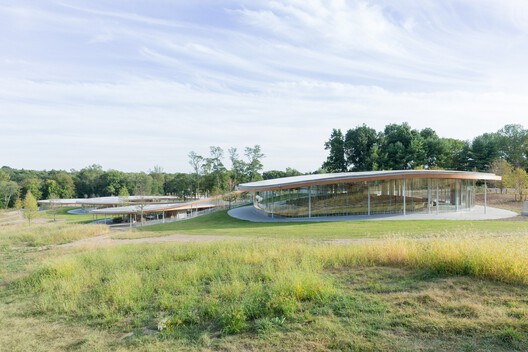
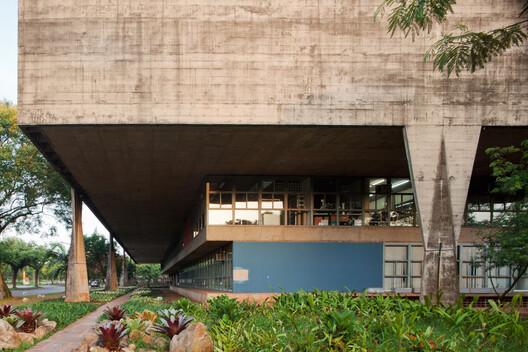
From that point on, different strategies emerged to reduce the apparent presence of construction. In some cases, this occurs through concrete structures that project outward with precision and minimal supports, as seen in the Saint Peter Chapel by Paulo Mendes da Rocha or the FAU-USP building by Vilanova Artigas. In others, such as the work of SANAA, structure is fragmented into minimal elements and tends to dissolve within the spatial experience.
This sense of lightness is largely perceptual, tied to how buildings are seen and experienced, rather than how they are made or what they require to exist. A large concrete cantilever, for example, may appear light, but it depends on significant quantities of steel and material. Similarly, fully glazed façades often reinforce an image of transparency and dematerialization, even though they rely on complex systems of profiles, layers, and treatments to meet thermal, structural, and enclosure requirements.
A contemporary parallel can be found in the infrastructure that supports computation and artificial intelligence. Often perceived as immaterial, these systems depend on data centers, networks, and physical equipment with high energy demands. Even outside architecture, lightness frequently results from the concealment of extensive material systems.
Lightweight construction systems often rely on aluminum, high-performance glass, polymers, and composites, whose production involves complex and energy-intensive industrial chains. Life cycle studies indicate that a significant portion of a building's environmental impact occurs before it is even occupied, particularly during extraction, processing, and manufacturing. While these systems reduce on-site mass, they tend to shift a substantial share of impact elsewhere, expanding their territorial and energy footprint.
When Less Is Not Less
Seemingly heavier systems, such as thick masonry or rammed earth, may operate with lower levels of processing and greater proximity to local contexts. In these cases, material mass does not necessarily translate into higher impact, particularly when resources are sourced, transformed, and assembled within regional supply chains. At the same time, this relationship is not fixed. Materials often associated with low environmental impact, such as timber or bamboo, can lose this advantage when transported over long distances or inserted into supply chains that require intensive processing and logistics. What is sustainable locally may become environmentally counterproductive when displaced.
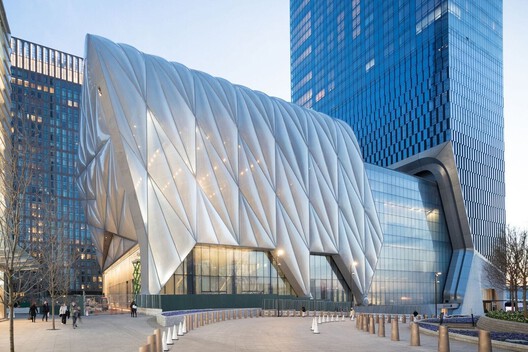
Materials such as ETFE clearly illustrate this paradox from another perspective. Used in extremely lightweight membrane systems capable of replacing traditional assemblies with a fraction of the mass, the material depends on complex petrochemical processes and highly specialized industrial chains. Its performance in use is significant, but its impact cannot be evaluated based solely on apparent lightness, revealing how lightweight systems are often tied to extensive production infrastructures.
The discussion is no longer purely quantitative, but involves transformation processes, energy input, durability, and material origin. This shift has been explored in research that frames architecture as part of a global technosphere, where materials, energy, and infrastructure are deeply interconnected. In this context, lightness does not eliminate impact, but often redistributes it across these networks.
Logistics also play an important role. Lightweight components are easier to transport, assemble, and standardize, contributing to construction efficiency and reduced building time. At the same time, this condition supports global production chains, in which materials travel long distances before reaching the construction site.
The dissociation between material and territory raises important questions about the ethical use of resources and the relationship between architecture and place. In an increasingly globalized context, the choice of lightweight systems may be associated not only with efficiency but also with intensified logistical flows, increased energy consumption, and dependence on complex infrastructures. Projects such as Shininess, by Andrés Jaque / Office for Political Innovation, presented at the 2023 Venice Architecture Biennale, reveal how seemingly immaterial materials, such as glass and reflective surfaces, are embedded in extensive production chains linking mining, industrial processes, and global distribution networks. In this case, lightness does not eliminate weight, but displaces it and makes it less visible.

Rethinking Lightness
In a context shaped by climate crisis, geopolitical tensions, and the need to address housing and infrastructure deficits, lightness must be reconsidered not as an end in itself, but as part of a broader set of trade-offs.
Several paths are already being explored. Hybrid systems combine structural lightness with thermal mass, balancing construction efficiency and environmental stability. The use of bio-based materials, such as timber and natural fibers, points toward less intensive production cycles and greater potential for renewability. Reducing layers and simplifying construction is gaining relevance, both in terms of resource efficiency and ease of maintenance and adaptation. At the same time, passive strategies are regaining a central role, reducing dependence on highly technological systems such as active climate control. Finally, designing for disassembly and reuse extends the lifespan of building systems, allowing structures to evolve without requiring complete replacement.
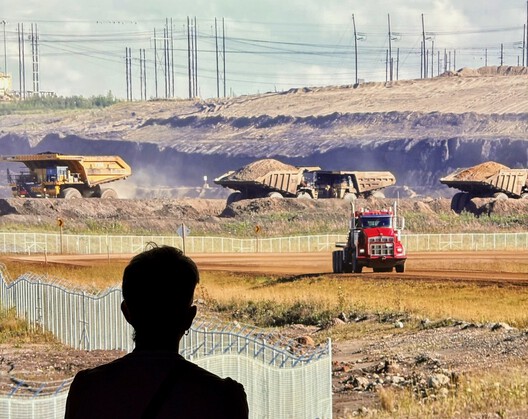
Lightness is no longer only a formal or structural quality, but a matter of responsibility: not just how much a building weighs, but what it requires to exist, operate, and be maintained over time. More than reducing mass, the challenge is to reduce the weight of its consequences. This does not imply limiting creativity or structural ambition of architects, but establishing clearer criteria for when and why these strategies are truly necessary.
This article is part of the ArchDaily Topic: Light, Lighter, Lightest: Redefining How Architecture Touches the Earth, proudly presented by Vitrocsa, the original minimalist windows since 1992.
Vitrocsa designed the original minimalist window systems, a unique range of solutions, dedicated to the frameless window boasting the narrowest sightline barriers in the world. Manufactured in line with the renowned Swiss Made tradition for 30 years, Vitrocsa's systems "are the product of unrivaled expertise and a constant quest for innovation, enabling us to meet the most ambitious architectural visions."
Every month we explore a topic in-depth through articles, interviews, news, and architecture projects. We invite you to learn more about our ArchDaily Topics. And, as always, at ArchDaily we welcome the contributions of our readers; if you want to submit an article or project, contact us.


