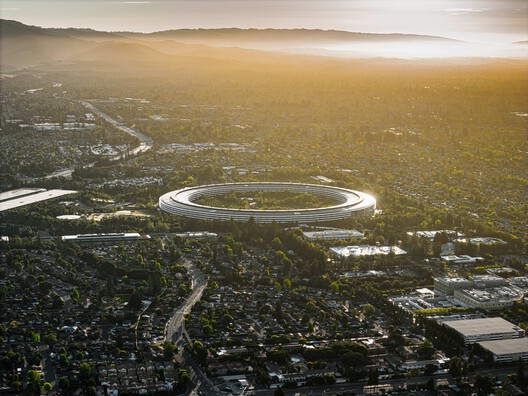
In 2026, Apple marked fifty years since its founding. Over the past two decades, Apple has developed a consistent architectural language that extends its brand into the built environment, transforming stores, workplaces, and public-facing spaces into active components of its identity. These environments guide movement, frame interaction, and condition the ways in which users encounter both products and the company itself.
From the handheld device to the urban interior, Apple has sought to maintain a high degree of control over form, material, and experience. Architecture becomes part of this system when the company begins to define how it is perceived and engaged with in physical space. Research on retail environments has shown how spatial layout, visibility, and circulation patterns can shape behavior and interaction, turning architecture into an interface between brand and user.
In Apple's case, this interface is carefully constructed through an economy of means, where reduced palettes and clear geometries conceal a high level of coordination. Material, proportion, light, and movement are calibrated to produce continuity between object and environment. The development of this architectural language can be read through a sequence of transformations: from the Apple Store as a redefinition of retail space, to its expansion into a hybrid urban environment, and finally to its consolidation at the scale of the corporate campus. Across these stages, architecture is the primary instrument through which the brand is articulated.
Related Article
A Decade of Redefining Experience Retail: 15 Apple Stores Designed by Foster + Partners in City Centers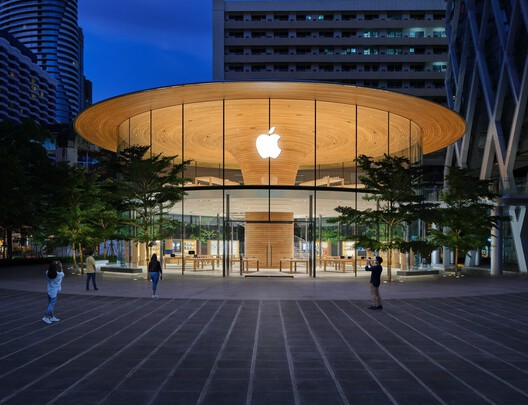
From Product to Space
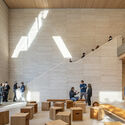
When Apple opened its first retail stores in 2001, in Tysons Corner and Glendale, it entered a field that was spatially stagnant. Consumer electronics retail at the time relied on density, cluttered signage, and rigid product segmentation, organizing space around transactional counters that acted as physical barriers. In collaboration with Eight Inc., Apple proposed a different model based on spatial clarity and direct engagement, where the architecture itself structures the relationship between user and object.
The layout was reduced to its essentials. Products were arranged on a limited number of oversized timber tables, allowing them to be freely handled in a physical manifestation of the "plug and play" philosophy. Circulation was left open, without prescribed routes, encouraging visitors to move according to interest rather than sequence. And visual noise was minimized, barriers between user and object were removed, creating an environment in which the product could be experienced without mediation. Just as the graphical user interfaces of macOS and iOS sought to reduce friction between user and device, the store removes the spatial "latency" of the retail experience.
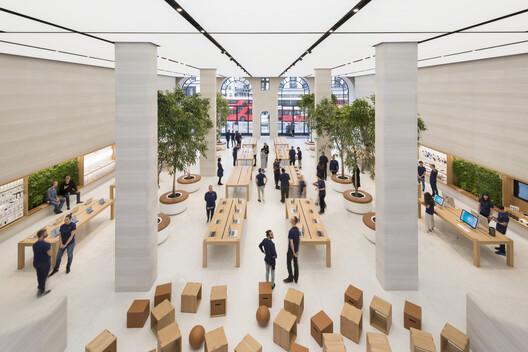
At the same time, the operational logic of the store was reconfigured. The introduction of mobile payment systems eventually dissolved the spatial hierarchy of the checkout point, turning the entire floor into a fluid zone of interaction. Complexity is absorbed into the system and concealed behind an appearance of simplicity. Technical systems are integrated to maintain spatial continuity, resulting in an environment that functions less as a container and more as a physical interface.
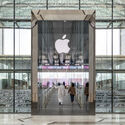
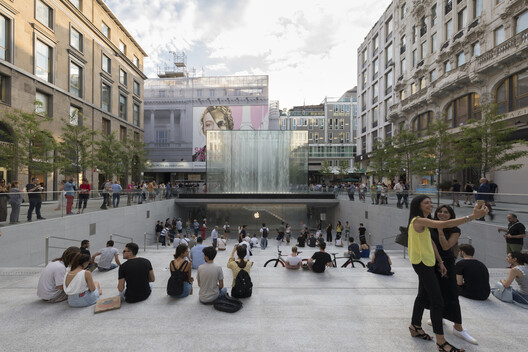
The Apple Store on Fifth Avenue in New York, designed by Bohlin Cywinski Jackson and opened in 2006, marked a turning point in the development of Apple's retail spaces, extending its spatial logic to the scale of the City. By reducing the store's street-level presence to a single architectural gesture—a 9.8-meters glass cube—the project departs from the model of the enclosed interior. It inverts the expected relationship between visibility and occupation; the threshold as the primary architectural element.
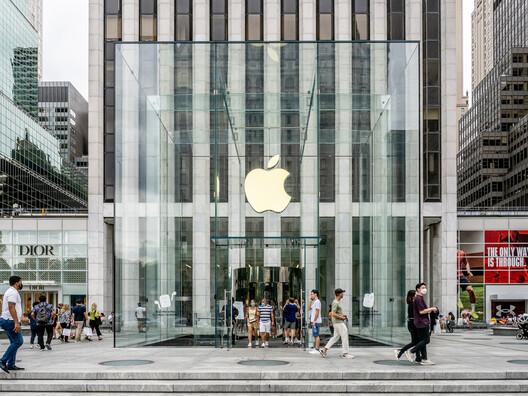
The cube, constructed from structural glass panels with minimal visible connections, achieves a high degree of material continuity, reinforcing the perception of dematerialization. Its apparent simplicity conceals a complex engineering system where glass acts not just as an enclosure, but as a load-bearing element. During the day, it reflects the surrounding city; at night, it becomes a luminous object, maintaining a constant visual presence within the urban fabric.
This object frames a vertical transition, where the act of entry becomes a choreographed spatial sequence. Descending through a cylindrical glass elevator or a suspended stair, the visitor is separated from the city while maintaining visual continuity through the transparent envelope. What is encountered at street level is the condition of access, an architectural gesture that displaces engagement and delays the moment of arrival, transforming a commercial transaction into a civic ritual.
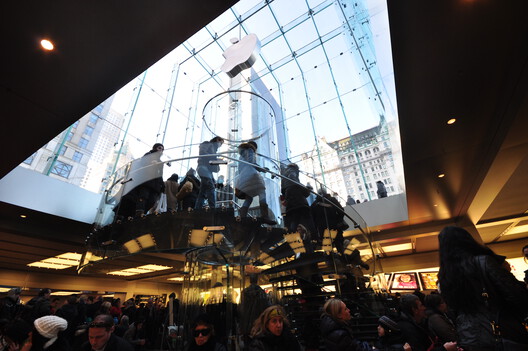
Transparency, in Apple's lexicon, is both a literal material condition and a metaphorical strategy. It allows activities to be observed and celebrated while maintaining a highly calibrated and controlled environment. Like circulation, it is treated as a user experience (UX) challenge, mirroring the intuitiveness of Apple's interfaces.
By the mid-2010s, Apple's architectural strategy shifted from refining a retail format to repositioning these spaces within a broader urban context. The introduction of the "Today at Apple" program in 2017 repositioned the store as a site for collective gathering, hosting workshops and cultural programming that extended its function beyond commerce.
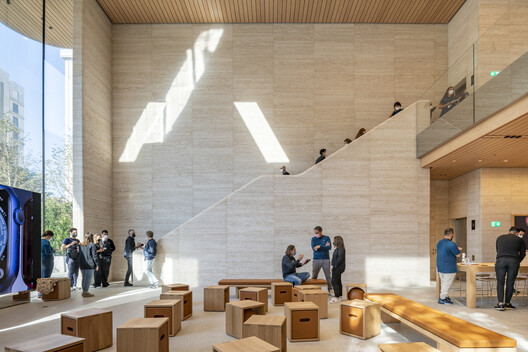
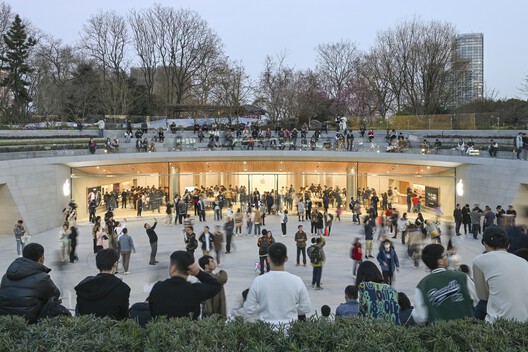
This transformation required a new architectural typology: the store as a quasi-public plaza. Projects like Apple Union Square in San Francisco (2016), designed by Foster + Partners, make this transition explicit as the building is conceived as a permeable structure; large sliding glass façades open the interior entirely to the street, while a public plaza and terraced seating integrate the store into the city's circulation.
In this configuration, the boundary between the private store and the public city becomes increasingly diffuse. While the space remains commercially driven and privately owned, it adopts the characteristics of civic architecture: accessibility, openness, and with the capacity to host collective use. However, this informality is supported by a precise organizational logic, a calibrated environment where the distinction between public and private is carefully managed. The store appears as a seamless extension of the city, yet it remains a fully controlled environment; a physical manifestation of a "walled garden" ecosystem, now scaled to the urban territory.
Scaling the System
The collaboration with Foster + Partners, initiated in the mid-2010s, marks a definitive moment of consolidation in Apple's architectural trajectory. More than the introduction of a new author, it reflects a convergence between two design cultures that share an identical obsession with precision, integration, and control. This shift is best understood by looking at the company's hardware through an architectural lens. For decades, Apple's design philosophy has centered on "internal architecture", the conviction that a device's internal logic should be as ordered as its exterior.
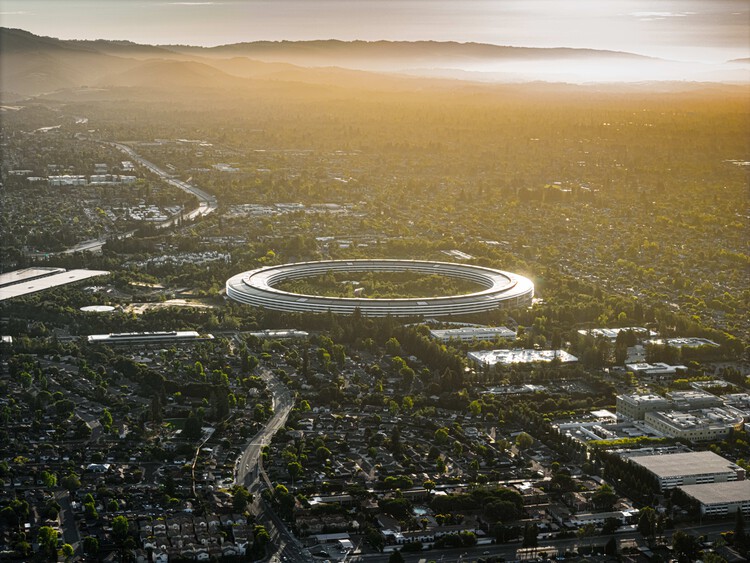
Consider the transition from the unibody MacBook — a complex assembly of multiple parts into a single, seamless aluminum block arranged with the same aesthetic rigor as the exterior casing where there is no distinction between form and function as the object is a singular, unified system —, to the massive ring of Apple Park. This is not merely a change in size, but a radical application of industrial design principles to the built environment.
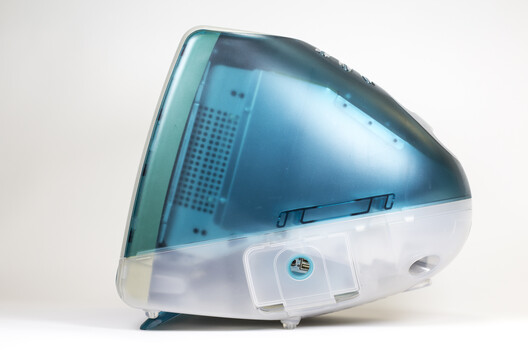
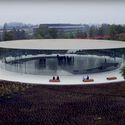
In the hands of Norman Foster, this unibody philosophy was scaled to the size of a landscape. In digital engineering, Apple's System on a Chip (SoC) integrates processors and memory into a single silicon wafer to maximize efficiency; in Cupertino, this same philosophy birthed the "void slab" system. Just as an engineer integrates circuits and sensors into a slim device, Foster and Arup integrated more than 4,000 architectural hardware modules. Each polished, precast element functions as a singular chassis that houses the structural frame, radiant cooling pipes, and air return plenums. By consolidating these disparate services into a single mass, the architecture moves away from the "layered" logic of traditional construction toward the integrated logic of industrial design.
This obsession with the seamless interface extends to the building's envelope, where the campus's glass fins echo the precision of a smartphone's glass-to-metal transitions. Much like the tactile continuity of an iPhone, where the seam between materials is imperceptible to the touch, the massive curved glass panels of the main building were engineered with millimetric tolerances. By removing the visual noise of window frames and bulky technical infrastructure (cables, vents, and fasteners) the architecture dissolves the boundary between the user and the landscape. In this deliberate pursuit of dematerialization, the occupant is left to experience only pure, Platonic geometry.
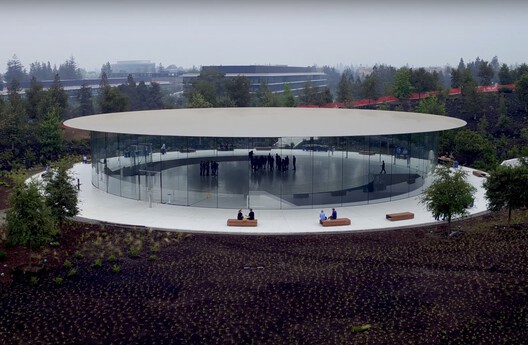
This scaling of the system introduces a certain ideological weight. The repetitive modularity and superhuman scale of the campus echo the monumentalism of mid-century industrial utopias (yet refined through the lens of 21st-century luxury). In this configuration, the boundary between the brand and the environment becomes seamless. Apple Park constructs a world where the operational, spatial, and cultural logics are perfectly aligned. The architecture operates as a calibrated system that, much like an operating system, structures every movement and interaction within its reach.
Beyond the Object
Across fifty years of evolution, Apple's architectural trajectory reveals a consistent pursuit of a unified field theory of design. Whether in a handheld device or a headquarters, the themes remain unwavering: the use of Euclidean geometries, the radical reduction of visible complexity, and an obsession with material honesty.
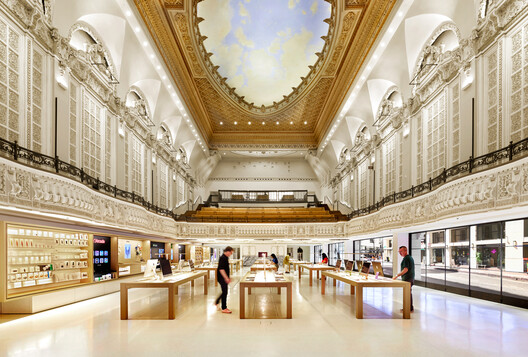
Looking back, it is clear that Apple's architectural projects are parts of a broader, evolving ecosystem. And in this world, the architect is helping construct a conceptual and aesthetic infrastructure that governs how the brand is inhabited. A building, an increasingly necessary bridge between the digital and the physical world.
As Apple enters its sixth decade, the future spaces will likely respond to emerging patterns of hybrid work and liquid consumption, yet the underlying logic remains: architecture is, and always will be, the primary instrument for structuring experience and communicating a corporate "worldview".
This article is part of the ArchDaily Topic: 20th Century Design in Flux: A Global Reinterpretation of Architectural History. Every month we explore a topic in-depth through articles, interviews, news, and architecture projects. We invite you to learn more about our ArchDaily Topics. And, as always, at ArchDaily we welcome the contributions of our readers; if you want to submit an article or project,contact us.


