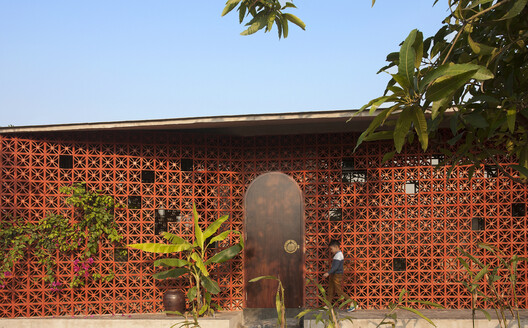
A perforated screen is often treated as an afterthought, something applied to soften light, to decorate a façade, or to add texture where a wall might otherwise feel flat. It is photographed as a surface, drawn as a pattern, and discussed as a craft. But in many buildings across the Indian subcontinent and the Islamic world, the screen was never an addition. It was the wall itself. Remove it, and the building does not simply change in appearance; it loses its ability to regulate heat, move air, and mediate between inside and outside.
This misreading reveals more about contemporary habits than about the screen itself. Architectural thinking has long separated structure from envelope, performance from expression. Within that framework, elements like the jaali or mashrabiya are easy to categorize as ornamental, visually rich but technically secondary. Yet these screens were conceived as integrated systems, where geometry, material, and climate operate together. Their intelligence lies in what they do.
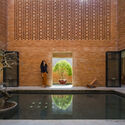
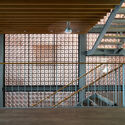
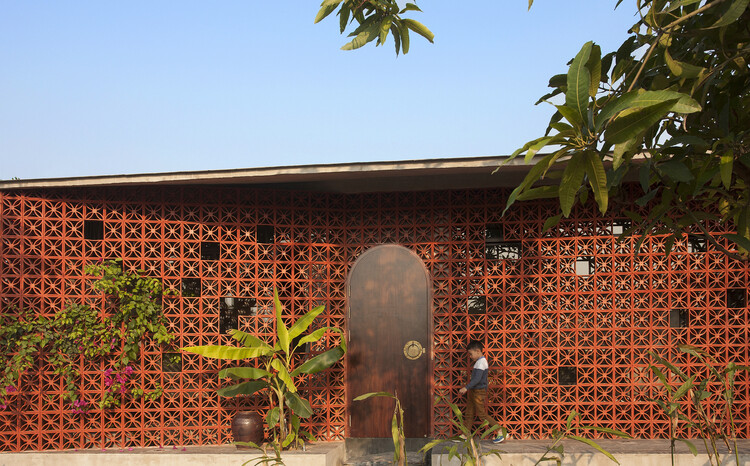
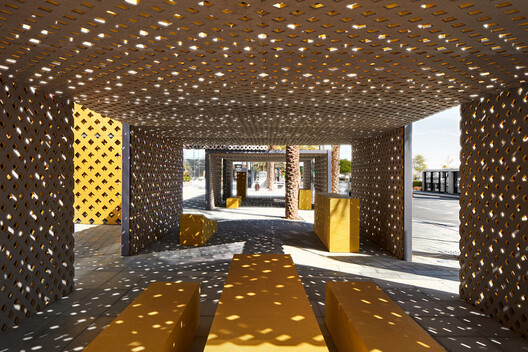
At the level of climate, that work is immediate and measurable. A perforated surface is not simply porous; it is calibrated. The proportion of solid to void, often falling between 30 and 50 percent, is tuned to allow air to pass while filtering sunlight. As wind moves across the façade, pressure differences accelerate airflow through the openings, increasing indoor air velocity compared to a standard window. Studies have shown that such configurations can improve ventilation rates by up to 60 percent, producing a perceptible cooling effect even in still air. At the same time, the depth and angle of each aperture reduce direct solar radiation, cutting heat gain by as much as 60 to 80 percent, as documented in research from Indian research organizations.
Related Article
Reimagining The Mashrabiya: Functionality and Symbolism in Contemporary Architecture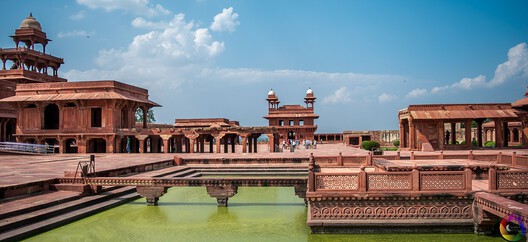
What appears as a pattern is therefore a precise environmental device. In historic complexes like Fatehpur Sikri, layers of stone screens temper the harsh North Indian sun, allowing interiors to remain luminous without overheating. Light is diffused, air is accelerated, and glare is softened—not through added systems, but through the thickness and geometry of the wall itself. The façade does not separate interior from exterior; it negotiates between them.
This negotiation extends to structure. Despite their delicacy, many of these screens function as load-bearing elements in their own right, rather than as panels inserted into a frame. Their strength lies in distribution rather than mass. The lattice geometry channels forces through a network of compressive paths, concentrating stress at nodal intersections while maintaining overall stability. Engineering studies on perforated masonry indicate that while introducing openings can reduce compressive strength, the loss is mitigated by redundancy in the pattern, allowing loads to redistribute rather than concentrate. Failure, when it occurs, tends to be gradual, localized cracking rather than sudden collapse.
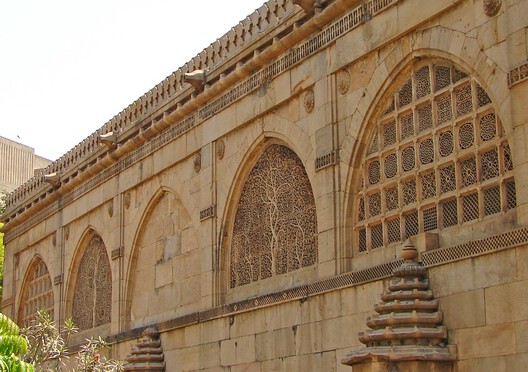
The enduring stone screens of the Sidi Saiyyed Mosque make this logic visible. Often celebrated for their intricate carving, they are equally defined by proportion: the relationship between thickness, span, and void carefully balanced to maintain structural integrity. What reads as ornament is in fact a structural strategy, one that achieves both lightness and stability without resorting to additional support.
Beyond climate and structure, the screen also shapes how space is occupied. Its perforations create gradients of visibility rather than fixed boundaries, allowing occupants to see without being fully seen. This effect is not only symbolic but optical, produced by contrasts in light and shadow and by the angle of openings. In many traditional contexts, the mashrabiya enabled forms of privacy that did not rely on complete enclosure, supporting social practices while maintaining connection to the outside. The wall, in this sense, becomes a filter, not only of air and light, but of interaction.
Taken together, these roles suggest a different way of understanding architecture itself. The screen operates as a system where multiple functions converge, rather than as a component performing a single task. Structure, climate, and social use are not layered but integrated, resolved within the same material and geometry. This integration is precisely what becomes difficult to sustain in contemporary practice.
In recent decades, perforated façades have reappeared through parametric design, often celebrated for their visual complexity. Yet in many cases, what is reproduced is the image of porosity rather than its performance. Patterns are generated without reference to orientation, airflow, or solar exposure, resulting in surfaces that resemble traditional screens but do little of the work they once performed. Computational studies show that without alignment to prevailing winds, perforations offer minimal improvement in ventilation, while uniform geometries fail to provide effective shading across different sun angles.
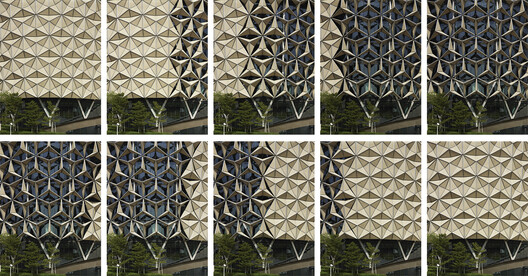
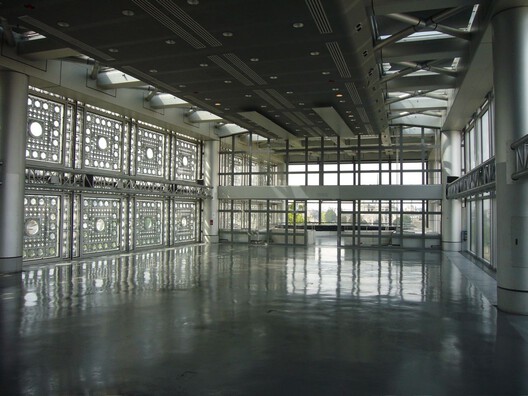
There are, however, projects that attempt to translate the logic of the screen into contemporary systems. The Institut du Monde Arabe reinterprets the mashrabiya through a façade of mechanical apertures that open and close in response to light, modulating daylight with precision. Similarly, the Al Bahr Towers deploy a kinetic shading system that reduces solar gain by roughly half, adjusting continuously to the movement of the sun. These projects demonstrate that the principles of filtering and modulation remain relevant. Yet they also mark a shift: performance is no longer embedded in material alone, but supported by sensors, actuators, and energy input.
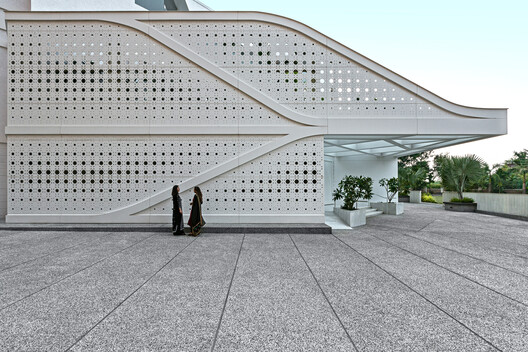
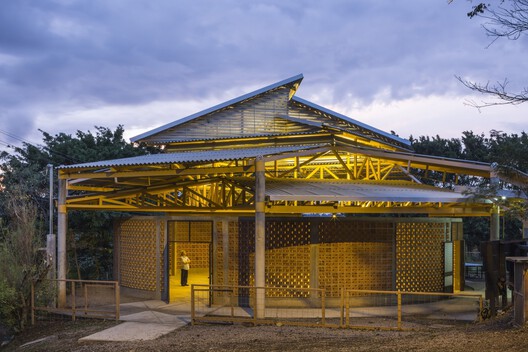
A quieter, more direct continuity can be found in buildings that return to passive strategies. The Gargash Mosque uses a perforated outer shell to filter daylight and reduce heat gain, creating an interior that is both shaded and luminous without relying on complex systems. In the Ismaili Jamatkhana & Community Center, a patterned envelope mediates light and ventilation while establishing a strong spatial identity. Even in different climatic and cultural contexts, similar logics emerge: the use of porous blocks in projects allows façades to remain open yet shaded, enabling airflow while maintaining privacy.
What connects these examples is a shared approach rather than a shared aesthetic. The screen is treated not as an applied layer, but as a performative element derived from climate, material, and use. Its geometry is informed by environmental conditions, its thickness by structural requirements, and its pattern by the need to balance openness with protection. Rather than adding systems to compensate for environmental challenges, these buildings incorporate those challenges into their design logic.
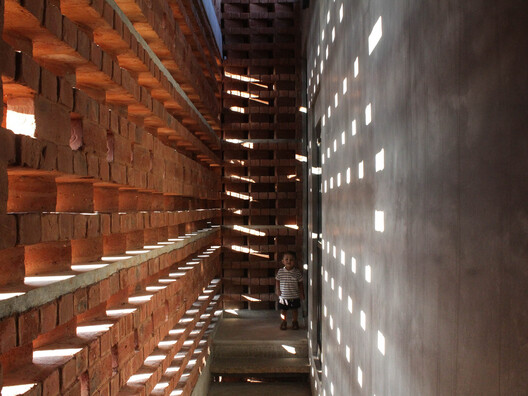
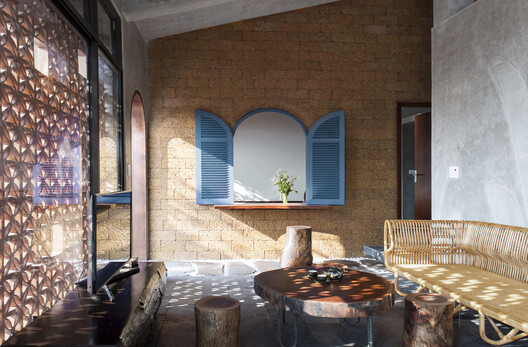
The relevance of jaali and mashrabiya — or even the Brazilian Cobogó — today lies precisely in this integration. At a time when buildings are often composed of multiple layers — structure, insulation, glazing, shading —, each performing a separate function, the perforated screen offers a different model. It suggests that architecture can achieve more with less, not by simplifying, but by aligning multiple forms of performance within a single element.
To engage with this tradition is not to replicate its forms, but to understand its principles. The question is not whether the screen can be reintroduced as a motif, but whether its intelligence can inform how we build now. In that sense, the jaali is less a historical artifact than a proposition: a way of thinking about architecture where walls do more than enclose, where surfaces are not passive, and where performance is inseparable from form. Seen this way, the perforated screen is not delicate at all. It is rigorous, efficient, and deeply responsive, a wall that breathes, carries, and connects, all at once.
This article is part of the ArchDaily Topic: Light, Lighter, Lightest: Redefining How Architecture Touches the Earth, proudly presented by Vitrocsa, the original minimalist windows since 1992.
Vitrocsa designed the original minimalist window systems, a unique range of solutions, dedicated to the frameless window boasting the narrowest sightline barriers in the world. Manufactured in line with the renowned Swiss Made tradition for 30 years, Vitrocsa's systems "are the product of unrivaled expertise and a constant quest for innovation, enabling us to meet the most ambitious architectural visions."
Every month we explore a topic in-depth through articles, interviews, news, and architecture projects. We invite you to learn more about our ArchDaily Topics. And, as always, at ArchDaily we welcome the contributions of our readers; if you want to submit an article or project, contact us.