Design teams are not short on tools; they're short on continuity. Project data remains fragmented across files, and decisions often lose context as work moves from planning to design to construction. As a result, teams spend valuable time reconnecting information instead of advancing projects.
This points to the need for workflows that preserve design intent and carry knowledge forward across each stage of the process. Within this framework, the idea of "design and make intelligence" can be understood as a shift toward continuity, where data, decisions, and lessons from planning, design, construction, and operations remain embedded in the project rather than stopping at handover. In this context, AI and automation operate with greater relevance, building on accumulated information instead of isolated inputs.
Recent developments across Autodesk's ecosystem point toward a shift in how information is structured and carried through the project lifecycle. The focus moves toward workflows that preserve design intent, allowing data, decisions, and lessons from each phase to remain accessible and actionable over time. Within this framework, the notion of "design and make intelligence" emerges as a way to understand project knowledge not as static output, but as a continuous resource.
These updates build on the ongoing consolidation of cloud-based workflows, reinforcing connections between planning, design, and construction. The broader aim goes beyond the integration, but focuses on continuity where information flows more consistently and decisions can be developed, rather than recreated, at each stage.
Introducing Forma Building Design
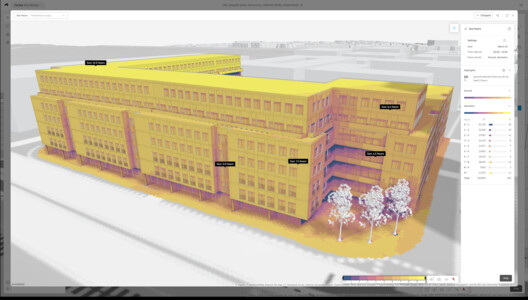
Autodesk introduces Forma Building Design, a new design and analysis environment focused on the schematic design phase. Positioned within early-stage workflows, the tool expands the possibilities for exploring design alternatives while integrating performance-based feedback into initial decision-making. Further developments are expected to extend these capabilities over time.
Early design stages have always concentrated the most critical decisions, yet they are often supported by tools developed for later phases, limiting the ability to explore alternatives quickly and with confidence. By embedding design generation and performance analysis directly into this stage, Forma Building Design begins to reposition schematic design as a more iterative and informed process.
Teams can establish geolocated sites, generate building options, and evaluate performance through metrics such as daylight, solar exposure, and carbon impact. Rather than treating analysis as a later verification step, these tools integrate feedback into early exploration, allowing design decisions to be tested as they emerge.
Once a direction is defined, projects transition into Revit as native, geolocated models, carrying forward site data and building elements. This continuity reduces the need for rework and helps preserve the logic behind earlier decisions, bridging a gap that has traditionally separated conceptual exploration from detailed development.
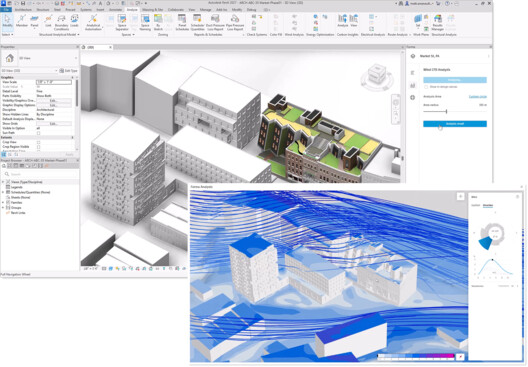
This complementary workflow of exploration in Forma and developing the project in Revit suggests a gradual restructuring of how design phases relate to one another, with less emphasis on handoff and more on progression.
For deeper environmental evaluation, Forma Carbon Insights extends this logic by connecting early-stage carbon analysis with later design stages. By maintaining these datasets across platforms, the tool supports a more consistent approach to sustainability, enabling decisions made early in the process to remain visible and relevant as the project evolves.
Expanding connections between Forma and Revit
The introduction of Revit as the first Forma Connected Client further reinforces this direction, with data moving directly between environments, maintaining alignment as projects develop. This integration allows contextual information, including data from the Forma Data Marketplace, to be incorporated with minimal friction. Environmental analyses can also be accessed within Revit, bringing performance considerations into the ongoing design process rather than isolating them in earlier stages.
More broadly, this development reflects an ongoing transition from file-based workflows toward shared data environments, where coordination happens through continuously updated models rather than discrete exchanges.
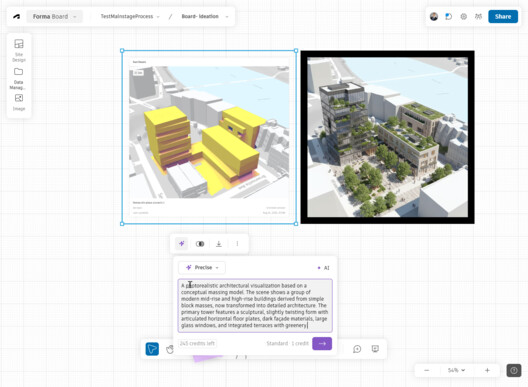
Expanded access to Forma Site Design, Forma Building Design, and Forma Data Management tools across Autodesk's portfolio supports this shift, extending cloud-based collaboration to a wider range of users. In parallel, tools such as Forma Board consolidate feedback and visual communication, helping teams maintain alignment across different phases without losing context.
AI-powered assistance in the flow of work
Artificial intelligence is increasingly being embedded within design tools as part of everyday workflows, not as a separate layers. Autodesk Assistant in Revit reflects this approach by providing contextual guidance based on the model, the task at hand, and broader project data.
The assistant supports actions and workflows, helping identify issues, maintain consistency, and streamline repetitive tasks. Similar capabilities are being introduced across AutoCAD, Civil 3D, and other tools, suggesting a broader move toward integrated, context-aware assistance.
Further strengthening the core
Alongside these developments, additional updates across Autodesk's portfolio address coordination and performance in more specialized areas. In AutoCAD, the introduction of Checkout enables more granular collaboration within shared DWG files, allowing multiple users to work in parallel without locking entire drawings. In Civil 3D, new capabilities focus on performance optimization and automated analysis, including machine learning-assisted alignment detection for infrastructure projects.
Expanded integration with Esri across Autodesk's water solutions aligns planning and operational data within a consistent GIS framework, improving reliability and reducing the need for reconciliation. In InfoWorks ICM, the introduction of Network Design consolidates planning and analysis into a single workflow for stormwater and sewer systems.
Looking ahead
At the center of these updates is a shift in how work moves across the project lifecycle and how context, decisions, and project intelligence are carried forward. By connecting workflows across Forma and Revit and bringing project data into a shared, cloud-connected environment, teams can move beyond file-based handoffs and work with greater continuity from planning through detailed design. Across even the most complex building and infrastructure projects, this cloud-connected approach helps teams start earlier, stay aligned as decisions evolve, and design with greater clarity and confidence.
The idea of design and make intelligence treats knowledge as a persistent resource that travels with the project instead of ending at handover. Delivering it is a platform-level capability: it requires product depth across design, construction, and operations and a training asset grounded in decades of real projects. When intelligence is continuous, AI works in context, offering guidance informed by real-world outcomes, automations that augment teams, and analytics that make building performance visible and actionable. It reframes the "I" in BIM from a static snapshot to a living, compounding resource.
For those interested in applying for the closed beta of this feature, sign up here.
