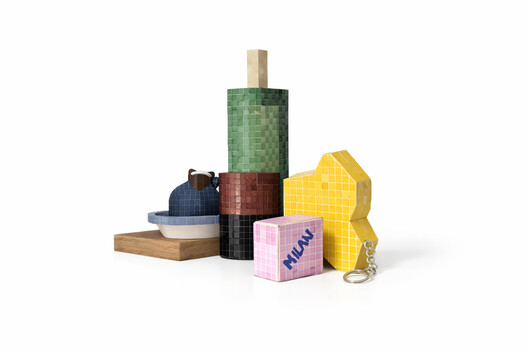
How does an architectural installation express the identity of a region? How can a building material connect with the essence of a nation? Throughout its history, Spain has been shaped by a wide range of cultures and civilizations, including Muslim, Phoenician, Roman, Greek, Carthaginian, and Visigothic influences. From flamenco to ceramic tiles adorning façades and historic monuments, each region of Spain embraces its own customs and traditions, reflected in its architecture, history, art, and design. During Milan Design Week 2026, Tile of Spain presents Spanish Design as a Souvenir at the Fuorisalone—an installation that transforms ceramic tile into a narrative medium through a series of sculptural objects reinterpreting everyday icons of Spanish life.
Across artistic expressions, festivals, gastronomy, music, and dance, Spain's cultural landscape reveals a rich artistic heritage, highlighted by figures such as Pablo Picasso and Salvador Dalí in art, and Miguel de Cervantes and Federico García Lorca in literature. Similarly, Spanish architecture reflects a diversity of influences and expressions as broad as its climates, geographies, and cultural heritage. Each region has developed its own architectural language based on available materials, environmental conditions, and historical influences. This crossroads of traditions reveals a fusion that, over millennia, has shaped an architectural tapestry characterized by ornamental elements, ceramic tiles, and complex geometries.
Spain's multilayered identity expresses cultural values and historical memory through architecture. From the Moorish palaces of Andalusia to the granite fortresses of Galicia, the use of materials in Spanish architecture reflects a conscious adaptation to regional contexts. While the Basque Country embodies an industrial heritage and maritime traditions, Valencian architecture balances Mediterranean influences with innovation in ceramic use and light-sensitive design. Just as the titanium of the Guggenheim Museum Bilbao became both symbol and catalyst for the region's reimagined identity, Valencia's ceramic production tradition takes center stage in its architecture, appearing in domes, church towers, and tiled façades of both public and private buildings.
The role of ceramics in construction faces global challenges that go beyond addressing climate change, economic shifts, or new cultural exchanges. It involves adapting architectural discourse to contemporary needs while preserving regional identity. Within the framework of Tile of Spain's international promotion program—led by ICEX and ASCER (Spanish Ceramic Tile Manufacturers' Association)—Spanish Design as a Souvenir highlights the material, cultural, and design potential of Spanish ceramics.
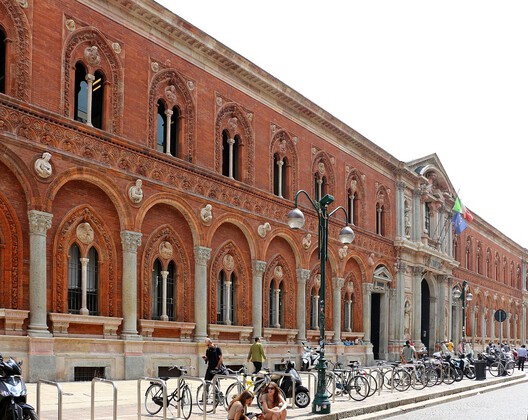
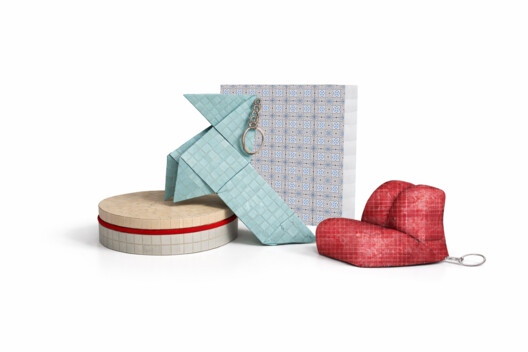
Designed by Madrid-based practice Codoo Studio, the installation consists of eleven sculptural objects that reinterpret iconic elements of Spanish material culture, each fully clad in ceramic tiles. Presented at MATERIAE, the main exhibition of Milan Design Week organized by Interni Magazine, it takes place in the historic courtyard of the Università degli Studi di Milano—Ca' Granda. The eleven objects include:
- El Salvamanteles, a trivet referencing the flamenco tablao and the Andalusian cajón (Cristacer)
- Las Castañuelas, an oversized pair of dark ceramic castanets (Vives)
- El Plato, inspired by the white-and-indigo porcelain dish common in Spanish homes (Arcana)
- El Aceite, a monumental olive oil bottle in green and gold tones (Dune Cerámica, Peronda)
- El Cenicero, a reinterpretation of the Copenhagen ashtray designed by Jørgen Haugen Sørensen and produced in Spain in the 1960s (Decocer, ECerámico)
- La Camiseta, the classic tourist T-shirt rendered in mustard-colored tile (Colorker)
- La Milán 430, the iconic Spanish eraser, one of the most recognizable objects of domestic design (Cevica)
- La Bota, the traditional Spanish wine container (Argenta, Tau Cerámica)
- La Pajarita, the bow tie associated with Miguel de Unamuno (Cevica)
- El Imán, a large-format refrigerator magnet inspired by hydraulic tile compositions (Apavisa, Gayafores, El Barco)
- El Beso, based on Salvador Dalí's Dalilips sofa from the 1970s (Vidrepur)
While structured as a contemporary still life at an architectural scale, each object functions as an autonomous, transportable volume—independent yet integrated within the whole. The central premise redefines ceramic tile as a material that shapes the object itself. With the exception of El Beso, all pieces are constructed using a system of wooden frames, moisture-resistant MDF panels, and ceramic tiles applied with flexible cement adhesive, allowing for dry assembly, disassembly, and reuse. El Beso, by contrast, uses an XPS (extruded polystyrene) core, shaped manually or via CNC and finished with glass mosaic to accommodate its organic, curvilinear geometry.
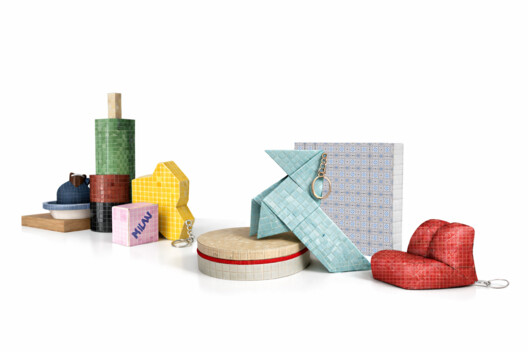
In terms of its formal characteristics, the installation occupies a total area of 1000 × 150 cm. The weight of the pieces ranges from 44 kg (La Milán 430) to 247 kg (El Aceite), while their heights vary between 20 cm and 250 cm. All elements are designed to stand independently on the exhibition floor without additional structural support.
Spain's architectural diversity reflects its complex history and geography, with each corner bearing traces of different historical periods. By placing Spanish ceramics at the center of Milan Design Week 2026, Tile of Spain positions the material not merely as a construction element, but as a cultural and design force. Spanish Design as a Souvenir transforms ceramic tile into a narrative medium, connecting industrial practice with memory, identity, and contemporary design. The contribution of collections from fourteen Spanish ceramic manufacturers underscores the collaboration and exchange that define Spanish culture—serving as both inspiration and a source of shared knowledge.


