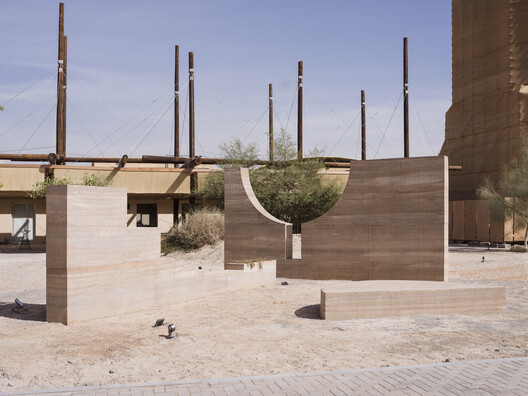
Twenty meters tall and four thousand years old, the Western Deffufa towers over the adjacent date orchards and ancient city remains in the desert. It is a former religious and administrative building near the modern-day Sudanese town of Kerma. Its significance is not only in its age and size, but also in that it is one of the oldest mud brick buildings in the world. And as the nearby mud brick houses also attest, earth is a material of continuous use from ancient times to the present. Yet, conversations around contemporary building systems have largely ignored this essential material. Some architects on the continent of Africa, however, are changing that.
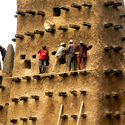
Across Africa, earth construction exists in multiple forms. In Burkina Faso, the painted houses of Tiébélé express the soft, hand-applied nature of the material and provide surfaces for elaborate pattern-making. Ghadames is a town in Libya with a sophisticated construction of earth, lime, and palm trunks. It is characterized by its interconnected structures with narrow streets, courtyards, and a walkable roofscape. Perhaps most famously, the great mosque of Djenné in Mali is the largest adobe building in the world. Its thick earth walls are studded with timber projections, permanent scaffolding for the annual community-led replastering. Their mass keeps the interior cool while a system of roof vents helps to release any heat build-up.


