In November 2025, ArchDaily launched its first edition of the Student Project Awards. The decision to introduce this new award came from a place of hope; hope in the next generations of architects, their talent and vision, and the importance of giving them visibility and recognition. After all, the future of architecture is being shaped right now, in classrooms, studios, and workshops around the world, and it is vital to support those shaping it. The response was remarkable, with projects from students in every continent, showcasing a wealth and breadth of viewpoints, solutions and visions.
Five months after the launch of the open call, and following the announcements of a longlist of 104 projects and a shortlist of 20, our external jury of architects and practitioners carefully reviewed the proposals to select the three winners and four honorable mentions of the ArchDaily Student Project Awards. Approaching each project with care, the jury looked beyond final outputs, focusing on the ideas, questions, and positions driving the work. The result is a selection of winning projects that reflect both the spirit of the awards and the shifting priorities shaping architecture today.
The selected winners engage with the theme Architecture of Coexistence across multiple approaches. From the preservation and transformation of a historic schoolhouse at the U.S.–Mexico border to the reimagining of extractive landscapes as regenerative systems and the integration of care within dense urban environments, the projects explore how architecture can mediate between people, ecologies, and infrastructures. Developed by students from universities in Argentina (Universidad Nacional de Córdoba), Spain (Universidad Politécnica de Madrid) and the United States (Harvard University), the winners demonstrate how speculative ideas can meet real-world conditions, while the honorable mentions expand the conversation, proposing new ways to inhabit, adapt, and connect across diverse scales and contexts.
Related Article
ArchDaily Student Project AwardsCongratulations to the winners for their inspiring projects, and thank you to all the students who participated, the esteemed jury panel who voted on the shortlisted projects, and the ArchDaily team that reviewed every single submission in detail. Regardless of the final outcome, all of the submissions contributed to the architectural discourse, while focusing on coexistence in this edition of the ArchDaily Student Project Awards.
Designing Coexistence
"This first edition of the Student Project Awards reveals a range of progressive interpretations of Architecture of Coexistence. Across different contexts, the winning projects expand the definition of the theme beyond a purely social understanding, positioning it as a multi-layered condition.
Humans, environments, and spaces intertwine, demonstrating how architecture can engage with existing conditions and operate as a framework for more integrated ways of living. Shifting toward evolving systems that accommodate change, these proposals establish structures for ongoing negotiation while supporting inclusive and diverse forms of everyday life.
Together, the projects position architecture as a mediating practice of care, one that reconnects fragmented relationships and frames coexistence as a spatial reality shaped through design." – Christele Harrouk, Editor-in-Chief, ArchDaily
Winners
Escuelita Lochiel / Leslie Ponce-Diaz
Harvard University, United States
Located in the San Rafael Valley near the U.S.–Mexico border, Escuelita Lochiel revisits one of the few remaining one-room adobe schoolhouses in the United States. Building on a long-standing community-led restoration effort, the project reimagines the historic site as a contemporary space for early education, where architecture, landscape, and ecology converge. Through an adaptive adobe system that responds to both climate and programmatic needs, the proposal frames learning as an experiential and place-based process, fostering cultural continuity while supporting new forms of environmental awareness.
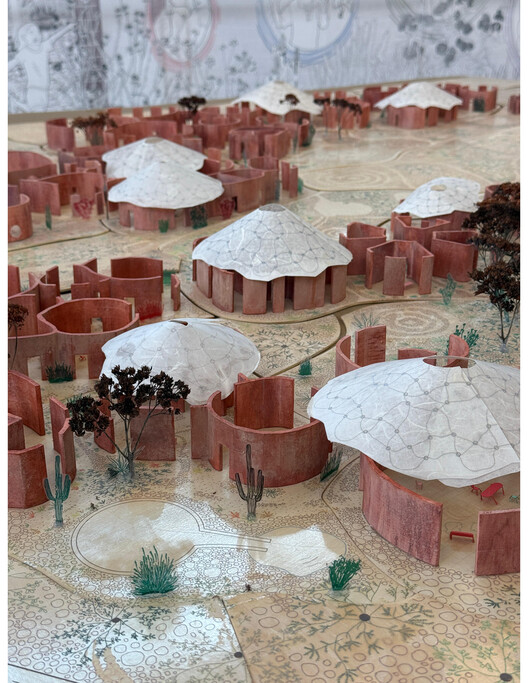
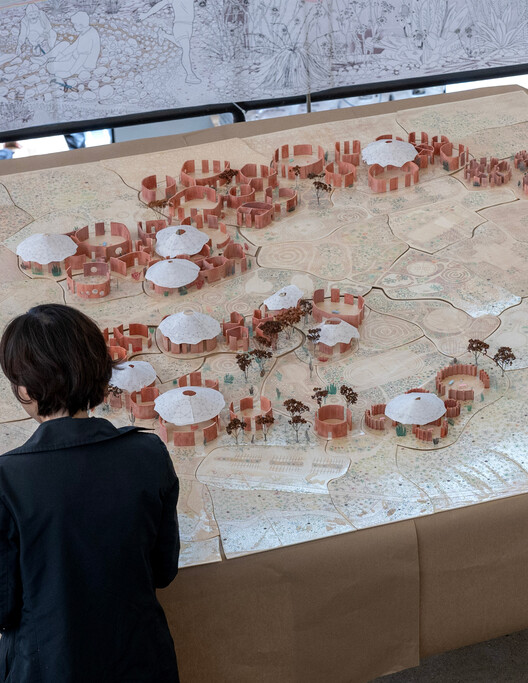
"A stand-out, masterful weave of interior space, free-flowing nature, and unrestricted rooms. Porosity and play go hand in hand with vibrant color and a sense of unending discovery. This sees the future generations at their curious eye- level, and the surrounding ecology on its terms. Open, gorgeous." — Balázs Bognár, Partner & Executive Vice President, Kengo Kuma & Associates
Regenerative Salt Landscapes / Ezequiel Lopez, Maria Victoria Echegaray, Agustina Durandez
Universidad Nacional de Córdoba, Argentina
Set within the Olaroz Salt Flat in Jujuy, this project addresses the tensions between lithium extraction and environmental fragility. Rather than opposing existing industrial processes, the proposal redefines them as agents of transformation, introducing a sequence of regenerative landscapes that combine remediation, agriculture, and energy production. Organized through a series of architectural devices, the project establishes a distributed infrastructure where ecological systems and human activity intersect, proposing a shift from mono-extractive territories toward diversified and collectively managed environments.
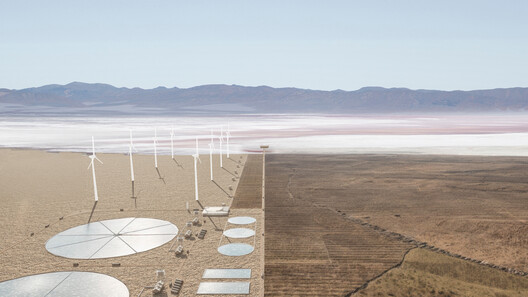
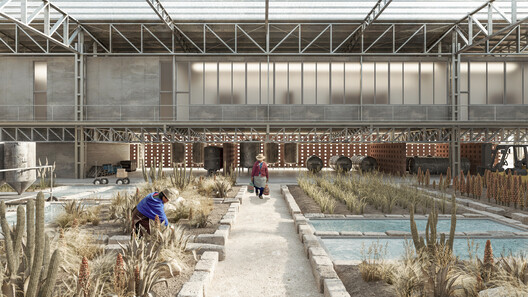
"A powerful and mature proposal that redefines extractive territories as spaces of regeneration and coexistence. The project stands out for its multiscalar approach, integrating environmental processes, productive systems, and community life into a coherent architectural framework." — Ivan Blasi, Director EUmies Awards, Fundació Mies van der Rohe
ParkTEA: Architecture of Coexistence / Ignacio Martinez Pardo
Universidad Politécnica de Madrid, Spain
ParkTEA explores how architecture can support neurodiversity within the contemporary city. Located on the former Cuatro Caminos depots in Madrid, the project challenges the peripheralization of autism-related care by embedding it within a dense and active urban context. Conceived as an open infrastructure, it combines specialized programs with public uses, organized into distinct yet interconnected volumes. Through spatial clarity, sensory calibration, and programmatic hybridity, the proposal creates an environment that enables both autonomy and interaction, reframing inclusion as an integral component of urban life.
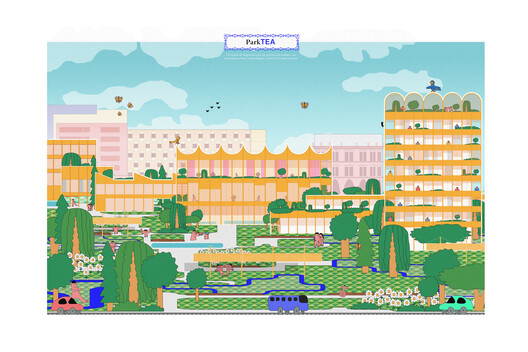
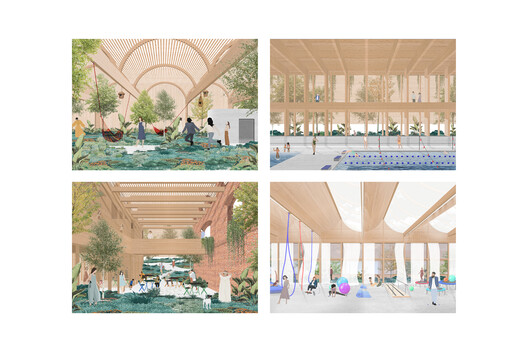
"The insistence of architecture of care to be inclusive and part of a city rather than a-part of it really stands out here. What shines through is a modern take on how we look after some of our most vulnerable, but also how architecture can be an active agent in such an effort." — Jeanne Autran-Edorh & Fabiola Büchele, Founders, Studio NEiDA
Honorable Mentions
Urban Continuity: A Systemic Park in Milan / Elena Eliseeva, Mariia Kovalenko, Laura Cappelli, Claudia Cipollone, Marta Colombi
Polytechnic Institute of Milan, Italy
Urban Continuity rethinks Milan's southern edge as a car-free, evolving landscape where historical traces and contemporary urban life intersect. Through a time-based design approach, the project reactivates forgotten infrastructures and reintroduces water as both a spatial and atmospheric element. Rather than proposing a fixed form, it establishes a flexible framework that accommodates changing rhythms, encouraging intergenerational use and new forms of collective experience.
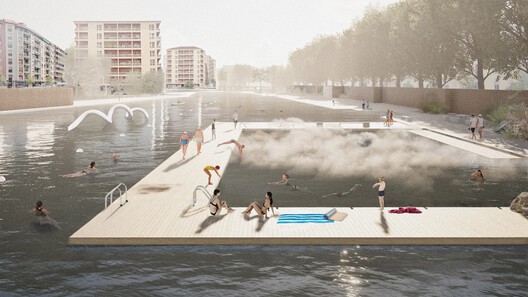
"The proposal carefully and creatively uncovers Milan's layered historical urban structures through water infrastructure, creating sensorial and calm inclusive spaces centered on citizens' wellbeing. It is an act of resistance against the commodification of the contemporary city." — Anand Sonecha, Principal Architect, SEALAB
Parazoa Building: Hydroecological Reprogramming / Tiago Barros Aguiar
Universidade de São Paulo, Brazil
This project transforms an existing parking structure in downtown São Paulo into a hydroecological system that integrates water management with public programming. Through strategies such as aquaponics, biodigestion, and constructed wetlands, the building becomes a closed-loop infrastructure that supports both environmental performance and social activity. By repositioning water as a visible and active element, the proposal redefines its role within the urban landscape, linking ecological processes with everyday use.
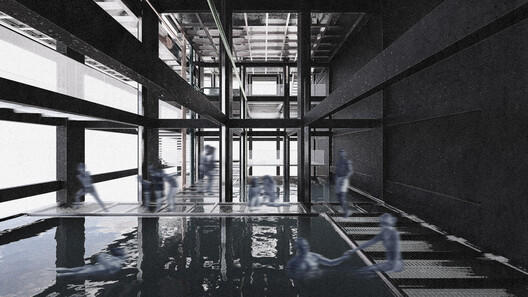
"It possesses the intelligence with which public projects are approached in Brazil, providing citizens with quality of life. It is resourceful, and the way it creates ecosystems within the building and restores water systems is highly valued." – Marie Combette & Daniel Morena Flores, Founders, La Cabina de la Curiosidad
Geographism: Over the Landscape Impermanence / Daniel Eslava Tovar
Universidad de Los Andes, Colombia
Situated in Manaure, where desert, sea, and salt extraction converge, this project approaches architecture as a process of geological and cultural reconstruction. By reworking industrial paths into spatial and social frameworks, the proposal integrates productive activities with collective practices such as fishing, learning, and water management. The intervention operates across temporal layers, seeking to reconnect fragmented landscapes while enabling new forms of coexistence between infrastructure and lived experience.
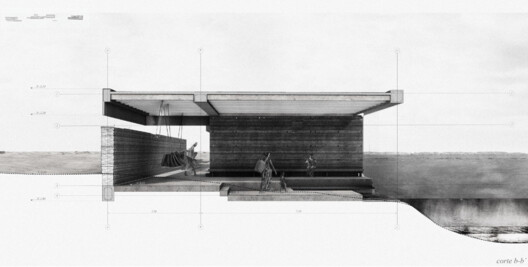
"A conceptually dense and spatially ambitious project that addresses extractive landscapes through reintegration and care. Highly valuable is its ability to reconnect industrial traces with cultural and ecological rhythms." – Ivan Blasi, Director EUmies Awards, Fundació Mies van der Rohe
When Objects Become Architects / Zhang Zichun
The University of Hong Kong, Hong Kong
Focusing on an informal residential building in central Bangkok, this project investigates how everyday objects shape spatial organization and social interaction. Through an object-based methodology, it maps patterns of appropriation, adaptation, and negotiation within a dense living environment. The design proposal builds on these observations, introducing new connections and shared spaces that support collective life while maintaining flexibility, framing architecture as an open-ended process shaped by its users.
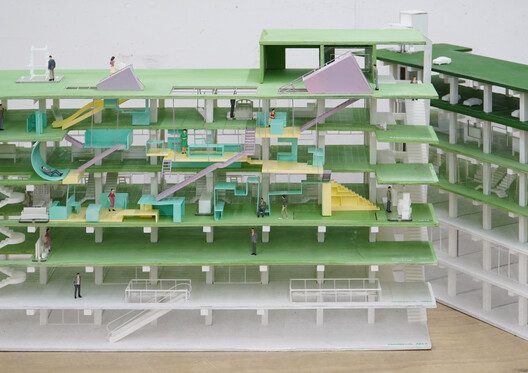
"Lively and playful, with a great sense of DIY in the adaptive structures and wild use of color. This design exudes joy, and a celebratory sense of the everyday." – Balázs Bognár, Partner & Executive Vice President, Kengo Kuma & Associates
The Student Project Awards was made possible by a team of talented individuals. Thank you to:
- Concept Design of ArchDaily Student Project Awards: Christele Harrouk, Daniela Porto, Hana Abdel, Melodia Berzia, and Romullo Baratto.
- ArchDaily Jury: Agustina Iñiguez, Christele Harrouk, Hana Abdel, Jonathan Yeung, Romullo Baratto, Susanna Moreira, and Victor Delaqua.
- External Jury: Abdulrahman Gazzaz & Turki Gazzaz, Anand Sonecha, Balázs Bognar, Ivan Blasi, Jeanne Autran-Edorh & Fabiola Büchele, and Marie Combette & Daniel Moreno Flores.
- Graphic & Motion Design: Anne Pohlmann, Cecilia Suárez, Evghenia Goras, Jorge Miñano, and Javiera Contreras.
- Marketing Campaign: Carla Walpen, Dima Stouhi, Enrique Tovar, Gloria Cardona, Melodie Berzia, Moa Tengqvist, Sofio Rukhadze, Teresa Spini, and Victor Delaqua.
- Product and Development: Amina Patak, Carolina El Mankabadi, Clara Ott, Daniel Giraldo, Diego Acuña, Gonzalo Leiva, Luis Mancilla, Nicolás Araya, Yermain Araya, and Yony Briñez.