
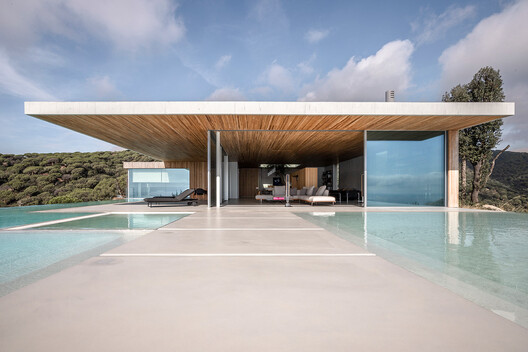
Throughout much of history, weight has been closely associated with the very idea of architecture. Vitruvius, whose notion of firmitas linked construction to stability and permanence, understood solidity as one of its fundamental qualities, and building largely meant resisting the effects of time, gravity, and natural forces. In Greek and Roman architecture, monumentality depended on the available construction systems and materials, such as stone and solid masonry, whose expression was defined by mass, thickness, and structural repetition. Columns, walls, and podiums, beyond supporting buildings, asserted their presence in the territory, communicating order, durability, and power. Architecture met the ground with weight.
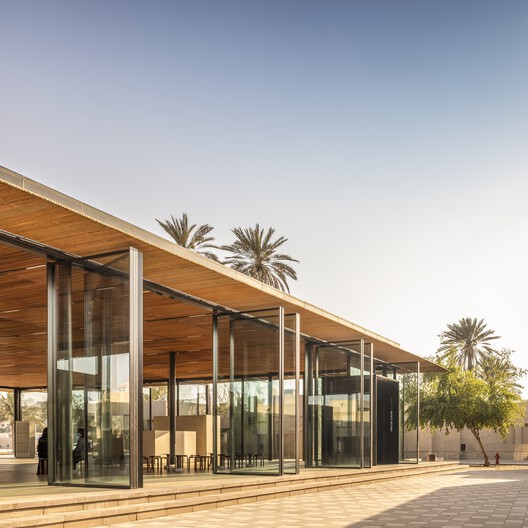
If, on one hand, this tradition associates architecture with permanence and materiality, contemporary practice has progressively shifted this understanding. Part of this transformation lies in how buildings relate to their surroundings, but also in how their boundaries are constructed. Today, architecture seeks to establish greater continuity between interior and exterior. By reducing the presence of frames and expanding glazed surfaces, window systems contribute to making boundaries less dominant and more subtly mediating. In this context, the evolution of glazing technologies becomes particularly significant. Systems such as those developed by Vitrocsa, with their ultra-slim profiles and large-format glass panels, allow openings to extend across wide spans while minimizing their supporting elements. What once depended on thickness and material mass is now achieved through precision and refinement at the scale of detail.
The quest for architectural lightness is not new. The modern period marks a decisive turning point in this process, as new construction techniques began to challenge the traditional association between architecture and mass. With the development of reinforced concrete, it became possible to consistently separate structure and enclosure, a condition that Le Corbusier consolidated as an architectural principle. In projects such as the Villa Savoye, this operation becomes explicit: the building rises on pilotis, while the structure is organized independently from the envelope, allowing greater freedom for façades and internal divisions. By concentrating supports and freeing up planes, the building no longer imposes itself on the ground and begins, to some extent, to detach from it. Lightness, in this context, does not result from the elimination of weight, but from the way it is organized and perceived, as architecture comes to be conceived as a system of layers.
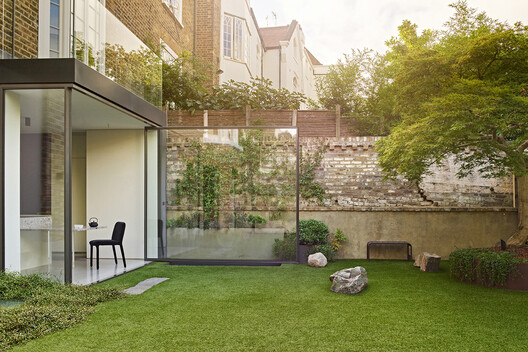
Throughout the twentieth and early twenty-first centuries, this pursuit intensifies and takes on different forms. In the Neue Nationalgalerie in Berlin, Mies van der Rohe sets the supports back and frees the perimeter, allowing the roof to project as a continuous plane over a transparent façade. This logic is further radicalized in projects by Junya Ishigami, for example, in which the structure becomes so slender and dispersed that it nearly loses legibility, and space comes to be perceived more as a continuous field than as a constructed volume.
Light has always played a fundamental role in architecture, but in contemporary production its role becomes more directly integrated into the design, participating in the construction of space, expanding the perception of depth, and reinforcing continuity between interior and exterior. Still, this condition does not depend only on transparency itself, but on how it is constructed. It is at the scale of detail that this lightness is defined.
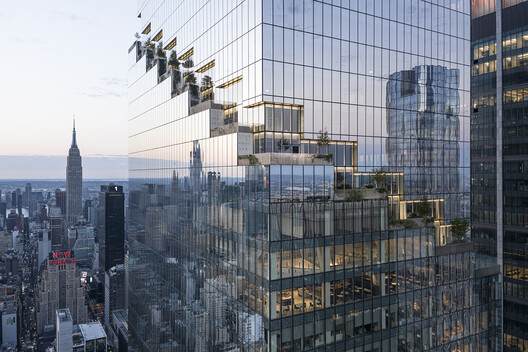
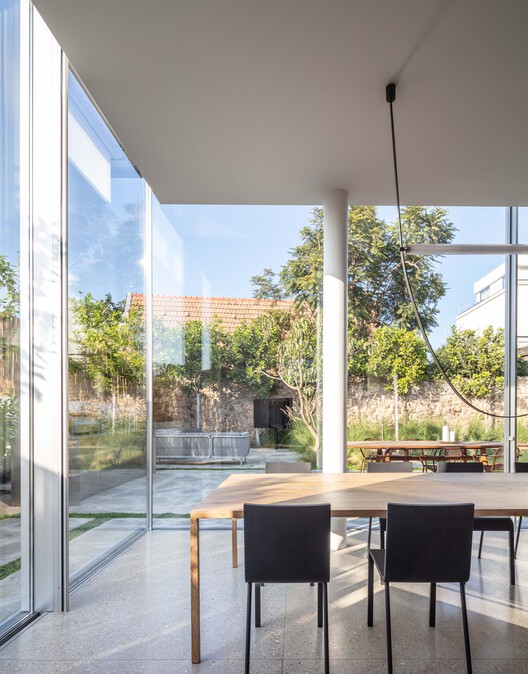
It is precisely at this scale that systems such as those developed by Vitrocsa operate. By reducing the visible presence of frames and integrating tracks within floors, walls, and ceilings, these systems allow glass to act as a continuous plane rather than a framed opening. The boundary between inside and outside is no longer defined by a thick threshold, but by a minimal and often imperceptible line, reinforcing the sense of continuity that underpins architectural lightness.
By working with extremely slender profiles and large-scale sliding solutions, systems such as those developed by Vitrocsa become particularly relevant, reducing the presence of visible structural elements and allowing glass to operate as a continuous plane. Frames cease to act as evident boundaries and instead function as minimal supports, capable of sustaining large surfaces without compromising the overall reading of the space.
This reduction is the result of precise technical development, combining high-strength metal profiles, recessed tracks, and highly precise sliding mechanisms capable of supporting large glass panels with minimal visual interference. In many cases, frames are partially concealed within floors, walls, or ceilings, allowing the glass to appear almost without visible mediation.
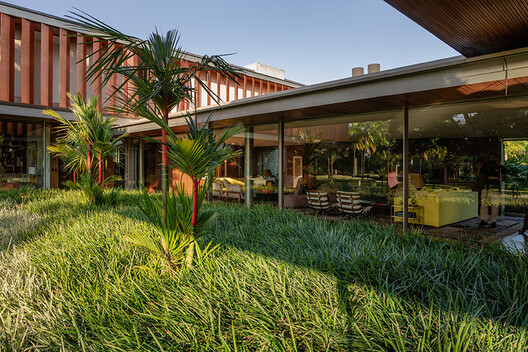
Vitrocsa develops different typologies that respond to distinct spatial needs, such as large-span sliding systems (Sliding System), pivoting solutions (Pivoting System), and motorized vertical systems (Guillotine System), as well as corner configurations without mullions (Turnable Corner System) and recessed tracks (Invisible Track). These systems redefine how spaces open, connect, and transform over time, operating as architectural devices that articulate movement, scale, and continuity.
Such constructive refinement contributes to a sense of suspension, in which façades seem to detach from the structure and glazed planes approach a condition of flotation. The relationship with the ground also becomes more subtle, and space comes to be defined less by rigid boundaries and more by gradual transitions.
This becomes particularly evident in Vitrocsa's new headquarters, conceived as a built extension of its own principles. The project functions as a full-scale showroom, where the systems developed by the company organically structure the architecture itself. Large glazed surfaces, slender profiles, and high-precision sliding systems allow the envelope to operate with maximum continuity, reducing the physical presence of boundaries to a minimum. Among the most significant elements are large-scale solutions that push these systems to the limits of their expression, such as pivoting windows up to six meters high and guillotine systems reaching openings up to nine meters high and six meters wide.
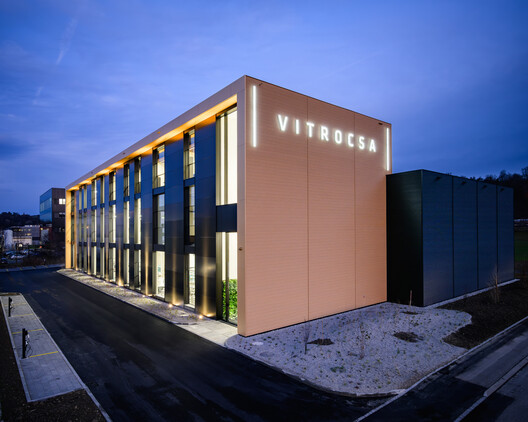
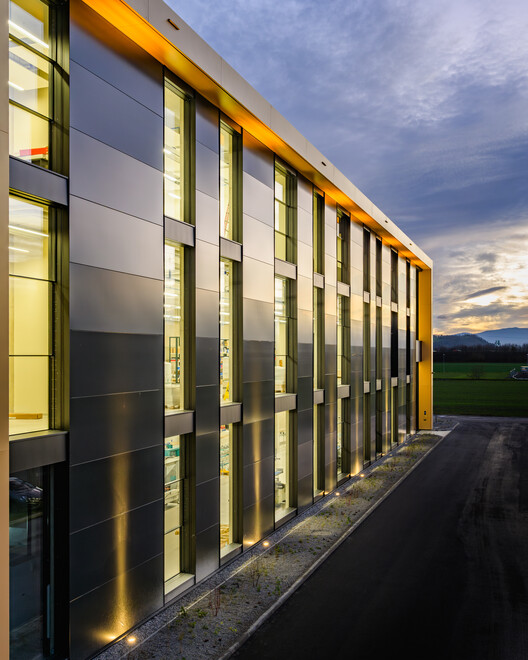
The architecture opens itself to the surroundings, establishing a direct relationship with the landscape and with variations of light throughout the day. At the same time, the building incorporates sustainable strategies, such as energy piles for geothermal heating and a photovoltaic roof that contributes to its energy autonomy.
Transforming something inherently heavy like a building into something light is, in itself, an art. In architecture, more specifically, lightness does not manifest as the absence of matter, but as the result of rigorous control at the level of detail. Structure, enclosure, and performance must operate in an integrated way, allowing the physical presence of architecture to be reduced without compromising its efficiency.


