

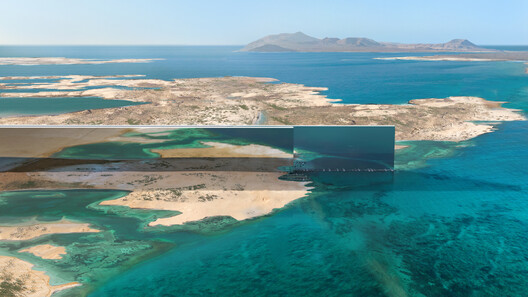
In 2023, ArchDaily's editor-in-chief sat down with Tarek Qaddumi, Executive Director of the Line Design at NEOM, at the closing of the Line Exhibition in Riyadh. Qaddumi described a layered, three-dimensional city organized around the idea of a "five-minute sphere" of access: walkable communities stacked vertically, connected by high-speed rail, freed from cars and conventional street infrastructure, and designed to coexist symbiotically with the surrounding natural landscape. It was a compelling vision, and in the context of the moment, it was simultaneously credible and appealing. For architects and urban thinkers grappling with the failures of twentieth-century city-building, the ideas articulated were worth engaging and planning.
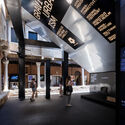
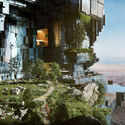
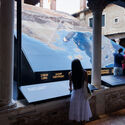
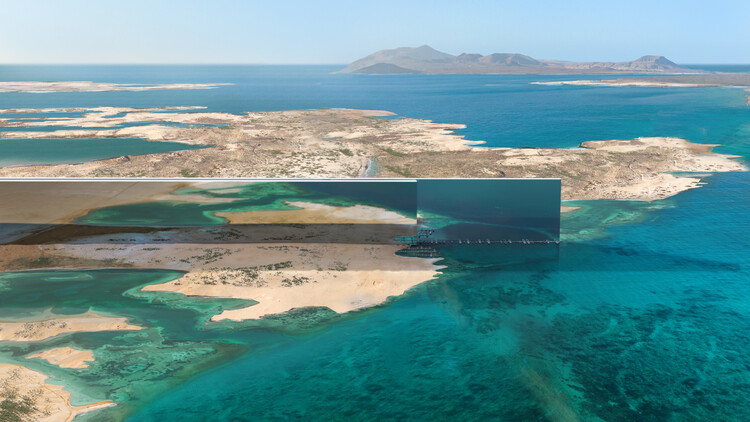
Since the exhibition, the centerpiece of the larger NEOM megaproject, the Line, has been colliding with the laws of physics, political structures, and unforgiving finance systems, having been sharply scaled back after years of overreach and mounting skepticism. What was announced in 2021 as a 170-kilometer mirrored linear city housing nine million people has, by early 2026, been reduced to construction pauses, a $8 billion sovereign wealth fund write-down, and a strategic review examining what aspects can be salvaged by 2030. On September 16, 2025, Saudi Arabia's Public Investment Fund suspended construction on the Line until further notice, with only 2.4 kilometers of foundation work completed out of a planned 170 kilometers. The population target for 2030, once set at 1.5 million residents, has been revised down to fewer than 300,000, with officials now expecting little more than two kilometers of the project to be completed by the end of the decade.
The intellectual framework outlined in early design proposals and exhibitions deserves a more honest reckoning than strict, uncritical admiration or reflexive dismissal. At least $50 billion has been spent to date, the desert is dotted with half-finished construction sites, and the foreign investment that the project had counted on did not materialize. Internal audits and a cascade of project suspensions across the NEOM portfolio offer a clearer picture of the gap between what was presented to the design world and what was feasible. The reporting and the official record of NEOM's public communications raise a question the profession has a responsibility to answer: what does the radical reimagining of the current state of the Line reveal about the design profession's relationship with power, spectacle, setbacks, and ambitious urban visions?
The Design Vision as Presented
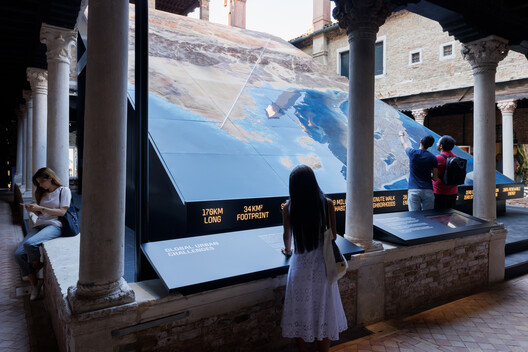
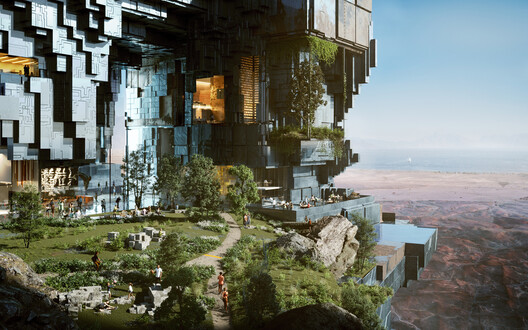
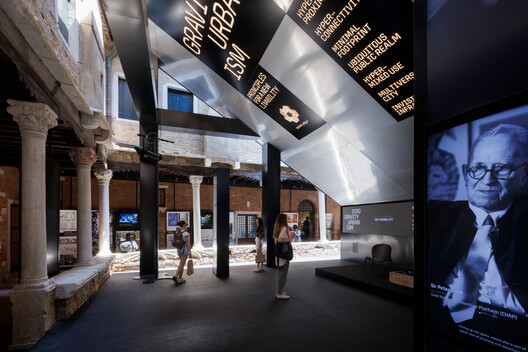
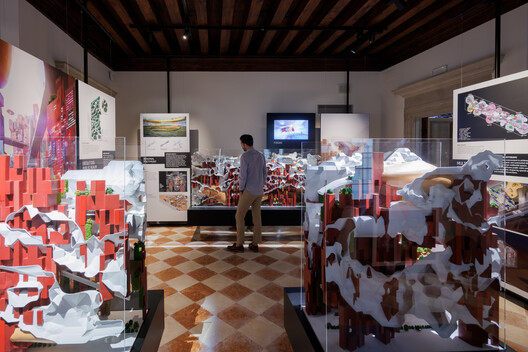
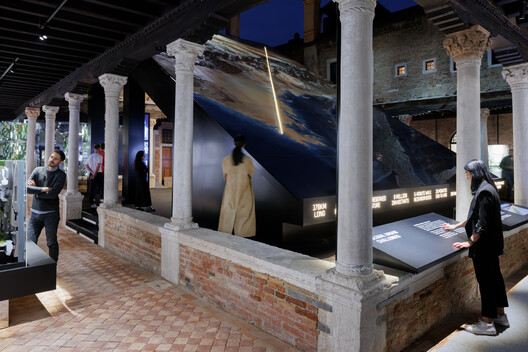
The design logic underpinning the Line was grounded in a genuine intellectual critique of conventional urban planning. The central argument was that traditional cities, organized around roads and horizontal sprawl, consume far more land, energy, materials, and resources than necessary and fragment the surrounding natural ecosystems. The Line proposed an alternative to this reality: a single continuous structure, 170 kilometers long, 200 meters wide, and 500 meters tall, that would consolidate an urban population of nine million people in a footprint of 34 square kilometers. The city would grow upward and inward, stacking multiple "ground planes" to create what Qaddumi described as a three-dimensional urban fabric. Each layer would function as its own walkable neighborhood, with residents able to reach schools, health facilities, parks, and workplaces within a five-minute radius. High-speed rail running the full length of the structure would connect its ends in under 30 minutes, while a separate logistics line handled industrial freight below grade. The project's designers described this model as "Zero Gravity Urbanism," and presented it at the Venice Architecture Biennale in 2023 alongside a cohort of internationally recognized architects and urban thinkers.
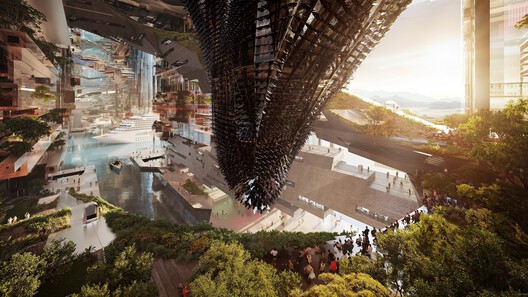
NEOM stated that the Line would operate on renewable energy, produce zero carbon emissions, and eliminate the need for private cars and roads altogether. On the question of environmental impact, the design's narrow 200-meter width was highlighted as an intentional feature: allowing natural light to penetrate from the sides, permitting wind to pass through the glass facade, and accommodating natural corridors aligned with the region's topography and hydrology. About 70 percent of the interior space would remain adaptable to residents' evolving needs, while anchor institutions like hospitals and cultural centers would provide continuity and identity. Together, these principles formed a proposition that was coherent in its rhetoric, if not yet tested against the physical and financial realities of construction. It was precisely this coherence and visionary urban thinking that made the project so difficult to dismiss.
The Gap between Vision and Finance
The gap between what was presented to the design world and what was structurally possible has since been documented in considerable detail. Investigative reporting by the Financial Times, followed by a Wall Street Journal audit disclosure in early 2025, revealed a project whose internal finances bore almost no resemblance to its public narrative. The budget for the Line started at $1.6 trillion in 2021; an updated internal estimate the following year placed total costs at around $4.5 trillion. By late 2025, the estimated cost had grown to $8.8 trillion and was counting, diminishing any urban infrastructure project in recorded history. The first phase, originally planned to deliver 20 residential modules across 16 kilometers by 2030, was reduced to three modules, rendering previously built foundations redundant. This target for constructing residential modules was reduced again in 2024, with the resident population revised from 1.5 million to fewer than 300,000. Project officials publicly denied reports of any meaningful scale-back as recently as 2024, even as construction was visibly decelerating and new contract awards were stalled.
The structural break came in the second half of 2025 as the Public Investment Fund formally halted all construction activity on the Line in September. By that point, new contracts for NEOM had stalled entirely, and there was no mention of the project in Saudi Arabia's 2026 pre-budget statement. A year-long strategic review now reports that the redesigned NEOM will be far smaller than originally envisioned, reflecting acknowledgment of cost overruns and fundamental challenges in the project's conception. With its coastal location offering access to abundant seawater for cooling, the government is believed to have shifted its focus toward industrializing NEOM as a hub for data centers, though this remains a speculative direction rather than a confirmed plan of action.
Numbers that Were Always Untenable
At the originally proposed scale, the Line would require approximately 4.8 million tons of structural steel for its superstructure alone. At peak procurement, NEOM was reportedly consuming one-fifth of all the steel available on the global market. Each of the project's early modules required more than 3.5 million cubic meters of concrete and was supported by over 5,500 foundation piles, some plunging 70 meters below grade, making the piling operation for the initial phase alone arguably the largest ever attempted in a single construction project. Concrete production depended on water, and in the early stages, water was being shipped to the site by tanker, a logistical problem that engineers acknowledged was not a scalable solution for a project whose sustainability credentials were central to its public identity. The high-speed transit system that would have delivered an end-to-end journey on the Line in under 30 minutes had no confirmed technology to underpin it, as the closest existing candidate for building this infrastructure no longer exists.
The Costs Not in the Renderings
At the height of the project's promotional phase, no public environmental impact assessment had been published, documented in peer-reviewed reports and journals. A 2024 paper identified the Line as one of the fifteen most pressing conservation concerns of the year, noting that its dimensions, its mirrored facades, and its east-west orientation at the head of the Red Sea were likely to pose a substantial threat to migratory species, particularly the estimated 2.1 billion birds of more than 100 species that pass through the region each autumn on their migration route. This finding stood in direct contradiction of earlier descriptions of animal corridors and the structure's symbiotic relationship with its landscape.
Additionally, researchers estimate that construction of the Line at its proposed scale would release approximately 1.8 billion tons of embodied carbon dioxide, a figure that renders the project's zero-carbon branding structurally incoherent. The sustainability argument was, in several of its most prominent claims, directly contradicted by available evidence and documented reports.
It is important to consider, in addition to the environmental cost of a project of this scale, the social implications of the existing communities in the region. The land on which the Line is to be built was not an empty, uninhabited desert before construction began. Several communities inhabited this region for generations, and reports by human rights organizations documented the displacement of an estimated 20,000 people from the area, with accounts of inadequate consultation and limited compensation. Those who publicly opposed the process faced serious legal consequences, with several individuals prosecuted for activities including social media posts and public statements.
Promises of Future Cities
It would be inappropriate to dismiss the Line as a spectacle or architectural theory. The urban critique at the heart of the project touched on real and pressing problems for built environments around the world. Horizontal sprawl consumes and degrades landscapes on every continent; automobile dependency continues to shape cities around the needs of private vehicles rather than people; the unequal distribution of urban amenity, where access to good schools, healthcare, and public space correlates tightly with income and geography, remains one of the defining failures of modern planning. The walkability argument and the critique of infrastructure-heavy conventional planning were not ideas that originated with NEOM, and none of them are wrong. The three-dimensional density model raised legitimate questions about how cities might be organized for efficiency and access, and the framing of density as a generator of proximity drew on a well-established tradition of urbanism. These ideas deserve serious discussion and rigorous feasibility testing, and in many ways, the project catalyzed this conversation, in Venice and beyond.
Where NEOM and the Line Stand Now
As of early 2026, the question is no longer whether the Line will be built as designed. Construction was suspended by the Public Investment Fund in September 2025, after more than $50 billion had been spent, leaving a handful of structures and foundations across the Saudi desert. The strategic review led by the new CEO is now understood to have reached its conclusions, though official communications from NEOM continue to describe the changes as "strategic discipline" and "phased recalibration."
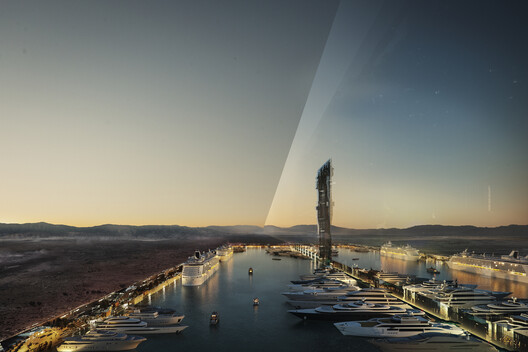
The site's practical advantages, among them Red Sea access for seawater cooling, abundant land, access to renewable energy, and a strategic location between Europe, Asia, and Africa, have tangible implications, even if they are disconnected from the urban vision presented to the design world. The precise future form of NEOM remains unconfirmed, the extent to which the project will be scaled back or recalibrated is uncertain, and no official statement has described the original urban vision as outright abandoned. What is not in dispute is that the vertical city of nine million people, layered ground planes, the fifteen-minute sphere, rapid transportation connecting the site extents, and natural corridors passing through the mirrored facade are no longer representative of the project under construction.
What remains is a reckoning with what the episode has cost, financially, humanistically, and professionally. The urban problems that animated the Line's original premise remain unsolved. Sprawl, automobile dependency, unequal access to urban amenities, and the carbon cost of conventional city-building continue to define the central challenges of twenty-first century planning. The next generation of ambitious urban proposals will need visionary design intelligence, coupled with rigorous independent feasibility review, transparent governance, and meaningful community engagement. It will need professional leaders willing to ask difficult questions and learn from the setbacks.
The urban challenges that gave the Line its rhetorical power are intensifying around the world. The profession's response to it reveals an important lesson: the design world's appetite for visionary urban thinking remains stronger than its appetite for the hard scrutiny that such visions require. The profession must not stop dreaming at scale, but there is an urgent need to be just as rigorous about critique, conditions, costs, and the people impacted by power and ambitious urban thinking.
This article is part of the ArchDaily Topic: The Technosphere: Architecture at the Intersection of Technology, Ecology, and Planetary Systems. Every month we explore a topic in-depth through articles, interviews, news, and architecture projects. We invite you to learn more about our ArchDaily Topics. And, as always, at ArchDaily we welcome the contributions of our readers; if you want to submit an article or project, contact us.


