In the nineteenth century, entire railway networks became obsolete almost overnight, not due to physical deterioration, but because of changes in the technical standards that supported them. The expansion of railroads across Europe and North America adopted different track gauges (the transverse distance between rails), and as a dominant standard gradually emerged, these infrastructures became incompatible with one another. This required large-scale adaptations, conversions, or even complete reconstruction, in what became known as the "Gauge War."
With the mass adoption of telecommunications networks in the twentieth century, cities around the world built large telephone exchange buildings filled with electromechanical equipment responsible for routing calls between regions. These structures were highly specialized pieces of infrastructure, often occupying entire city blocks and organized around large-scale technical machinery. With the transition to digital switching technologies and, later, the widespread adoption of mobile telephony, much of this equipment became obsolete within a few decades. The buildings themselves often remained structurally sound, but the systems they were designed to support had already evolved beyond them.
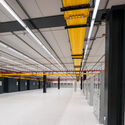

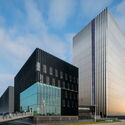

A similar phenomenon can be observed in early data centers built in the 1990s and 2000s. Many of these facilities were designed for specific server densities, relatively stable energy demands, and cooling systems that quickly became insufficient in the face of accelerated digital processing and the expansion of cloud computing. In many cases, the physical structures remained viable, but the installed technical infrastructure could no longer meet new requirements for performance, redundancy, and efficiency.
Related Article
Obsolete Typologies Revived Through 17 Adaptive Reuse Projects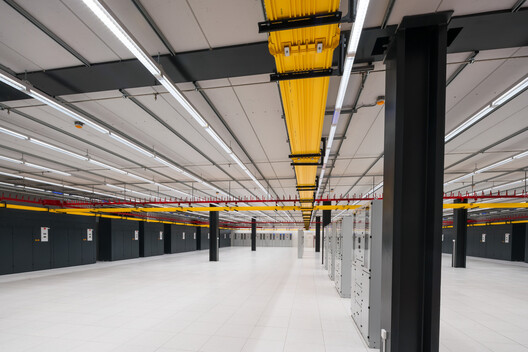
Taken together, these cases point to a recurring mismatch: technological systems evolve at a much faster pace than the physical infrastructures that support them. Buildings are designed to last decades, sometimes centuries, and a significant part of architecture's cultural prestige derives from this aspiration to durability, as articulated by Vitruvius. However, contemporary production now operates within technical ecosystems in constant transformation, whose pace far exceeds that of the built material itself.
Obsolescence emerges as a structural condition of the built environment and can be understood not as a design failure, but as an inevitable consequence of architecture's growing dependence on continuously evolving technical systems. Recent studies on building life cycles and energy performance highlight the dynamic nature of these systems, whose parameters evolve over time. In practice, this condition manifests through distinct update cycles: mechanical systems typically require renewal every fifteen years, while digital infrastructures evolve at much shorter intervals, often closer to five years. Data networks, sensors, building automation systems, and communication technologies demand even faster updates, driven both by technological advances and increasing demands for efficiency and monitoring.
The relationship between permanence and change in architecture was explored with particular influence by Stewart Brand in How Buildings Learn (1994). In the book, Brand argues that buildings should not be understood as static objects, but as systems composed of different layers, which he calls the shearing layers, each operating at its own pace of transformation over time. These layers range from nearly permanent elements, such as the site, to long-lasting components like the structure, followed by the building envelope, technical systems, and interior layout, and finally the most ephemeral elements, which change continuously. The friction between these different temporalities is precisely what allows buildings to adapt, learn, and remain relevant, opening the door to a deeper shift in how we conceive architectural design.
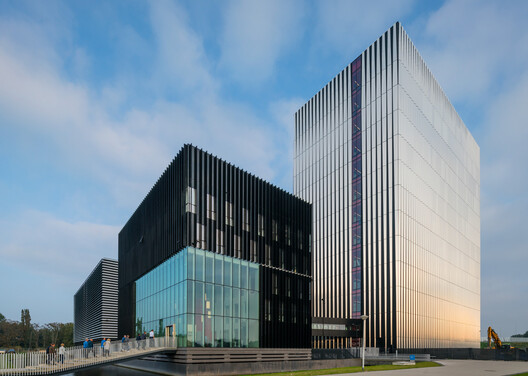
Other approaches, such as those developed by Dutch architect John Habraken and later expanded by initiatives like the Open Building Institute, also propose a layered understanding of architecture, separating the building into systems that evolve at different speeds. At the most durable level lies the support, which includes the structure, circulation cores, and primary envelope. These components form the building's long-term infrastructure. Within this framework, infill systems—such as internal partitions, façade panels, and service distribution networks—can be modified as needs change. Finally, short-cycle components, such as equipment, digital infrastructure, finishes, and furniture, can be replaced or updated without affecting the building's fundamental structure.
By distinguishing these layers, this approach shifts architecture toward a system capable of gradual transformation, moving away from the notion of a fixed and immutable object. Design, in turn, incorporates time as a fundamental parameter. Buildings become platforms that accommodate change, rather than rigid containers that attempt to resist it. In contemporary buildings, increasingly connected through digital systems, this acceleration becomes even more evident, particularly in data infrastructures, automation systems, sensors, and communication technologies.
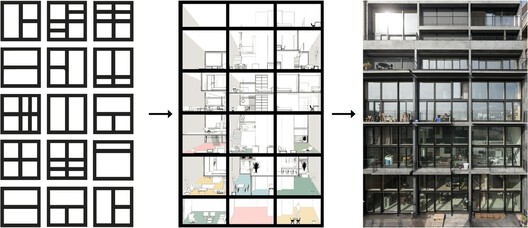
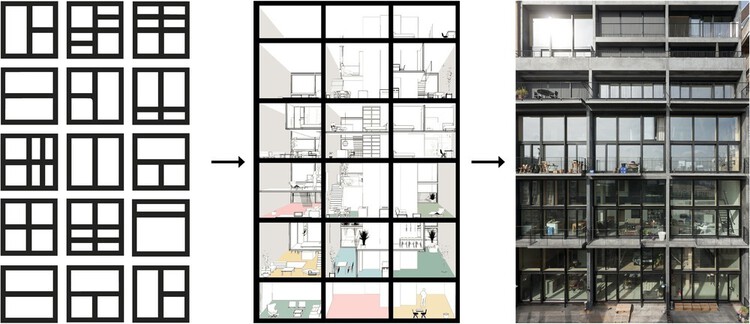
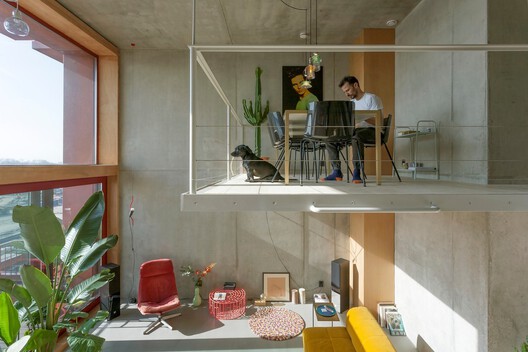
This approach is not limited to theory. In recent years, several projects have explored Open Building principles as a strategy to address obsolescence and programmatic uncertainty. A relevant example is Superlofts, in Amsterdam, developed by MKA (Marc Koehler Architects). The project is based on a robust base structure, organized through a regular grid and fixed cores, conceived as an open system in which users can define and modify the internal organization of their units over time. The units are delivered in a semi-finished state, with technical infrastructure already in place, but with considerable freedom in defining layouts, mezzanines, partitions, and uses. The strategy allows for different spatial configurations, expansions, and adaptations as residents' needs evolve, whether through family cycles, changes in use, or transformations in ways of living. In this model, architecture establishes a long-lasting support, while the interior remains deliberately indeterminate, functioning as an open field for appropriation and continuous transformation.
Strategies for Designing Buildings That Can Evolve
If obsolescence is inevitable, the architectural challenge becomes how to design buildings capable of accommodating continuous updates over time. In this context, several strategies have proven particularly relevant.
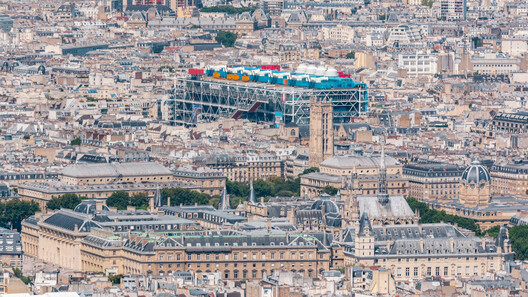
One is the organization of accessible, layered infrastructures. The separation between structural systems and technical infrastructure is essential to enable future adaptation. When services are embedded directly within walls and slabs, any update becomes complex and costly. When organized as independent layers, however, they can be modified with minimal intervention. Elements such as raised floors, accessible ceilings, and service corridors transform infrastructure into a replaceable system rather than a hidden network. Designing mechanical systems as modular and accessible assemblies reinforces this logic, allowing buildings to respond to new environmental requirements and technological advances without major structural interventions. The Centre Pompidou in Paris (Renzo Piano and Richard Rogers, 1977) is an emblematic example of this approach: by externalizing its systems, it keeps infrastructure visible, accessible, and replaceable, while maintaining a highly flexible interior.
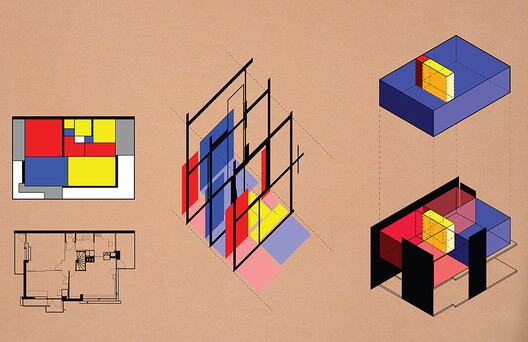
Another important strategy is structural flexibility. Generous structures, with foundations designed for future load increases, regular grids, greater floor-to-floor heights, and large spans, facilitate adaptation to new uses over time. This helps explain why industrial and modernist buildings are often successfully reused, accommodating different programs without significant transformation. Experiments such as the Schröder House (Gerrit Rietveld, 1924), with its movable partitions, already anticipated this logic by enabling continuous spatial transformation in response to changing domestic dynamics.
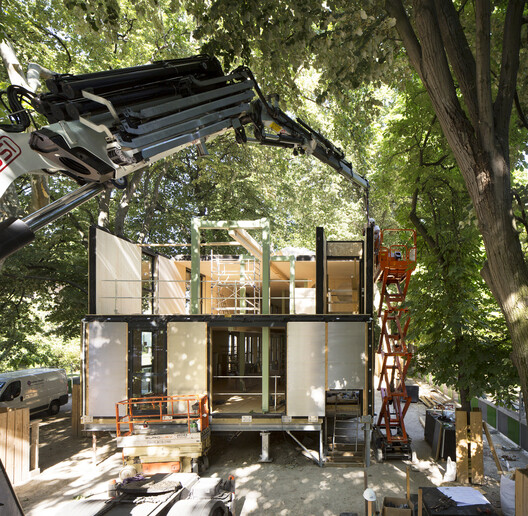
Finally, façades are increasingly understood as updatable systems. The building envelope is no longer treated as a fixed element, but as a technological layer capable of evolving over time. Modular façade systems allow for progressive replacement and upgrades, whether to improve thermal performance or to incorporate new technologies such as photovoltaic surfaces. In this context, approaches such as Design for Disassembly (DfD) become particularly relevant, proposing that components be designed for disassembly, reuse, and replacement throughout their life cycle. In this way, buildings can evolve environmentally without requiring big structural changes.
This perspective also connects to broader discussions on the circular economy and resource conservation. If buildings can evolve over time, their structural components remain in use for longer periods, reducing the environmental costs associated with demolition and new construction.
In an era marked by rapid technological change, digital infrastructure, climate adaptation, and shifting patterns of work and living, it becomes increasingly difficult to predict future building requirements. Designing for obsolescence, therefore, is less about anticipating specific technologies and more about creating the conditions that allow change to occur.
Architecture thus engages not only with form and space, but also with temporal resilience. Rather than resisting change, it can structure it. By organizing buildings as layered systems, accessible infrastructures, and adaptable spatial frameworks, architects can design environments capable of evolving alongside the societies that inhabit them. In an age of continuous upgrades, the most resilient buildings may not be those that attempt to remain unchanged, but those that are able to accommodate change without losing coherence.
This article is part of the ArchDaily Topic: The Technosphere: Architecture at the Intersection of Technology, Ecology, and Planetary Systems. Every month we explore a topic in-depth through articles, interviews, news, and architecture projects. We invite you to learn more about our ArchDaily Topics. And, as always, at ArchDaily we welcome the contributions of our readers; if you want to submit an article or project, contact us.


