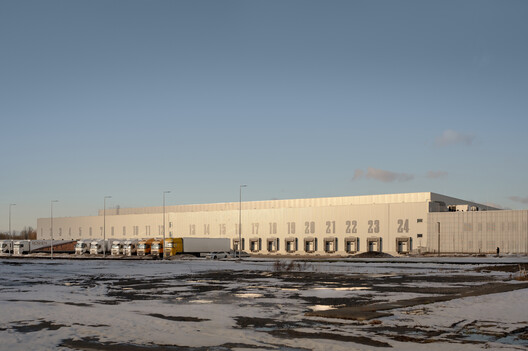
At the edge of most cities, beyond the ring roads and interchanges, a different kind of architecture is taking shape. It is not designed to be seen, visited, or remembered. It does not gather people; it moves things. Inside, thousands of parcels travel continuously, being sorted, lifted, scanned, and dispatched with minimal interruption. These buildings rarely enter architectural discourse, yet they are among the most consequential spaces of our time. The defining typology of the 21st century is increasingly the warehouse.
The scale of this transformation is difficult to grasp because it unfolds horizontally, across territories rather than skylines. Global warehouse space now exceeds tens of billions of square feet, expanding rapidly alongside the rise of e-commerce. During the COVID-19 pandemic, demand for logistics infrastructure accelerated by several years, compressing future growth into an already strained present. In India, the warehousing sector continues to grow at double-digit rates, reshaping peri-urban land into storage and distribution corridors. Logistics is no longer a background system; it is a territorial condition.
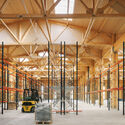



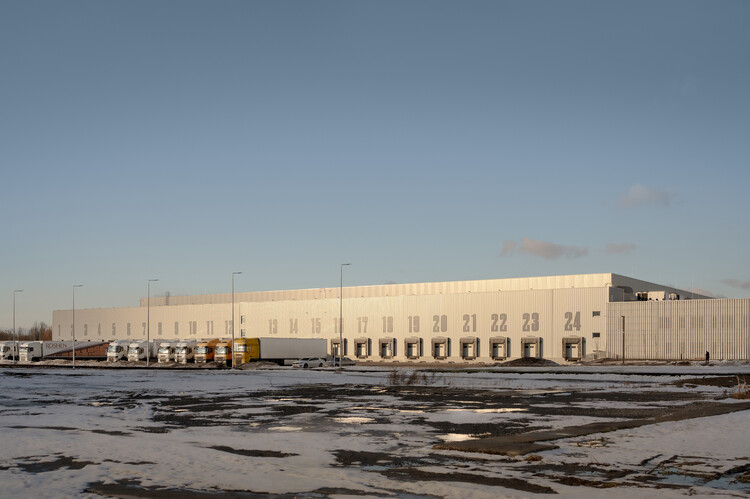
The shift becomes legible at the scale of projects like Maasvlakte 2, where architecture extends into engineered geography. Built on reclaimed land, the expansion adds roughly 2,000 hectares to the Port of Rotterdam, integrating automated terminals, storage zones, and transport infrastructure into a single logistical landscape. Here, the building dissolves into a system. Cranes, containers, and vehicles operate as part of a continuous spatial field, coordinated across land and sea. What emerges is an operational territory, architecture functioning as infrastructure, calibrated to global flows of goods.
Related Article
Making Infrastructure Visible: When Systems Become Architecture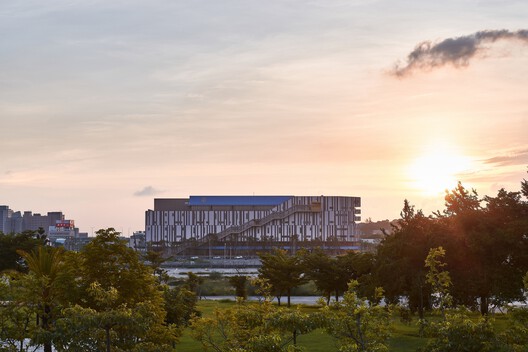
If logistics landscapes operate at a territorial scale, their internal organization is equally precise. Far from being neutral containers, warehouses are shaped by the demands of automation, where efficiency is embedded directly into plan geometry. In Amazon fulfillment centers, storage systems are organized into dense grids, navigated by mobile robots. Shelving units move instead of people, reducing walking distances and accelerating picking times. Column spacing, circulation paths, and storage layouts are all determined by robotic movement, transforming the plan into a choreography of machines.
This shift from human-centered to system-centered design produces spaces that are both highly optimized and spatially uniform. Deep floor plates extend across hundreds of meters, often without access to daylight. Circulation is divided into distinct regimes: autonomous zones for robots and controlled paths for workers. In facilities developed by Cainiao Network, artificial intelligence coordinates the flow of parcels in real time, processing millions of items per day through continuous sorting systems. Architecture here operates less as enclosure and more as interface, an environment tuned to the rhythms of data, throughput, and prediction.
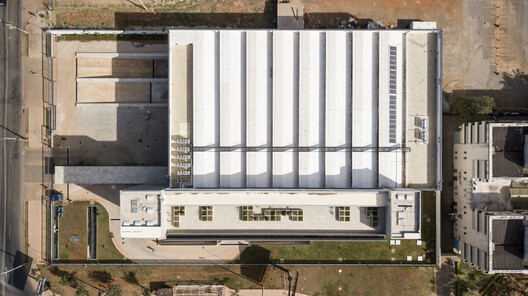
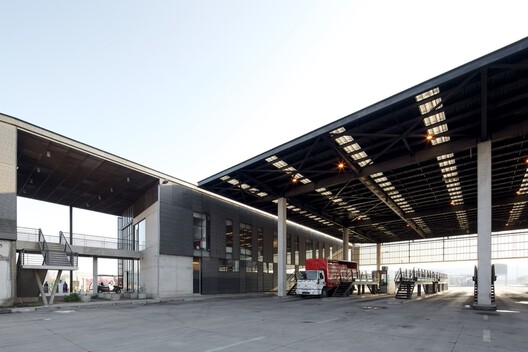
Within these systems, the role of the human worker is carefully structured by space. Layouts are designed to minimize idle time, with picking zones and routes optimized through time-motion analysis. Handheld scanners and wearable devices guide workers through the building, translating logistical algorithms into physical movement. As Deborah Cowen argues in her book The Deadly Life of Logistics, infrastructure is not only about circulation but governance, organizing labor through spatial and technological systems. In this context, architecture becomes an active participant in regulating behavior, embedding productivity metrics into the very arrangement of space.
The consequences of logistics architecture extend beyond the interior. At the urban and regional scale, these buildings contribute to a new kind of environmental footprint. Warehouses require vast, impermeable surfaces for storage and circulation, intensifying heat island effects and increasing flood risks. Their proximity to highways and ports concentrates freight traffic, contributing to localized air pollution. Freight transport accounts for a significant share of global carbon emissions, linking the spatial expansion of logistics directly to climate impact. What appears as a neutral storage facility is in fact part of a broader ecological system shaped by energy consumption, land transformation, and mobility.
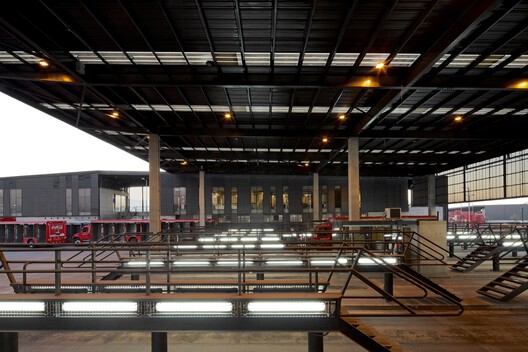

Projects like Maasvlakte 2 illustrate this dual condition clearly. While automation within the port improves operational efficiency and reduces certain localized emissions, it also enables higher volumes of global trade, intensifying the overall throughput of goods. The environmental cost is therefore not eliminated but redistributed, embedded within a larger network of extraction, transport, and consumption. Logistics architecture does not simply occupy land; it reorganizes ecological relationships at scale.
Despite this, logistics buildings remain largely absent from architectural discourse. They rarely appear in exhibitions, awards, or publications, existing instead within the domains of engineering, real estate, and operations management. Institutions and prizes continue to foreground cultural and civic typologies, reinforcing a disciplinary focus on representation over infrastructure. As Keller Easterling has noted, much of the built environment today is shaped not by singular architectural objects but by repeatable systems and protocols, forms of space that operate beyond traditional design authorship.
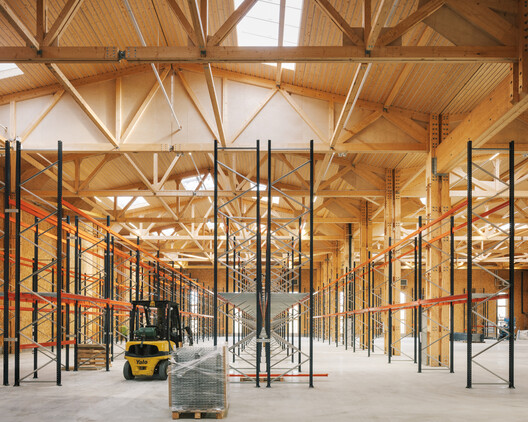
This disciplinary gap has material consequences. When logistics buildings are treated purely as technical problems, design decisions default to efficiency alone. Materials are selected for speed and cost, environments are sealed and standardized, and the potential for spatial variation or public interface is largely ignored. The result is a landscape of monofunctional structures, vast, opaque, and disconnected from their surroundings, despite their growing presence in everyday life.
Yet the scale and influence of logistics architecture also suggest a different possibility. If these buildings are already shaping territory, labor, and ecology, they cannot remain outside the scope of design. Emerging industry practices offer glimpses of alternative approaches: warehouses equipped with large-scale solar roofs, facilities that integrate energy production into their operation, and automated systems that reduce land requirements through more efficient use of space. These incremental shifts suggest that logistics infrastructure can be rethought.
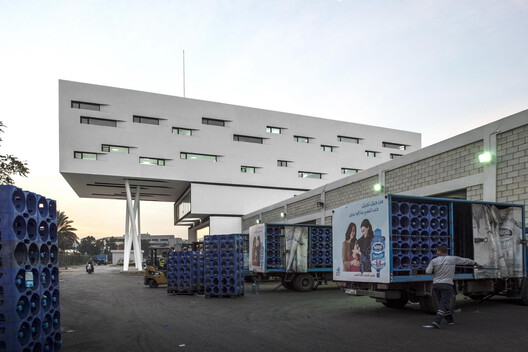

The challenge, then, is not to aestheticize the warehouse, but to recognize it as architecture. This means engaging with its systems rather than disguising them, understanding how spatial decisions influence labor conditions, environmental performance, and urban form. It means moving beyond the idea of the building as an isolated object toward a conception of architecture as part of larger logistical networks. Logistics landscapes point to a different role for architecture in the 21st century. The discipline is increasingly confronted with systems that operate across scales, from the movement of a parcel within a grid to the transformation of entire coastlines. To engage with these systems is to acknowledge that architecture is not only about spaces we inhabit, but also about those that sustain the flows we depend on.
This article is part of the ArchDaily Topic: The Technosphere: Architecture at the Intersection of Technology, Ecology, and Planetary Systems. Every month we explore a topic in-depth through articles, interviews, news, and architecture projects. We invite you to learn more about our ArchDaily Topics. And, as always, at ArchDaily we welcome the contributions of our readers; if you want to submit an article or project, contact us.