Deir ez-Zor: Raising Hope Through Heritage Documentation

Sponsored Content

The historic city of Deir ez-Zor in eastern Syria has had more than its fair share of calamity after the outbreak of the war in 2011. After seeing destruction caused by fierce battles between armed groups and the central government, as well as occupation by ISIL, the earthquake in February 2023 brought further damage. Behind the headlines, however, is an ancient city tracing its founding to the dawn of civilization on the banks of the Euphrates River, with living architecture from the Ottoman and French Mandate periods. A winner of the ArchDaily 2025 Next Practices Awards, the Deir ez-Zor Heritage Library aims to revitalize the city and support sensitive reconstruction by documenting and promoting its built heritage.
Deir ez-Zor: Raising Hope Through Heritage Documentation - Image 2 of 14Deir ez-Zor: Raising Hope Through Heritage Documentation - Image 3 of 14Deir ez-Zor: Raising Hope Through Heritage Documentation - Image 4 of 14Deir ez-Zor: Raising Hope Through Heritage Documentation - Image 5 of 14Deir ez-Zor: Raising Hope Through Heritage Documentation - More Images+ 9

While Syria's large cities are situated on the western half of the country, Deir ez-Zor sits across the desert from them on the eastern half and is regarded as a gateway city between the Levant and Mesopotamia. With reliable riverine water sources, the region contains archaeological remains indicating it was one of the earliest sites where agriculture became common. It would be inhabited by Sumerian, Akkadian, and Aramaic peoples through the centuries, while the city became an important caravan stopping point between the eastern Mediterranean and Baghdad.

Deir ez-Zor: Raising Hope Through Heritage Documentation - Image 14 of 14
Plan showing extent of destruction; courtesy of Deir ez-Zor Heritage Library

The area became part of Ottoman control and, in the eighteenth century, Deir ez-Zor became the administrative center of the region. The city was planned from 1833 onwards, as it expanded outwards from the old town (Deir Al-Atiq). This process continued until the early twentieth century, making the city more diverse and establishing it as a major commercial center, where many vaulted markets were constructed. In 1968, modernization efforts in an independent Syria saw much of the old town cleared for new housing and government buildings, despite local objections. Much of the Ottoman town remained, continuing to flourish, until war broke out in 2011. Intense battles saw much of the historic center destroyed and its inhabitants displaced.


Related Article

20 Practices Shaping the Future of Architecture: Winners of the ArchDaily 2025 Next Practices Awards

In 2018, Deir ez-Zor Heritage Library was established by Lamis Bakjaji with Bahaa Abdallah and Hazem al-Khleaf as a voluntary initiative focused on the built cultural heritage of the city and province of Deir Ez-Zor. The primary goal was to establish an accessible digital heritage library of architectural data to support potential rebuilding efforts in the city. With a grant for research secured, the initiative's flagship project has been the documentation of Main Street. Commercially and culturally, it is the beating heart of the city, with its prominent location in the center between the old town and the later Ottoman extensions. Markets, various religious buildings, and houses can all be found on Main Street.

Deir ez-Zor: Raising Hope Through Heritage Documentation - Image 7 of 14
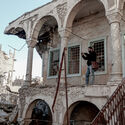
Characteristic house entrances of Main Street, Deir ez-Zor. Image Courtesy of Deir ez-Zor Heritage Library

The project recognizes that safety and livelihood have been the residents' key priorities during conflict over the needs of heritage conservation. The intention is to reconnect the people of Deir ez-Zor with their heritage through documentation, which in turn would establish the groundwork for future revitalization. The project focuses on the stretch of Main Street between the Capuchin Church in the west and Al-Rawi mosque in the east, encompassing a variety of building types, some of which carry historical value but are not registered on the National List of Heritage, such as houses. The wood market and the Khan Ganama market hall are also important landmarks on the street.

Deir ez-Zor: Raising Hope Through Heritage Documentation - Image 5 of 14
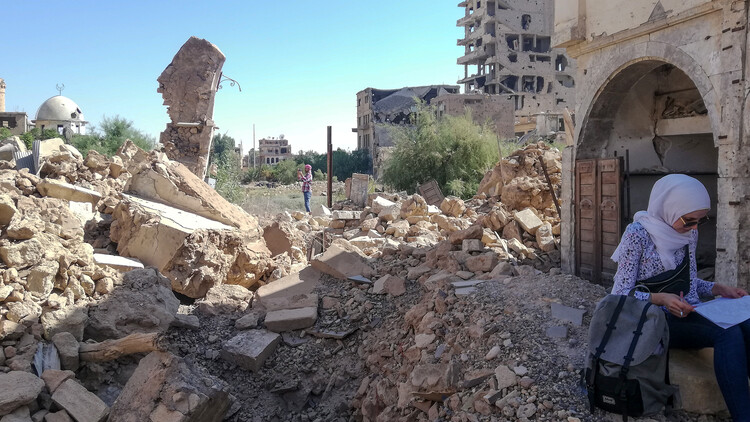
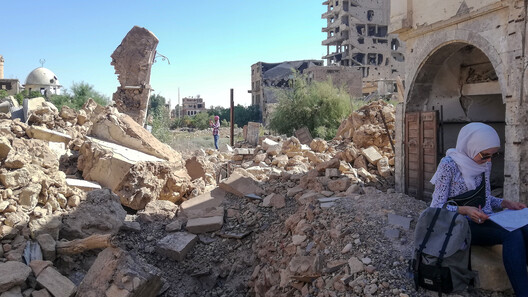
Documentation work in Deir ez-Zor. Image Courtesy of Deir ez-Zor Heritage Library

The documentation of Main Street commenced while the war was still ongoing in parts of the country, restricting travel and transport possibilities. Thus, small tools such as smartphones and laptops played a major role, alongside the use of GIS, structure from motion software, and photogrammetry. Social media was used to connect with the wider public, especially the former residents and users of Main Street. Lamis Bakjaji notes how the release of short videos with digital models of houses triggered an emotional response from their former owners, who were forced to leave the city at the start of the war.

Deir ez-Zor: Raising Hope Through Heritage Documentation - Image 3 of 14
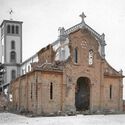
Capuchin Church, Deir ez-Zor, overlaid on historic photograph of intact church. Image Courtesy of Deir ez-Zor Heritage Library

The value of Main Street is multifold. At the urban level, it is the city's first straight street, running through several districts, and is situated between the old town and later extensions. Its architecture includes late Ottoman, French Mandate architecture from the early twentieth century, and later, modern buildings. Spiritually, the vicinity is home to several mosques and churches, including the Armenian Genocide Memorial Church, dedicated to those who perished in the Deir ez-Zor area. Economic and cultural activity was rife, with markets displaying handicrafts, as well as restaurants, bookshops, and social spaces.

Deir ez-Zor: Raising Hope Through Heritage Documentation - Image 9 of 14
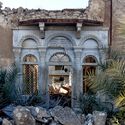
Stonework in the rubble. Image Courtesy of Deir ez-Zor Heritage Library

The vaulted wood market was one of the buildings of focus. Heavily damaged and its users scattered by the conflict, the goal of the study was to also conserve the intangible heritage aspect by connecting with the craftspeople who worked there. Sadly, after the physical documentation of the market, the 2023 earthquake caused further destruction. The incident highlighted the importance of the physical documentation being undertaken by Deir ez-Zor Heritage Library.

Deir ez-Zor: Raising Hope Through Heritage Documentation - Image 4 of 14
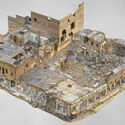
Model of Khan Ganama. Image Courtesy of Deir ez-Zor Heritage Library
Deir ez-Zor: Raising Hope Through Heritage Documentation - Image 13 of 14
Courtesy of Deir ez-Zor Heritage Library

Khan Ganama was another building of focus. Khans in Syria were constructed as centers for the trading of goods and as a rest house for merchants, typified by a square plan and an open courtyard. Khan Ganama was constructed in 1920 in a late Ottoman architectural style, with a characteristic courtyard. Over the years, alterations were made, such as the courtyard being roofed over in 1960 and some areas converted into offices, but the overall form and function as a marketplace remained. The construction materials included marble, limestone, mud, and gypsum, and the significance of the khan was recognized by being registered as a historical building in 2002-2004.

With buildings like Khan Ganama and others, Main Street possesses a very wide range of uses in a short distance, and is thus a culturally significant place. The aim of Deir ez-Zor Heritage Library is to restore this urban vitality across the street. Their proposal for Khan Ganama is to rehabilitate the structure to its original form, without later additions, and in accordance with Syrian conservation law. Several options for future uses are proposed, including restoration of its commercial function, or conversion into a museum or cultural center, a center for education in heritage, a business innovation center, or repurposing it as a historic hotel. The hope is that the rehabilitation of a major building like Khan Ganama can kick-start the restoration of the rest of Main Street.

This article is presented by Buildner. As sponsor of ArchDaily's 2025 Next Practices Awards, Buildner—the world's leading architecture competition organizer—helps architects get what they enter competitions for: recognition, opportunity, and progress.

Exercise your creativity now: the Buildner UNBUILT Award 2026 is open to all, with a €100,000 prize fund. Submit your unrealized designs and celebrate your creativity now.

Image gallery

See allShow less
About this author
Cite: Mohieldin Gamal. "Deir ez-Zor: Raising Hope Through Heritage Documentation" 20 Mar 2026. ArchDaily. Accessed . <https://www.archdaily.com/1039786/deir-ez-zor-raising-hope-through-heritage-documentation> ISSN 0719-8884

You've started following your first account!

Did you know?

You'll now receive updates based on what you follow! Personalize your stream and start following your favorite authors, offices and users.