Artificial intelligence has made its way into almost every corner of professional workflows, prompting the architectural industry to rethink how it works. To adapt to this shift, firms are now facing the limits of a model that has changed very little over the past few decades.
What has shifted, and noticeably so, is the pressure on productivity. Today's studios are expected to deliver more work faster and with greater accuracy, while managing tighter budgets, complex regulations, and rising client expectations. In practice, this translates into compressed timelines and a constant demand for precision that leaves little room for error. Often, much of this pressure falls on a small group of individuals who hold critical project knowledge.
For years, firms have tried to smooth these frictions by adopting new tools and pushing teams to work more efficiently. Yet, these are often cosmetic fixes for a structural problem. The gap between what modern projects require and what traditional, labor-based models can provide is no longer marginal; it's structural. The firms currently pulling ahead aren't necessarily those with the most tools, but those rethinking how work is organized, how knowledge is accessed, and where value is actually created.
The Limits of a Fragmented Model
The traditional architecture firm is built around specialization, manual oversight, and fragmented responsibilities. Knowledge of building codes, jurisdictional requirements, and feasibility tends to sit with a few senior architects. For a long time, this arrangement held. The inefficiencies it created were manageable within the scope and expectations of practice.

But that balance is becoming harder to sustain. Professionals with the most experience are often stretched across projects and responsibilities, while more junior staff may recognize that a requirement exists without knowing how to interpret it or where to find it. When that gap cannot be resolved within the team, work slows down or shifts to external consultants, adding time and cost. This reveals a structural limitation: knowledge exists, but it does not move efficiently across the practice.
AI as Operational Infrastructure
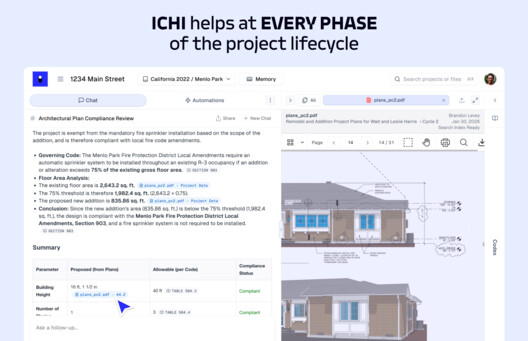
Against this backdrop, architecture-specific AI is transitioning from an isolated tool to operational infrastructure. Platforms like Ichi Plan—a collaborative AI platform built for architects—read construction documents, cross-reference applicable building codes, and return cited, defensible answers in minutes rather than hours. More importantly, the best of these platforms operate less like a search engine and more like a member of the team: an active thought partner that engages with the context of a project, works alongside the architect, and helps surface the judgment the problem requires rather than simply returning an answer.
This increases workflow speed and changes team dynamics. Questions that once required four to six hours of research can now be resolved in under five minutes, with references that can be shared across the team.
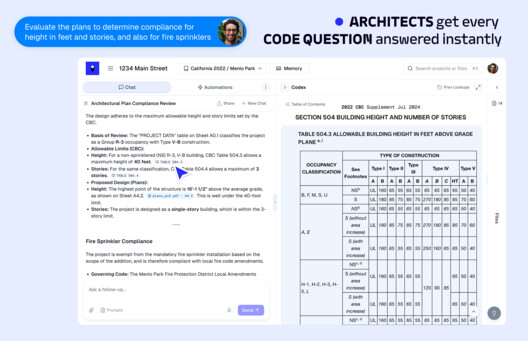
In one case, a principal working on a laboratory project used the platform to evaluate fire protection requirements that were driving up costs. Within five minutes, the system validated that fire dampers were not required and produced a cited explanation that could be communicated directly to the client, resulting in an estimated savings of $250,000. When scaled across the dozens of regulatory questions in a project's lifecycle, the cumulative impact begins to reshape how work is organized and delivered.
From Labor to Leverage
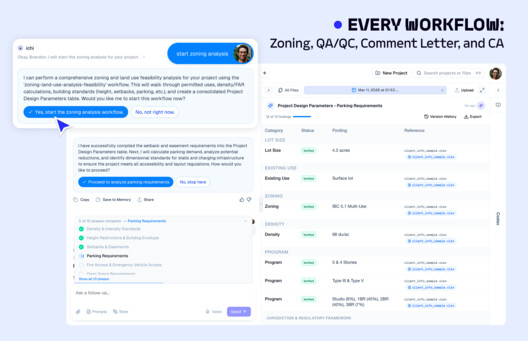
The implications of this shift extend beyond isolated tasks. Much of architectural work involves repetition: code research, zoning analysis, quality control reviews, and document verification. Through "agentic workflows," these processes can be structured into semi-automated sequences. The system performs an initial pass—reviewing documents, identifying inconsistencies, and flagging issues. Architects step in to validate decisions and resolve more complex conditions, but spend less time assembling the information needed to make them.
The impact becomes especially visible at scale. On large drawing sets, tasks such as sheet index reviews, which traditionally require hours of manual coordination, can be completed in a fraction of the time. In one example, a review process that typically took six hours was reduced to under one hour, while broader QA/QC coordination across a 500-sheet set significantly reduced the need for lengthy internal meetings. This shift suggests a transition from a labor-based model to one driven by leverage. Value is no longer defined primarily by the number of hours invested, but by how effectively knowledge is accessed, applied, and shared across the project.
Knowledge as a Business Asset
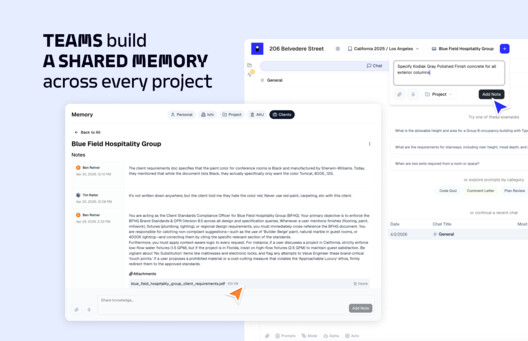
Institutional knowledge has historically been informal, held in conversations and personal memory. By structuring all this knowledge within a shared system, it becomes an operational asset. Teams can revisit how similar problems were resolved, access prior interpretations of regulations, and apply that reasoning to new contexts without interrupting colleagues.
At one practice, routine code-related questions that previously required external consultants were handled internally, reducing costs and improving consistency. Jurisdictional comments declined, resubmittals became less frequent, and teams were able to maintain greater control over both timelines and outcomes.
What the Next Decade Will Reward
What is changing is not only the introduction of new tools, but also how these technologies reshape the organization of work. Beyond improving existing workflows; AI is making it more difficult to sustain them in their current form. The firms that will define the next decade are not those that add AI to the edges of an unchanged practice, but those that rethink how knowledge flows across the entire lifecycle of a project—from early feasibility and code research to construction documentation and administration.
In this context, it's less about replacing what architects do and more about clearing the path for that work. Routine tasks can become more automated, practice shifts closer to its core: the ability to interpret constraints, synthesize information, and make decisions that shape the built environment. Architectural practice begins to operate through the strategic application of knowledge supported by systems that allow that knowledge to circulate, accumulate, and inform decisions at every stage of the process.