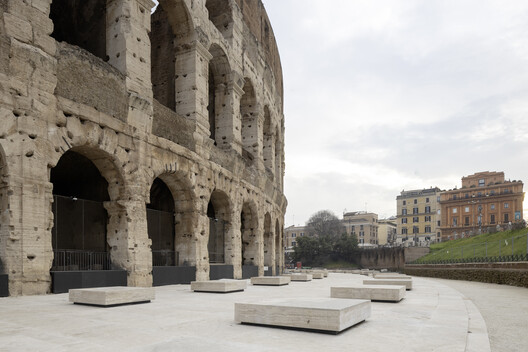
The southern ambulatory of the Colosseum in Rome has been restored through an intervention led by Stefano Boeri Interiors, a multidisciplinary studio founded by architects Stefano Boeri and Giorgio Donà, for the Parco Archeologico del Colosseo, focusing on the reconstruction of the crepidine and the repaving of missing sections to reinstate the monument's original ground levels and improve the legibility of its southern perimeter. The project builds on an archaeological investigation campaign that informed both the geometric definition of the intervention and its material articulation.
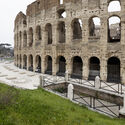
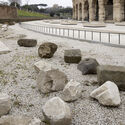
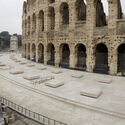
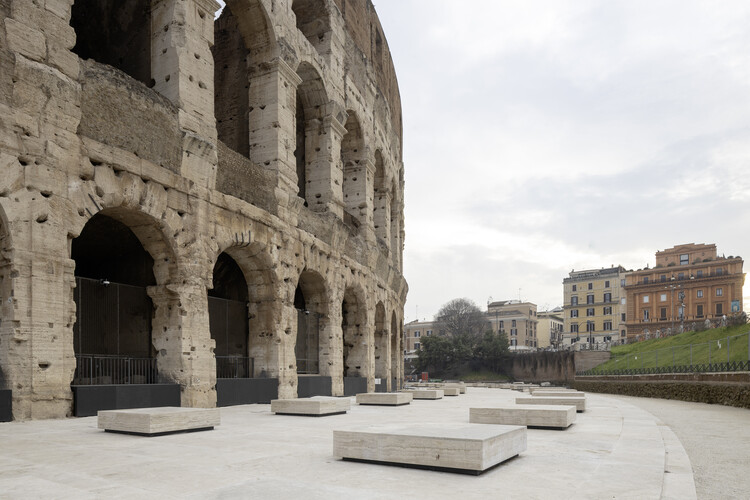
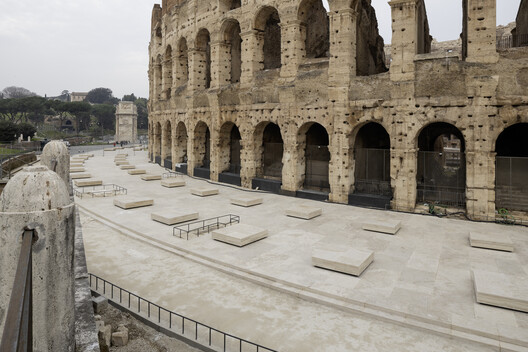
The works concentrate on the southern facade between arches 60-76 and 1-18, where the original crepidine, still visible on the northern side, had been lost, and reintroduce this double perimeter step through a controlled lowering of the surrounding piazza by approximately one meter, allowing the reemergence of its proportions and reestablishing the relationship between the amphitheatre and the adjacent public space. As noted by Stefano Boeri, the intervention "restored the perception of the monument's original scale and pavement level," while enabling visitors to approach the structure more directly and understand the sequence of the ambulatory and its arches. This recalibration of levels, based on archaeological findings and geometric studies, also enabled the reorganization of the stormwater drainage system, integrating surface slopes and transitions into the paving design while maintaining coherence with the monument's historical configuration. The project, therefore, combines spatial restoration with technical adjustments that respond to both the site's current conditions and its historical logic.
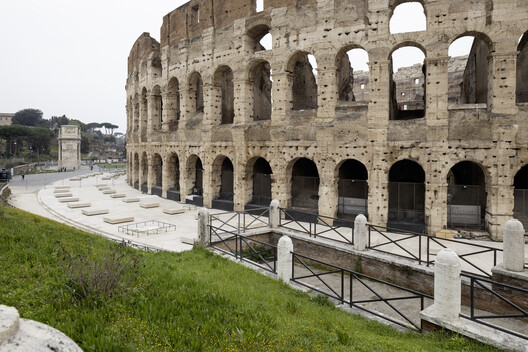
Extending across approximately 3,130 square meters, the new paving system interprets the Colosseum's radial geometry through a contemporary layout of trapezoidal travertine slabs, arranged in alternating bands that respond to the curvature of the crepidine while aligning with the axes of the arches to guide movement and reinforce spatial orientation. The surface incorporates regular modules alongside compensation strips to accommodate geometric variations, while the use of Classic Travertine ensures continuity with the material character of the monument and distinguishes the intervention from the surrounding cobblestone paving.
The project also introduces a series of integrated elements that trace the footprint of disappeared structures along the southern facade, combining raised components that function as seating with flush markers defined by textured finishes that indicate circulation paths without interrupting pedestrian flow. In parallel, the design ensures accessibility through the insertion of ramps at key points along the route, allowing visitors to navigate level differences introduced by the restoration while integrating these elements into the overall spatial configuration.
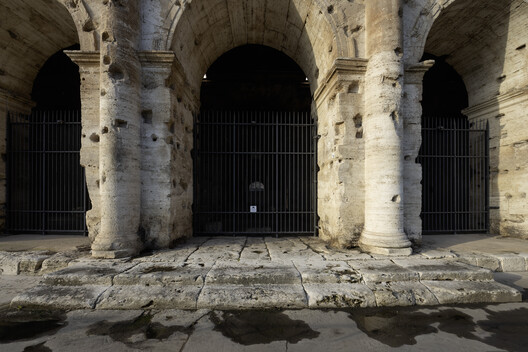
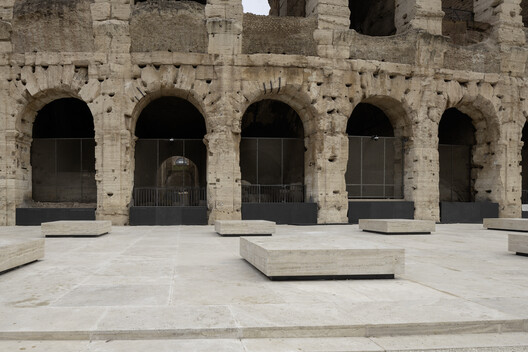
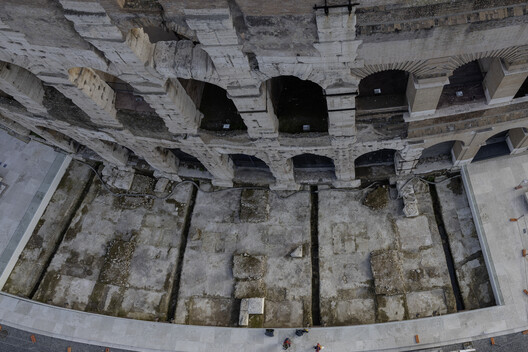
Between arches 65 and 71, the paving is interrupted to create an archaeological window that reveals the monument's foundations and stratifications, where the excavation perimeter is defined by tuff blocks and protected with metal profiles and glass railings, ensuring both visibility and reversibility. As Giorgio Donà explains, the intervention "restores the Colosseum's original levels and reconstructs its ancient base," while the abstraction of missing elements allows the former system of access routes to be understood. The intervention also reinstates the numbering of the arches along the southern facade, which had been lost following the collapse of the ambulatory, by engraving progressive numbers onto dedicated travertine slabs aligned with the entrances, based on references from the preserved northern side. The intervention restores the southern ambulatory as a continuous, accessible public space, where archaeological research and design strategies work together to clarify the Colosseum's original footprint and its relationship with the surrounding piazza.
In related developments in Roman architecture, David Chipperfield Architects has presented a proposal to restore and reinterpret a Roman theater in Brescia, Italy, blending conservation with contemporary design. Meanwhile, recent excavations in Fano have brought to light the basilica described by Vitruvius in De Architectura, a discovery of exceptional importance, as it stands as the only known structure that can be definitively attributed to the famed Roman architect.