Setbacks as Courtyards: How Civil Architecture Reimagines the Gulf House in Bahrain

Sponsored Content

For centuries, domestic architecture throughout the Gulf has been organized around the courtyard. Houses presented thick exterior walls and limited openings to the street, turning inward toward a shaded garden that structured everyday life. This spatial arrangement responded to both climate and culture. The courtyard brought daylight into deep plans, enabled cross-ventilation, and provided a protected outdoor environment within dense urban fabrics. In the House with Seven Gardens, in Diyar Al Muharraq, Bahrain, the Bahrain-based practice Civil Architecture, one of the winners of the ArchDaily 2025 Next Practices Awards, revisits this spatial tradition through the conditions of contemporary suburban housing. Rather than reproducing the courtyard house as a historical model, the project reinterprets its environmental logic within the regulatory frameworks and spatial conditions that shape much of today's urban development in the Gulf.

Setbacks as Courtyards: How Civil Architecture Reimagines the Gulf House in Bahrain - Image 2 of 8Setbacks as Courtyards: How Civil Architecture Reimagines the Gulf House in Bahrain - Image 3 of 8Setbacks as Courtyards: How Civil Architecture Reimagines the Gulf House in Bahrain - Image 4 of 8Setbacks as Courtyards: How Civil Architecture Reimagines the Gulf House in Bahrain - Image 5 of 8Setbacks as Courtyards: How Civil Architecture Reimagines the Gulf House in Bahrain - More Images+ 3

The project begins from a situation that has become familiar across many cities in the region. Large areas of contemporary housing are organized as suburban developments composed of detached villas. Unlike the compact urban quarters where traditional courtyard houses once emerged, these new neighborhoods are characterized by separated plots surrounded by mandatory setbacks. Each house stands apart from its neighbors, enclosed within its own parcel of land. While these regulations are intended to ensure privacy, access to daylight, and ventilation, they also create a particular spatial condition: the emergence of narrow strips of land surrounding each building that often remain unused or underutilized.

Setbacks as Courtyards: How Civil Architecture Reimagines the Gulf House in Bahrain - Image 4 of 8
House with Seven Gardens / Civil Architecture. Image Courtesy of Civil Architecture

Across many suburban districts in Bahrain, Saudi Arabia, and the United Arab Emirates, these peripheral spaces become residual zones. They separate houses but rarely contribute to domestic life. Instead of forming meaningful outdoor environments, they function primarily as regulatory distances between buildings. Civil Architecture approaches this condition, in the House with Seven Gardens, as an opportunity to recreate the setbacks from leftover spaces as the primary spatial structure of the house.


Related Article

20 Practices Shaping the Future of Architecture: Winners of the ArchDaily 2025 Next Practices Awards

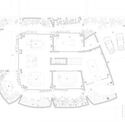
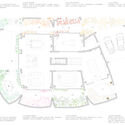
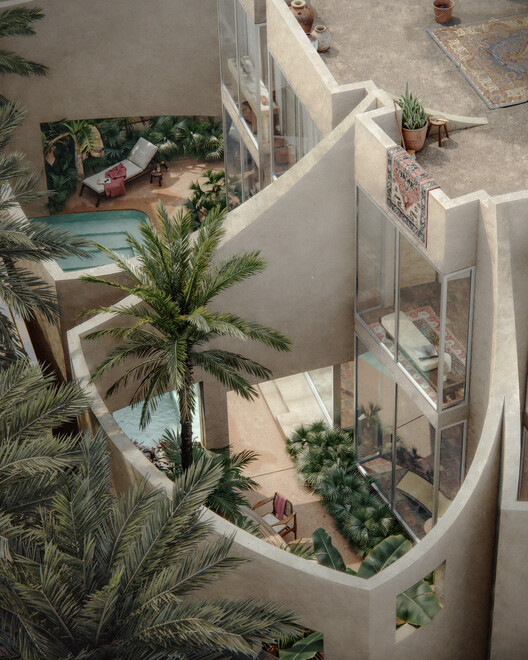
Rather than placing a single courtyard at the center of the plan, the project organizes the dwelling around a series of smaller gardens positioned along its edges. Seven planted courts occupy the setbacks surrounding the building, each directly associated with a particular room. Bedrooms, living areas, and circulation spaces open toward these gardens, allowing daylight and vegetation to enter the interior from multiple directions. In doing so, the project redistributes the environmental and spatial functions historically associated with the courtyard across the entire perimeter of the plot.

Setbacks as Courtyards: How Civil Architecture Reimagines the Gulf House in Bahrain - Image 3 of 8
House with Seven Gardens / Civil Architecture. Image Courtesy of Civil Architecture

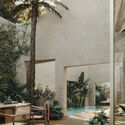
Moving through the house becomes a sequence of encounters with these outdoor spaces. Some gardens are narrow and intimate, others wider and more open, each offering different orientations and light conditions throughout the day. Windows frame planted courts at close distance, corridors run alongside vegetation, and moments of transition between interior and exterior occur gradually. Rather than concentrating outdoor life within a single central void, the house disperses landscape across the plan, allowing rooms to maintain their own relationship with light, air, and greenery.

Setbacks as Courtyards: How Civil Architecture Reimagines the Gulf House in Bahrain - Image 7 of 8
House with Seven Gardens / Civil Architecture. Image Courtesy of Civil Architecture

This redistribution of the courtyard also reflects broader shifts in contemporary domestic life. In traditional courtyard houses, everyday activities were organized around a shared central space that gathered the rhythms of the household. In the House with Seven Gardens, outdoor space becomes more fragmented and individualized. Each room maintains its own visual and spatial connection to the exterior, creating a series of smaller environments rather than a single collective center. The gardens operate simultaneously as environmental devices and as moments of privacy, mediating between interior spaces and the surrounding plot.

Setbacks as Courtyards: How Civil Architecture Reimagines the Gulf House in Bahrain - Image 5 of 8
House with Seven Gardens / Civil Architecture. Image Courtesy of Civil Architecture

From the street, however, the building maintains a restrained presence. The exterior envelope remains relatively closed, limiting direct visual connections with the public realm. This inward orientation continues a long-standing characteristic of domestic architecture in the Gulf, where privacy and climatic protection have historically shaped the relationship between house and city. Yet within the boundaries of the plot, the architecture gradually opens toward its gardens. Light filters through narrow outdoor rooms, planted courts introduce seasonal variation, and the boundaries between interior and exterior become subtly layered.

Setbacks as Courtyards: How Civil Architecture Reimagines the Gulf House in Bahrain - Image 2 of 8
House with Seven Gardens / Civil Architecture. Image Courtesy of Civil Architecture

The project also reveals something about the contemporary urban condition of the Gulf. The detached villa surrounded by setbacks is not a traditional urban form but the result of modern planning regulations introduced during the rapid urban expansion of the late twentieth century. As cities such as Manama, Doha, and Dubai expanded, planning systems borrowed from international suburban models reshaped residential landscapes across the region. While these frameworks established standardized plots and building distances, they also disrupted the spatial logic of the compact courtyard house that had historically organized domestic environments in Gulf settlements.

Setbacks as Courtyards: How Civil Architecture Reimagines the Gulf House in Bahrain - Image 8 of 8
House with Seven Gardens / Civil Architecture. Image Courtesy of Civil Architecture

Within this context, the House with Seven Gardens can be understood as a typological adjustment rather than a nostalgic return to historical forms, as the project does not attempt to reconstruct the courtyard house within a suburban plot. Instead, it examines how the environmental intelligence of the courtyard can be redistributed across the fragmented spatial structure produced by contemporary planning rules, transforming regulatory voids into inhabitable outdoor rooms that participate actively in the spatial organization of the house.

This approach reflects a broader line of inquiry present throughout Civil Architecture's work. The practice has consistently explored how architecture in the Gulf can engage with the region's climatic and cultural conditions while operating within the realities of contemporary development. In the House with Seven Gardens, this investigation appears through a relatively simple but precise architectural gesture. The project recognizes that the courtyard, long understood as the defining element of domestic architecture in the Gulf, has not entirely disappeared under contemporary suburban planning. Instead, it has been displaced. The result is a house where climate, landscape, and domestic life remain intertwined, not through the reconstruction of a traditional model, but through its careful adaptation to the conditions of the contemporary Gulf city.

This article is presented by Buildner. As sponsor of ArchDaily's 2025 Next Practices Awards, Buildner—the world's leading architecture competition organizer—helps architects get what they enter competitions for: recognition, opportunity, and progress.

Exercise your creativity now: the Buildner UNBUILT Award 2026 is open to all, with a €100,000 prize fund. Submit your unrealized designs and celebrate your creativity now

Image gallery

See allShow less
About this author
Cite: Diogo Borges Ferreira. "Setbacks as Courtyards: How Civil Architecture Reimagines the Gulf House in Bahrain" 11 Mar 2026. ArchDaily. Accessed . <https://www.archdaily.com/1039457/setbacks-as-courtyards-how-civil-architecture-reimagines-the-gulf-house-in-bahrain> ISSN 0719-8884

You've started following your first account!

Did you know?

You'll now receive updates based on what you follow! Personalize your stream and start following your favorite authors, offices and users.