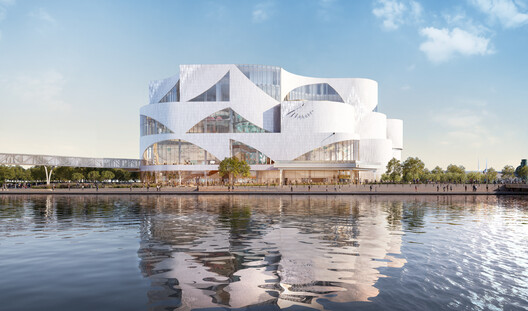
Hariri Pontarini Architects and Snøhetta have been selected to design the new Ontario Science Centre in Toronto. Announced in February 2026, the 400,000-square-foot facility will anchor the site's ongoing transformation through a 220,000-square-foot building defined by a series of scalloped, modular volumes. A central component of the proposal is the physical integration of the existing Pods and the historic Cinesphere via elevated connections and a continuous public promenade. Construction is expected to begin in Spring 2026, with completion anticipated in 2029 as part of a broader waterfront redevelopment strategy.

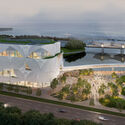
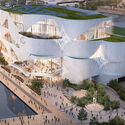
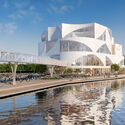
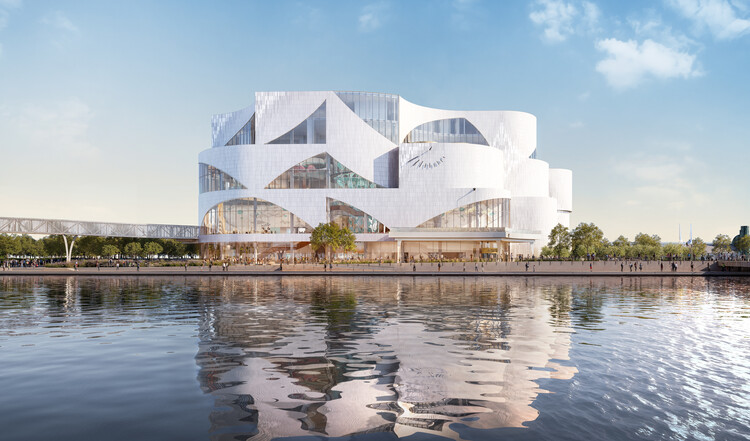
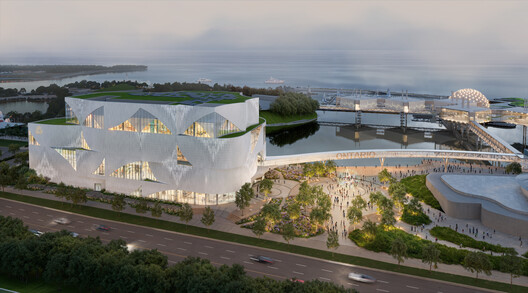
Positioned on the mainland of Ontario Place, the new Science Centre is conceived as a cultural anchor within the province's long-term vision to reimagine the site as a year-round destination. The architectural proposal organizes new construction and heritage structures into a cohesive campus, establishing visual and physical connections between the city and Lake Ontario. By consolidating the five existing Pods, the Cinesphere, and the new building into a unified spatial framework, the design reinforces the waterfront's civic identity while reinterpreting Ontario Place's original ambition as a landscape for public learning, innovation, and recreation.
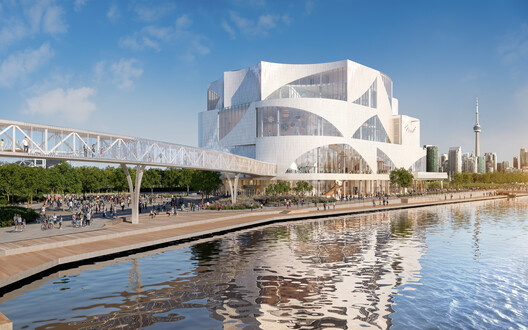
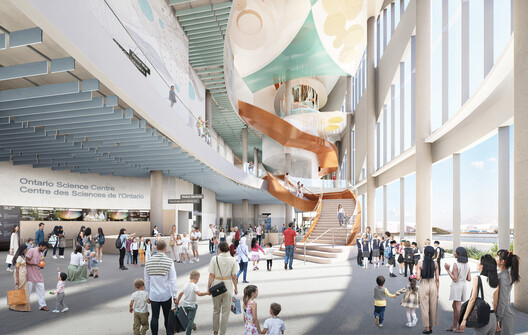
As described by the architects, the concept draws on the metaphor of constellations, using celestial patterns as an organizing principle to connect the project's multiple components. Program elements are conceived as a series of "molecules" or modules that cluster to form immersive interior and exterior environments. This strategy translates into a massing composition articulated by scalloped and arced silhouettes, creating a rhythmic envelope that modulates scale, frames views toward the lake and skyline, and establishes a distinct architectural presence along the shoreline.
Related Article
The 12th Edition of Toronto’s Winter Stations Reveals Images of Five Winning ProjectsInternally, circulation is envisioned as an experiential sequence that makes scientific exploration visible and participatory. Vertical and horizontal pathways weave through exhibition halls, immersive installations, and educational spaces, encouraging overlap between programming and public movement. Transparency across levels fosters orientation and visual continuity, while moments of compression and expansion articulate the galleries. Through this emphasis on connectivity, the architecture aligns spatial organization with the institution's mission to spark curiosity and discovery.
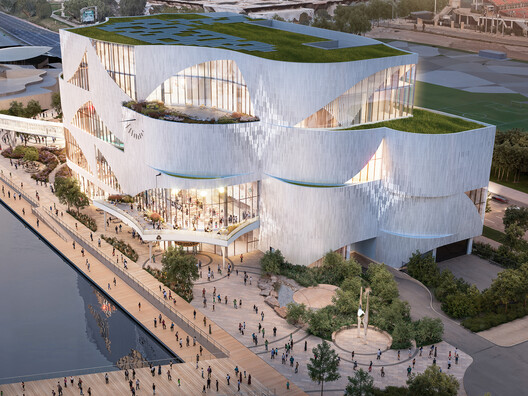
The surrounding public realm extends the architectural concept outward through landscaped plazas, pathways, and ecological interventions that stitch the Science Centre into the broader grounds of Ontario Place. Designed to accommodate both everyday use and large-scale cultural events, these spaces reinforce the waterfront as an accessible civic landscape. The project is being delivered by Infrastructure Ontario in partnership with the Ministry of Tourism, Culture and Gaming, following an open procurement process initiated in 2024, and is targeting high standards in energy performance and environmental sustainability.
Other recent global projects include Manresa Wilds, a 125-acre waterfront park on a former power plant peninsula along Long Island Sound in Norwalk, U.S., developed with SCAPE and BIG to transform a polluted industrial shoreline into an accessible coastal landscape. In Poland, Kengo Kuma and Associates won first prize to design a new library in Rzeszów, the capital of the Subcarpathian Voivodeship. In India, BDP, Cox Architecture, and Collage Design revealed the master plan for the 350-acre Sardar Vallabhbhai Patel Sports Enclave in Ahmedabad, centered on the 132,000-seat Narendra Modi Stadium.