

Architecture has traditionally been described as a discipline concerned with space, form, and material presence. Yet this understanding becomes increasingly limited when confronted with the conditions that shape contemporary construction. Buildings no longer emerge from a stable relationship between site, program, and material. Instead, they are produced within a dense web of technological systems that operate across territorial, ecological, and temporal scales. Energy networks, data infrastructures, extraction processes, and global logistics shape architecture as decisively as climate or urban context.
Seen from this angle, architecture is less a discrete object than a moment within a larger technical field. Supply chains, data systems, automated maintenance, and energy grids do not sit "behind" the built environment. In a certain way, they influence what can be built, what is affordable, how buildings perform over time, and what kinds of waste they produce. When architecture is assessed primarily through form, it risks overlooking the systems that condition its production and afterlife.



It is within this expanded field that geologist Peter Haff proposed the term technosphere, describing the growing envelope of human-made matter and systems on Earth. For architecture, this is less a new topic than a sharper name for the ground it already occupies. It shifts the discipline from designing objects in space to operating within interdependent systems that bind technology, ecology, and human life together.
From Autonomy to the Systemic
Throughout much of the twentieth century, architectural discourse was shaped by the notion of autonomy. Even when responding to social, political, or environmental concerns, buildings were often conceived as bounded entities, capable of internal coherence and disciplinary intent. Architecture could engage with context, but it was still commonly understood as something that stood apart from the systems that enabled it. That stance becomes harder to sustain once architecture is read as part of a continuous technical field.

It is precisely this condition that geologist Peter Haff sought to describe with the concept of the technosphere. Unlike earlier accounts of technology as a tool controlled by human intention, Haff defines the technosphere as a self-organising system composed of infrastructures, machines, energy flows, and material networks that sustain contemporary life. What distinguishes this system is not its scale alone, but its relative autonomy from direct human control. While human actions initiate and maintain it, the system as a whole follows technical, energetic, and economic logics that constrain those very actions. Power grids must remain active, supply chains must keep moving, and data infrastructures must be continuously cooled, updated, and secured. Once established, these systems demand their own continuity, often regardless of social intention or ecological consequence. In this sense, the technosphere behaves less like an instrument and more like a condition of existence.
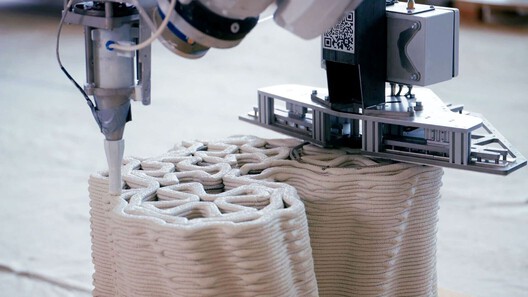
This perspective challenges long-standing assumptions about agency, responsibility, and design. If the technosphere operates as a system that exceeds individual control, then architecture cannot be understood as an isolated act of authorship acting upon a passive environment. Instead, architectural projects become moments of negotiation within a larger technical ecology, shaped as much by infrastructural dependency and systemic inertia as by design intention. Haff's contribution lies in making this dependency explicit, framing the built environment not as a collection of autonomous objects, but as a structural component of a planetary technical system that both enables and constrains how architecture can act.
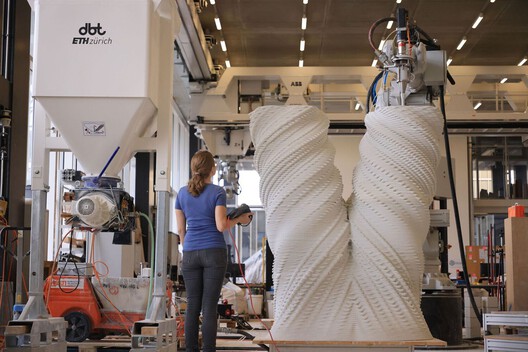
Seen through the lens, architecture no longer marks a clear boundary between nature and technology, or between human intention and mechanical process. Instead, it occupies a position within a dense field of interdependencies, where material choices, energy performance, and digital management are inseparable from planetary systems. Contemporary buildings depend on extended supply chains, global material extraction, and energy infrastructures that operate far beyond their immediate context. Digital technologies intensify this entanglement. Design, construction, and operation are mediated by software platforms, databases, and automated systems that reorganise architectural labour and redistribute responsibility. A building today is not only a physical structure but also a node within informational and logistical networks that precede its construction and persist long after completion.
The Tangible Aspects
If the technosphere operates as a planetary system, its most immediate evidence is material. The built environment concentrates vast quantities of matter into stable forms: concrete, steel, glass, plastics, composites, and an increasing amount of digital hardware embedded within buildings. Together, this accumulated mass now rivals the planet's living biomass, marking a shift in which human-made materials have become a geological presence. Architecture plays a direct role in this condition, not as a byproduct, but as one of its primary agents.
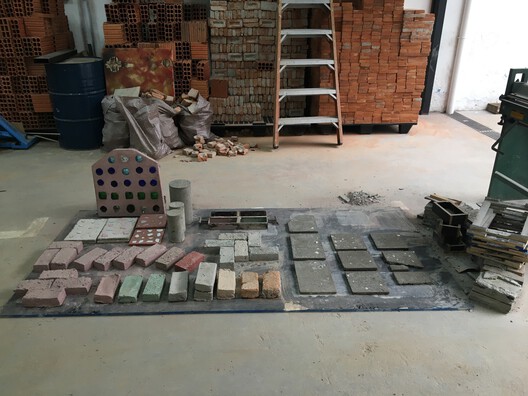
Despite this scale, architectural materiality is often discussed in relative isolation. Materials are typically framed through performance, aesthetics, or constructability, while the systems that make their use possible remain abstract or external. The technosphere disrupts this separation. Every material choice activates extended chains of extraction, processing, transportation, and waste, linking architectural projects to landscapes and labour far removed from the building site. What appears as a local assembly is, in fact, the spatial condensation of planetary processes.
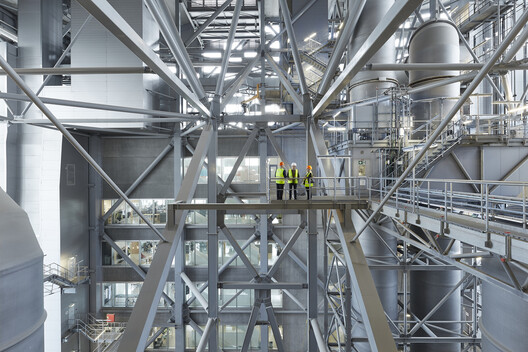
Seen from this perspective, materials cannot be understood as neutral components. They carry embedded energy, carbon, and labour histories that continue to unfold over time. Concrete locks in emissions long after construction, metals circulate through cycles of extraction and reuse, and digital components rely on rare materials tied to fragile geopolitical and ecological contexts. Architecture becomes a point of fixation within these flows, transforming mobile resources into durable technical artefacts.
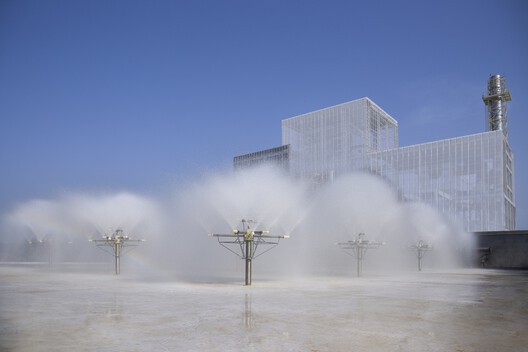
The question is no longer only how materials perform within a building, but how they participate in broader material cycles. Architecture does not simply consume matter; it reorganises it, stabilising certain processes while accelerating others. In doing so, buildings translate distant ecological impacts into localised spatial conditions, making the technosphere tangible.
The invisible aspects
Much of the technosphere operates through architectures that remain largely absent from architectural discourse. Data centres, cable landing stations, logistics hubs, ports, distribution warehouses, energy substations, and the territorial corridors that connect them form the spatial backbone of contemporary life. These environments support digital communication, stabilise financial transactions, coordinate supply, and keep energy and goods circulating. Yet they remain largely absent from architectural discourse, not because they lack spatial qualities, but because they are typically treated as technical necessities rather than designed environments.
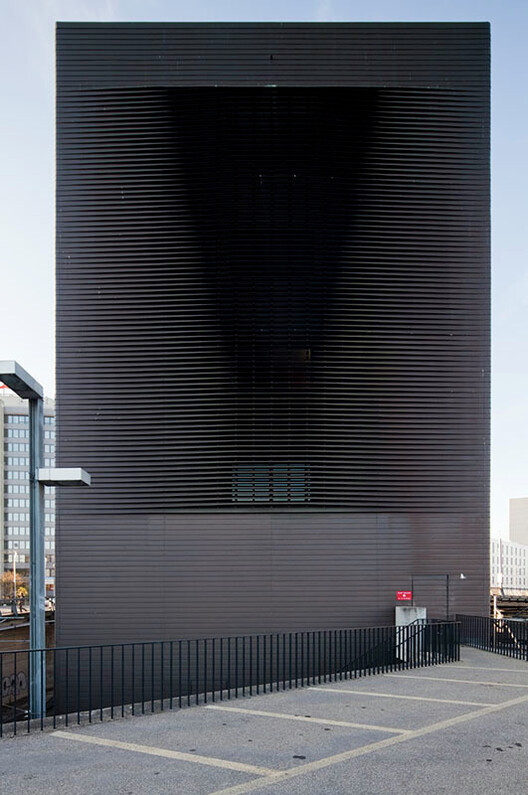
This invisibility reflects a persistent separation between architecture and infrastructure, in which technical systems are treated as a neutral background rather than as spatial and political constructs. As these systems expand, consuming land, water, and energy, their architectural dimension becomes increasingly difficult to ignore. Many of these facilities are physically concealed, located at the edges of metropolitan areas, inside industrial zones, or in remote landscapes where land is available, and regulation is permissive. Others are hidden in plain sight, designed to read as anonymous boxes, fenced perimeters, or infrastructural leftovers. Even when they are prominent (massive halls, cooling systems, security envelopes, road networks), they rarely become part of public architectural literacy.
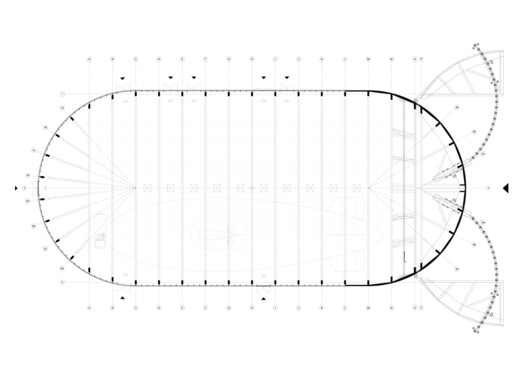
This condition reflects a long-standing separation between architecture and infrastructure, where technical systems are framed as a neutral background. They consume land, water, and energy; they produce heat, noise, light, and traffic; they require security regimes and exclusion zones; they reorganise territories through corridors, easements, and logistical time. Their footprints often appear not as singular objects, but as distributed fields (routes, nodes, redundancies) whose spatial logic is defined by efficiency, risk management, and operational continuity.
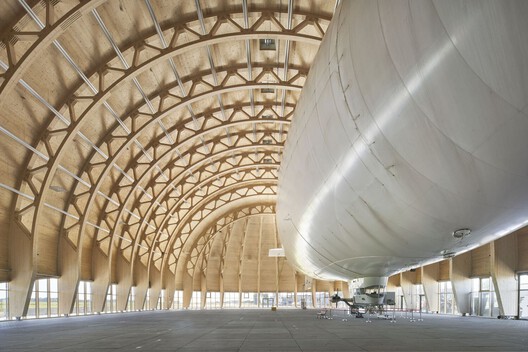
For architects, this raises questions of agency and responsibility. Engaging with the technosphere does not necessarily mean designing more infrastructure, but rather acknowledging how architectural projects depend on and contribute to these systems. Architecture can act as a mediator that renders technological processes visible, legible, and spatially meaningful, rather than allowing them to operate entirely outside the disciplinary field.
Ethics at a Planetary Scale
Designing within the technosphere inevitably expands the ethical horizon of architectural practice. Decisions taken at the scale of a building are no longer confined to a site or a moment in time. Choices related to energy performance, material sourcing, construction systems, or digital tools are embedded in global processes of extraction, production, logistics, and waste. What appears local in form is often distributed in impact, unfolding across territories and over decades.
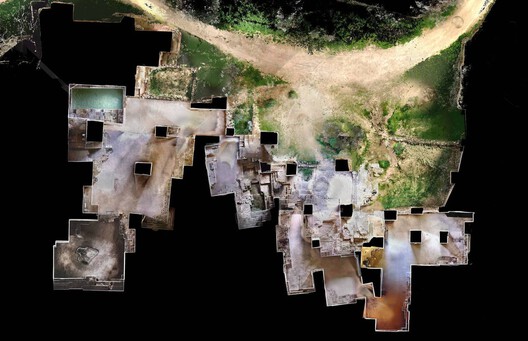
Architecture alone cannot redirect the technosphere toward more responsible futures, nor can it claim control over systems that exceed disciplinary boundaries. Yet recognising architecture as an integral component of a planetary technical system sharpens what responsibility can mean. Ethical engagement shifts away from symbolic gestures and isolated fixes, toward decisions that acknowledge constraint, interdependence, and delayed consequence—toward a practice that treats impact as something that happens elsewhere, and often later.
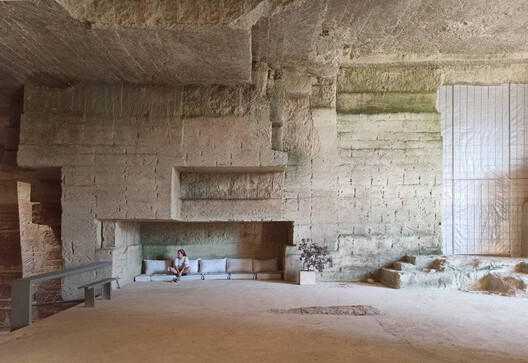
The technosphere does not present itself as a single object or a clearly defined system. It is encountered through effects: accelerated construction cycles, intensified resource consumption, digital mediation, and ecological pressure. Architecture is implicated in these conditions, but it also provides one of the few places where they can be read as space. Buildings make abstract dependencies tangible. They translate energy regimes into comfort, logistical systems into availability, and data infrastructures into daily routines. In that sense, architecture is not only within the technosphere; it is one of the ways the technosphere becomes inhabitable.
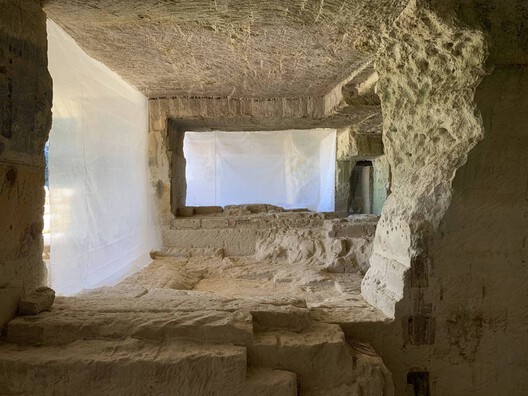
What follows is not a new style or a new toolbox, but a change in how architectural problems are framed. If the ground of design is no longer only the site, but a mesh of material and technical relations that stretches across territories, then "context" expands beyond the immediate surroundings. The relevant question becomes less how architecture can stand apart from these systems, and more what forms of spatial intelligence can operate inside them.
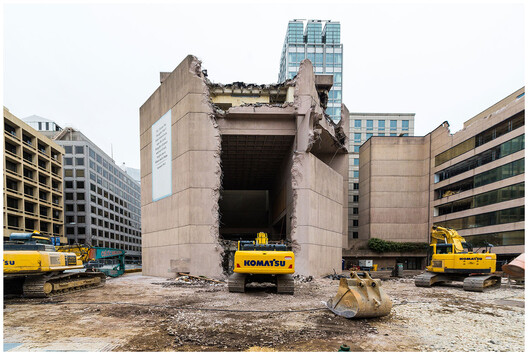
The technosphere is often described through its scale, its weight, its networks, and its reach. Architecture might approach it differently, through thresholds, interfaces, and everyday life: the moments where planetary systems touch the body, the home, the street, the workplace. In that shift of scale lies a possibility that remains open; not the promise of control, but the chance to rethink what counts as architectural agency when the world we build is also the world that builds back.
This article is part of the ArchDaily Topic: The Technosphere: Architecture at the Intersection of Technology, Ecology, and Planetary Systems. Every month we explore a topic in-depth through articles, interviews, news, and architecture projects. We invite you to learn more about our ArchDaily Topics. And, as always, at ArchDaily we welcome the contributions of our readers; if you want to submit an article or project, contact us.


