First Aid for Endangered Heritage: An Interview with Ambulance for Monuments

Sponsored Content

Ambulance for Monuments is a first-aid initiative dedicated to safeguarding Romania's endangered built heritage, operating in a race against time to prevent collapse and irreversible loss. The project responds to the growing vulnerability of historic structures, from Saxon fortified churches and manor houses to wooden churches and rural landmarks, many of which no longer benefit from the community networks that once sustained them. In a country deeply affected by emigration since 1990, where nearly half the population still lives in rural areas, entire villages have lost the people, skills, and everyday care that once kept these monuments standing.

Built around a mobile intervention unit, an "Ambulance" equipped with tools, scaffolding, and on-site equipment, the initiative delivers urgent stabilization works that buy time for endangered buildings. Rather than replacing full restoration, these strategic interventions preserve historic fabric, ensure structural safety, and keep long-term conservation and adaptive reuse possible. 
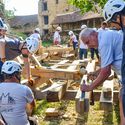
First Aid for Endangered Heritage: An Interview with Ambulance for Monuments - Image 2 of 20First Aid for Endangered Heritage: An Interview with Ambulance for Monuments - Image 3 of 20First Aid for Endangered Heritage: An Interview with Ambulance for Monuments - Image 4 of 20First Aid for Endangered Heritage: An Interview with Ambulance for Monuments - Image 5 of 20First Aid for Endangered Heritage: An Interview with Ambulance for Monuments - More Images+ 15

In recognition of its impactful and context-driven approach, Ambulance for Monuments was selected as one of the winners of the ArchDaily 2025 Next Practices Awards, highlighting how a locally grounded, hands-on model can generate international relevance and inspire new forms of heritage stewardship. In this interview, the team reflects on the origins of the "ambulance" metaphor, their collaborative work with local communities, and the training of future professionals through hands-on programs such as AmbuLab.


Related Article

20 Practices Shaping the Future of Architecture: Winners of the ArchDaily 2025 Next Practices Awards

First Aid for Endangered Heritage: An Interview with Ambulance for Monuments - Image 6 of 20
Roades – volunteers and sponsors group photo on site. © Asociatia Monumentum

Camilla Ghisleni (ArchDaily): The metaphor of the "ambulance" applied to heritage is extremely powerful. What inspired the idea of treating historical monuments as "patients" in need of first aid, and how did this analogy with medical services shape the conception of the project's emergency interventions?

Ambulance for Monuments: Indeed, the Ambulance for Monuments takes inspiration from medical emergency care. We focus on stabilizing the "patient" and saving what can still be saved. In Romania, many listed historic buildings are deteriorating, while there are too few specialized experts and craftsmen available to intervene properly. In this context, the priority is urgent care rather than full restoration.

The conservation principles are inspired by operations on human bodies: compatibility (new construction materials need to be compatible with the "existing" body), minimal intervention (as little as possible should be cut out from the malignant parts), and reversibility (new interventions need to be reversible over time, whenever needed). The Ambulance works to "rescue" as much as possible with minimal funds, typically by stopping leaks and rainwater penetration, securing roofs, stabilizing walls and paintings, and preventing further loss of historic fabric.

The point is simple: to keep these buildings standing long enough so future generations can continue their full conservation and adaptively reuse them, not only with ruins and archaeology.

First Aid for Endangered Heritage: An Interview with Ambulance for Monuments - Image 7 of 20
Surduc Church – interior painted vault collapse © Asociatia Monumentum

CG: Ambulance for Monuments operates through a collaborative network of organizations and volunteers. How does the project's working methodology — involving professionals, students, craftsmen, and local communities — redefine the role of the architect in heritage preservation?

AM: The recipe which made this model work and scale up at national level refers to the most efficient distribution of tasks among the four actors that should contribute to the preservation of built heritage according to their competences and potential. The community offers housing and food. The owner or the local administration supports most of the costs for construction materials. Experts research the buildings and do the conservation design. The NGO manages the logistics and coordinates these three actors.

First Aid for Endangered Heritage: An Interview with Ambulance for Monuments - Image 2 of 20
Roades – site demonstration (hands-on training moment) © Andrei Paul

From my perspective as a heritage architect, this field requires a different approach from the "classic" architect role taught in school. Soft skills are central: speaking to community members who are emotionally attached to a monument, negotiating with local officials who operate in a political context, engaging the relevant authorities, and communicating the work publicly, including through media. Heritage practice asks for a high level of creativity and emotional intelligence, not only because of legal constraints, but because constraints redirect creativity into strategy and collaboration. This is also why volunteers and coordinators are often provoked to step beyond their comfort zone; the work demands initiative, adaptability, and responsibility in real conditions. Predesign from the office shows its limits when it comes to conservation. The architect needs to be permanently on site and to provide details and solutions in real time, according to new findings.

First Aid for Endangered Heritage: An Interview with Ambulance for Monuments - Image 14 of 20
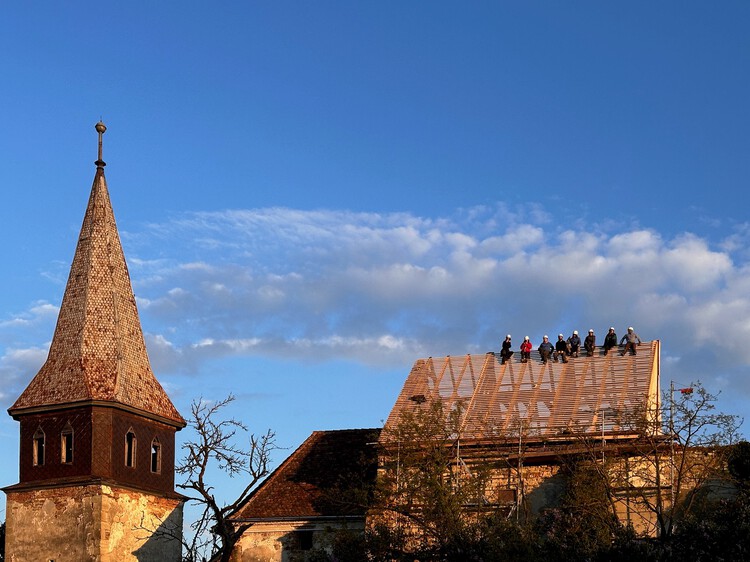
Sighisoara – finial mounted on the tower © Asociatia Monumentum

CG: In what ways does Ambulance for Monuments contribute to the education and training of new generations of restoration professionals — and how does this translate into more sustainable architectural practices?

AM: The Ambulance develops a dedicated program called AmbuLab for training future professionals through hands-on, non-formal education embedded in real emergency interventions. Each participant receives a dedicated notebook in which the main tools are explained. Their work and evolution are evaluated based on the main workshops offered by the Ambulance: masonry, carpentry, roofing, tinsmithing, etc. Each year, a volunteer registration platform opens in March for 15–20 working sites, bringing together more than 600 students and young professionals who want practical experience beyond what universities typically provide. Most volunteers come from architecture, restoration, urban planning, engineering, archaeology, history, and cultural tourism.

First Aid for Endangered Heritage: An Interview with Ambulance for Monuments - Image 18 of 20
Volunteer notebook – site sketches and measured details © Asociatia Monumentum

On site, volunteers work alongside craftsmen and specialists from complementary fields. They learn the stages of an intervention, meet the community that owns the monument, and execute joints or details that would otherwise remain purely theoretical. This interdisciplinary setting also builds soft skills and meta-competences. Project management and fundraising are included, and these skills are needed for future coordinators and leaders. After several years, some former volunteers have moved into project management and coordination roles within the heritage ecosystem.

This training translates into more sustainable architectural practice by strengthening capacity to extend the life of existing buildings, and by rebuilding collaboration between key actors: architects, craftsmen, communities, researchers, and decision-makers. This helps ensure solutions are realistic and grounded in materials, skills, local resources, environmental impact, and cost–benefit balance.

First Aid for Endangered Heritage: An Interview with Ambulance for Monuments - Image 19 of 20
Sighisoara – volunteer on the scaffold (work gear and harness) © Asociatia Monumentum

CG: The active participation of local communities is another central aspect of the project. How do you see the role of architecture as a tool for social engagement and the reactivation of local identities?

AM: Architecture becomes a tool for social engagement when it is treated less as an object to admire and more as a shared responsibility. In the Ambulance for Monuments, the local community is the main steward of heritage, because maintenance and daily care will always stay with the people who live next to the building.

That is why we work mainly on public buildings: they naturally belong to many, not to one. On site, mayors, priests, local councillors, and other community members have literally picked up tools and worked alongside craftsmen and volunteers in a race against time to prevent further loss. This hands-on involvement shifts the monument from "someone else's problem" to "our place", and that change often reactivates local identity, cultural confidence, and self-worth.

First Aid for Endangered Heritage: An Interview with Ambulance for Monuments - Image 5 of 20
Fagaras – community event after synagogue roof work © Asociatia Monumentum

A community-impact research study carried out between 2022 and 2024 looked at over 80 communities. It offers a complex picture of the project mechanism, combining quantitative methods, qualitative research, and social network analysis to highlight the impact of Ambulance for Monuments on local civic life, trust, and community cohesion. The results show that, although the interventions are primarily technical, the project's social effects are profound and long-lasting. At the same time, the study indicates that the confidence communities gain after an intervention needs long-term support to translate into lasting care, conservation, and adaptive reuse. Our next step is to extend this support through a consultancy office for community members and deeper work with children, so stewardship becomes a habit and a local skill, not a one-time event.

CG: Many of the monuments you rescue are in an advanced state of degradation, often visible as ruins or abandoned structures. How does the atmosphere of these places — shaped by time, silence, and deterioration — influence the way you interpret architecture? And what reflections does this provoke about our own relationship with time, forgetting, and collective memory?

AM: Many of the places we reach are already beyond the usual "building" stage. They sit somewhere between architecture and absence: roofs gone, walls opened, vegetation reclaiming corners, and long periods with no human voice. In that atmosphere, heritage principles matter more than ever: act minimally, respect authenticity, and keep interventions compatible with what survives. Each site demands its own approach, because decay, meaning, and community ties are never identical.

First Aid for Endangered Heritage: An Interview with Ambulance for Monuments - Image 20 of 20
Sighisoara – volunteer portrait on site (work setting in the background) © Asociatia Monumentum

A ruin is not a failure of design; it is a record of centuries. It teaches a different kind of precision: to respect fragments, to understand that a small consolidation can protect a whole story, and to accept that sometimes the most responsible act is simply to keep the place legible, so it can still be understood by others after us. 

This is especially clear at the Dacian fortress in Costești, a UNESCO World Heritage site, where we built a protection cover over the ancient remains. The same logic applies in very different contexts: a WWII-bombed church in Iași County, an iron-melting furnace, or a church standing alone in the fields after the village relocated decades ago when it was not provided with electricity. Access is difficult, yet people still go there and leave prayers. It functions as a place of pilgrimage even in near-abandonment. These sites carry historical and cultural value, but they can also hold spiritual value.

Beyond personal memory, such places carry collective memory: the kind that anchors people in who they are and where they belong. When they disappear, forgetting becomes easy. When they remain, even as ruins, they remind us that time is not neutral.

First Aid for Endangered Heritage: An Interview with Ambulance for Monuments - Image 16 of 20
Hinchiris – industrial climber working at height © Asociatia Laborator Zero Pozitiv

CG: How does the project balance the urgency of interventions (first aid) with long-term conservation strategies, especially in rural contexts with limited resources? Have you established any post-project strategies aimed at conserving these restored buildings so that, in 20 or 30 years, they will not need to be rescued again?

AM: Balancing first aid with long-term conservation starts with a clear goal: our best outcome is to lower the need for emergency interventions gradually to an acceptable level, though it will never completely disappear. In rural contexts with limited resources, we treat the on-site work as a stabilization phase and, at the same time, as a transfer of responsibility. After the intervention, we guide, with limited resources, the owner and the community in the process towards complete conservation and reuse of the site. Often, we suggest possible funding applications for complex design and research projects, so major conservation works can be continued in partnership with the Ambulance. In a few cases, we provided information about competent experts who should be involved in continuing the work. In others, we helped solve property papers so they can obtain legal permits to carry out more complex works.

First Aid for Endangered Heritage: An Interview with Ambulance for Monuments - Image 8 of 20
Children learning about architecture (community education) © Asociatia Arhaic

We already have positive examples where post-intervention follow-through happened. A fortified house in Southern Romania was fully restored by the local authority and transformed into a local museum. In another case, an abandoned synagogue where we repaired the roof was partially restored and its courtyard arranged for public events. These outcomes matter because a building that is used and cared for locally is far less likely to slide back into crisis. In the last two years, we piloted a project on heritage education with children from the communities we worked in, aiming to build a more responsible and aware future generation of adults when historic buildings start decaying again. The project is called AmbuKids and was implemented in more than 20 villages.

CG: In Brazil, where I am speaking from, and more broadly across Latin America, many listed or protected buildings are privately owned. In several cases, owners show little interest in preserving them, allowing them to deteriorate to the point of ruin as a strategy to enable new construction. In light of this scenario, what advice would you give to Latin American architects and urban planners who wish to work in heritage preservation, even when facing such adverse conditions?

AM: This is common in many countries, including Romania. When heritage is valued only for tourism income, it is rarely seen as beneficial to the community or the owner, largely because wide-scale education in this field is missing.

That is why we see the architect's role as more than desk-based design. It also has activist value: helping educate the public about the quality of space, heritage, and aesthetics. Architects are often the first to recognise a building's intrinsic value, and they must learn how to convey that value properly.

If an owner understands what their building means for a neighbourhood, street, town, or region, their self-esteem and sense of belonging can grow and that can translate into a greater willingness to invest in conservation. At the same time, communities need to understand that beyond legal ownership, they are the moral custodians of their town's built heritage and have a responsibility to contribute to its preservation. Events around a building help, too: the more locals and tourists talk about a privately owned building, the more likely the owner is to care for it and invest in it.

First Aid for Endangered Heritage: An Interview with Ambulance for Monuments - Image 4 of 20
Domnesti Church shingles mounting © Asociatia Monumentum

Finally, support from public funding could help cover the extra costs caused by scarce specialists and craftspeople, limited appropriate materials, and regulatory requirements, which would give the heritage a better chance to be kept in use.

This article is presented by Buildner. As sponsor of ArchDaily's 2025 Next Practices Awards, Buildner—the world's leading architecture competition organizer—helps architects get what they enter competitions for: recognition, opportunity, and progress.

Exercise your creativity now: the Buildner UNBUILT Award 2026 is open to all, with a €100,000 prize fund. Submit your unrealized designs and celebrate your creativity now.


Related Article

20 Practices Shaping the Future of Architecture: Winners of the ArchDaily 2025 Next Practices Awards

Image gallery

See allShow less
About this author
Cite: Camilla Ghisleni. "First Aid for Endangered Heritage: An Interview with Ambulance for Monuments" 23 Mar 2026. ArchDaily. Accessed . <https://www.archdaily.com/1039254/first-aid-for-endangered-heritage-an-interview-with-ambulance-for-monuments> ISSN 0719-8884

More interviews from ourYouTube Channel

You've started following your first account!

Did you know?

You'll now receive updates based on what you follow! Personalize your stream and start following your favorite authors, offices and users.