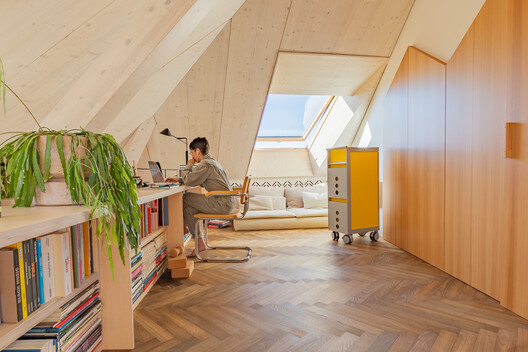
If we ask a child to draw a house, a triangular silhouette will almost certainly appear, with two sloped planes meeting at a ridge. Few architectural forms are as universally recognizable as the pitched-roof house. From a semiotic perspective, this elemental image functions as a condensed sign of shelter that, in just a few traces, synthesizes protection, interiority, and belonging. What we now read as a universal symbol, however, emerged from a concrete necessity. From Alpine chalets shedding snow to Mediterranean roof tiles mitigating summer heat, the slope responded to climate and construction challenges long before it became an aesthetic code.
Although modern architecture has favored horizontal planes and orthogonal plans, the pitched roof requires a project to be conceived in section. Its angle allows for efficient use of the volume beneath the roof and introduces variations in height, spatial compression, and expansion. When openings are incorporated into this plane, the condition intensifies. Unlike vertical windows, which capture lateral light, roof apertures receive a larger portion of the visible sky and significantly higher luminance than the horizon, offering up to three times more light than vertical glazing on overcast days.

This condition explains the superior performance indicated by simulations based on the Daylight Factor, an indicator that relates interior illuminance to the diffuse light available outdoors. Top lighting tends to penetrate more deeply into the floor plan and to distribute more evenly, reducing contrast and dependence on artificial lighting. While it is not difficult to perceive whether a space feels bright or dim, the European standard EN 17037 reinforces this approach by establishing verifiable criteria for daylighting, considering four dimensions: the amount of light indoors, quality of view, access to direct sunlight, and prevention of glare.
Regarding quantity, specific illuminance levels, measured in lux, must be achieved across at least half of the usable floor area. For residential buildings, the reference thresholds are 300 lux (minimum), 500 lux (medium), and 750 lux (high). The standard also recommends that 100 lux be reached across 95% of the area for at least half of the daylight hours throughout the year, avoiding persistently underlit zones and promoting greater visual comfort. Expanding the visible portion of the sky through roof windows also helps meet these criteria, especially in urban contexts with lateral obstructions. When properly oriented, these openings can ensure periods of direct sunlight ranging from 1.5 to 4 hours on clear days at the end of winter, contributing to environmental comfort and passive heat gains even during seasons with limited daylight. Naturally, greater daylight admission requires control of glare and overheating. The geometry of the pitched roof itself, through light shaft depth, roof angle, and the integration of shading devices, allows for this calibration.


This logic becomes particularly relevant in renovation contexts. In existing buildings, especially underused attics, the strategic introduction of roof windows can transform dark interiors into habitable and environmentally balanced spaces without expanding the built area. By improving daylight access and promoting ventilation, these interventions simultaneously enhance well-being and reduce dependence on artificial systems.
Position, Combination, and Configuration
Before defining the position and combination of openings, it is essential to understand the roof typology. Gable, hip, gambrel (mansard), shed/skillion, sawtooth, among others, each have distinct implications for attic usability, available pitch, and solar exposure. The roof geometry, the angle, the height of the knee wall, and the structure of rafters and purlins all influence both the usable floor area and the feasibility of integrating roof windows. Regarding window typologies, options range from pivot and top-hung roof windows to combined solutions such as integrated vertical elements, mini dormers, and balcony or roof terrace systems. Each model responds to specific conditions of pitch, ventilation, and view, expanding the architectural repertoire for different scenarios.
The performance of daylight under a pitched roof depends not only on the presence of an opening, but on where and how it is installed. The VELUX Design Guide demonstrates that small variations in these parameters significantly alter light distribution. A window installed higher on the roof tends to project light deeper into the space, while lower openings concentrate illuminance near the aperture. Likewise, the difference between a single opening and a grouped configuration is not merely quantitative but spatial: an isolated solution may create a concentrated focal point, whereas two or more smaller units, when well distributed, promote a more balanced relationship between bright and shaded areas, structuring the environment more evenly.

The number and articulation of windows also influence space's behavior, but their position is just as important as their quantity. Moving from a single unit to double or triple compositions increases daylight admission and can support passive ventilation strategies. Openings placed on opposite sides of a space allow for cross ventilation, while vertically separated openings—such as a lower window paired with one placed higher in the roof plane or in a double-height space—enable the stack effect, encouraging air renewal through natural convection. Horizontal combinations expand the visual field and reinforce the sense of openness. Vertical compositions, in turn, allow daylight to penetrate deeper into the interior while strengthening the visual connection with the outdoors.
The integration of these openings into different roofing systems is equally decisive. Roofs finished with clay tiles, metal panels, shingles, or fiber cement require specific flashing solutions and installation kits compatible with the roof's pitch, module, and material thickness. The appropriate selection of flashing and waterproofing systems ensures watertightness and thermal continuity, preventing leaks and thermal bridges. At lower slopes, detailing becomes even more critical, demanding precision at the junction between structure, insulation, and glazing.
Beyond the opening itself, the system can integrate additional elements that refine environmental control. Interior blinds help modulate daylight and mitigate glare, while exterior shading intercepts part of the solar radiation before it reaches the glazing, reducing heat gains at the source. High-performance glass further improves thermal stability by limiting unwanted gains in summer and heat loss in winter. Automated sensors and motorized controls make it possible to maintain ventilation even as weather conditions shift. Performance is also shaped by interior design decisions. The depth of the light shaft and the reflectance of surrounding surfaces directly influence how light is distributed within the space. As the guide indicates, certain finishing configurations can improve daylight performance by up to 55%, underscoring how environmental strategies continue through construction detailing rather than ending at the window frame.


If the pitched roof remains in the collective imagination as a symbol of shelter, its relevance today lies in its capacity to operate as a calibrated environmental device. Conceiving the roof in section, properly sizing its openings, and articulating multiple sources of natural light can be a measurable design decision, capable of meeting regulatory parameters, reducing energy consumption, and enhancing spatial experience. An ancient geometry, still capable of transforming space through light from above.


