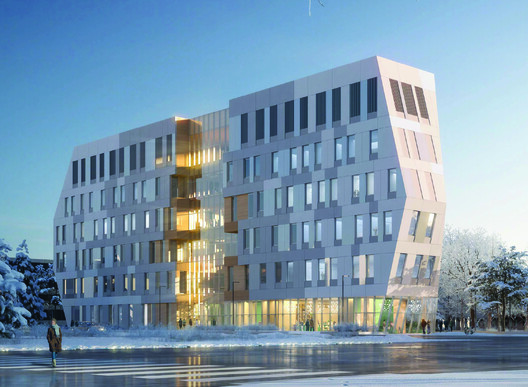
The Myron and Berna Garron Health Sciences Complex (SAMIH), at the University of Toronto Scarborough, was shaped by a clear and non-negotiable mandate: at least 20% of the building's energy consumption had to be generated from renewable sources installed on-site. To meet this ambitious requirement, the project team explored how solar technology could move beyond the roof and become embedded within the architecture itself, positioning the project within a broader shift toward performance-driven sustainable architecture. The 63,000-square-foot facility houses teaching, research, and clinical training programs dedicated to educating future healthcare professionals. Designed by Diamond Schmitt Architects and MVRDV, the project initially followed a conventional path, pairing a restrained facade with rooftop photovoltaic panels.
Diamond Schmitt already had experience working with BIPV on other projects and proposed leveraging the building's envelope as a primary energy-producing surface. Working alongside the architects and general contractor EllisDon, Mitrex engineered and manufactured a custom BIPV system, transforming the exterior facade into a high-performance vertical infrastructure. Through the integration of its facade-based BIPV system, what had been conceived as a passive exterior evolved into a high-performance vertical infrastructure. The complete solar installation delivers a total installed capacity of 632 kW, of which 513 kW is integrated directly into the facade and the remaining 119 kW is located on the rooftop. The majority of the system's capacity is therefore embedded within the vertical envelope itself, producing approximately 420,000 kWh of energy annually and effectively turning the building's exterior into an active energy asset.
Unlike rooftop installations, BIPV surfaces require the simultaneous reconciliation of solar orientation, electrical performance, color selection, and architectural composition. What began as a simple facade with two panel sizes and a single tone evolved into a mosaic composition incorporating eight panel sizes and five distinct tones through a structured design-assist process. Mitrex, the BIPV system manufacturer, worked closely within the design process, developing detailed construction documentation and shop drawings to ensure that increased visual complexity did not compromise output or cost efficiency.
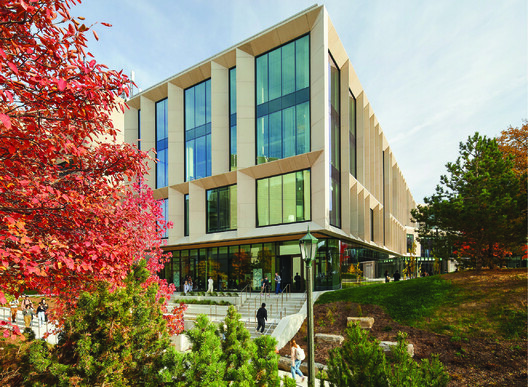
As the facade layout grew more complex, strategic optimizations were introduced to maximize energy generation. These included adjusting module dimensions to align with standardized formats, increasing the number of solar cells per panel, and selectively darkening panel tones to enhance power output, raising system capacity to 513 kW and further reducing reliance on rooftop arrays. Once performance targets were demonstrably surpassed, the architects regained greater compositional flexibility. Lighter tones were reintroduced while maintaining high efficiency, with final refinements to panel configuration and cell density ensuring that the system fully satisfied the university's renewable energy requirements.
eFacade PRO+ and Aluminum Honeycomb: Structure and Energy in a Single System
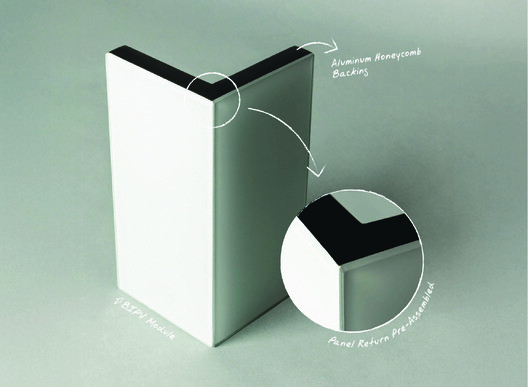
The eFacade PRO+ system integrates photovoltaic glass directly onto panels backed by aluminum honeycomb structural support, creating facades that operate simultaneously as enclosure, structure, and energy infrastructure. Each panel combines photovoltaic glass, encapsulated solar cells, and a rigid structural backing, reducing reliance on heavy secondary framing and simplifying attachment systems.
In traditional facade assemblies, construction typically follows a layered sequence: primary structure, secondary framing, auxiliary profiles, and finally cladding. In honeycomb-based systems, this hierarchy is condensed. The structural rigidity of the alveolar aluminum core allows each panel to function simultaneously as both support and substrate, reducing components, simplifying fixings, and rationalizing installation.
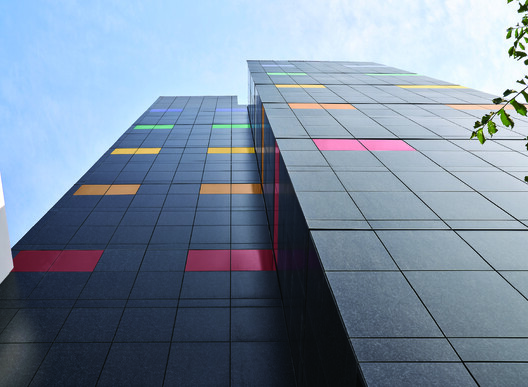
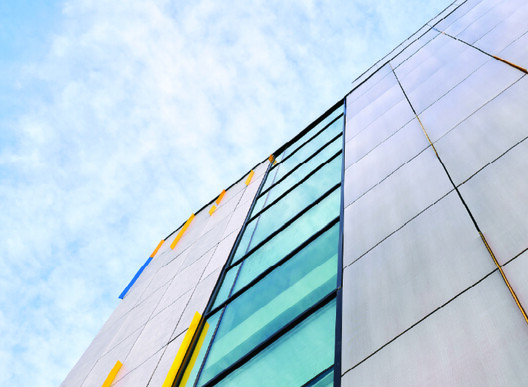
Widely tested in aerospace engineering, honeycomb technology combines lightweight performance with structural stiffness and dimensional precision. In architectural applications, it can result in weight reductions of up to 90% compared to conventional framed systems, directly impacting slab and foundation sizing while facilitating transportation, lifting, and installation. This structural logic also expands formal possibilities, enabling three-dimensional projections, fins, and geometries that can extend up to 4 feet beyond the facade plane without additional reinforcement.
Fully customizable in size, geometry, color, and finish, the panels accommodate satin, matte, glossy, or textured glass. Depending on orientation and chromatic configuration, the system can achieve up to 18 W/ft² of energy generation. It is also non-combustible and certified under standards such as NFPA 285 and EN 13501, meeting the stringent requirements of mid- and high-rise institutional buildings. At SAMIH, a high-performance ventilated rainscreen system was adopted to ensure proper moisture management and long-term durability. The modular system simplified installation without requiring special structural modifications, demonstrating how the integration of BIPV and honeycomb structural backing can absorb formal complexity within a rational construction logic. The design-assist and detailing process proved critical in balancing performance, cost, and aesthetics, resulting in an integrated solar facade without compromising architectural integrity.
Panels are fixed using thermally broken metal brackets, creating a continuous ventilated cavity between the cladding and insulation. Interfaces with glazing systems and slab edges were resolved through standardized details, reducing on-site variability. A high level of prefabrication ensured dimensional precision and streamlined assembly. Beyond environmental performance, the project also demonstrates strong economic viability. With estimated annual energy revenue of approximately $80,000, the return on investment for the SAMIH project was effectively immediate, with overall costs comparable to high-end metal panels. While payback periods vary depending on location, energy pricing, available incentives, and project scale, this case demonstrates how facade-integrated photovoltaics can compete economically with conventional cladding systems.
The SAMIH project demonstrates that energy performance and architectural expression can coexist, establishing a benchmark for buildings seeking to reduce carbon emissions without compromising spatial or construction quality. Within the campus context, the building assumes an exemplary role as an educational facility dedicated to healthcare training, also functioning as a visible showcase of technological innovation and environmental responsibility. Its visibly active and productive facade transforms energy performance into part of the institution's narrative, making sustainability more than a technical metric, it becomes a value embedded in the daily experience of students, researchers, and visitors, where architecture, technology, and environmental commitment converge in explicit and tangible ways.
