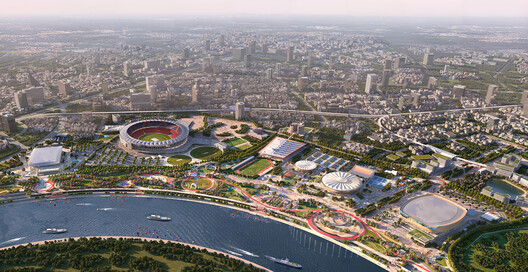
BDP, Cox Architecture, and Collage Design have unveiled the master plan for the 350-acre Sardar Vallabhbhai Patel Sports Enclave in Ahmedabad, India. Positioned on the Sabarmati Riverfront and structured around the 132,000-seat Narendra Modi Stadium, the world's largest stadium by capacity, the project proposes a large-scale sports district integrating international competition venues with public landscapes and community facilities. Conceived as both an events precinct and an urban park, the development is intended to accommodate the 2030 Commonwealth Games centenary event, following Ahmedabad's selection as host city.
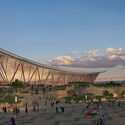
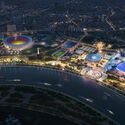
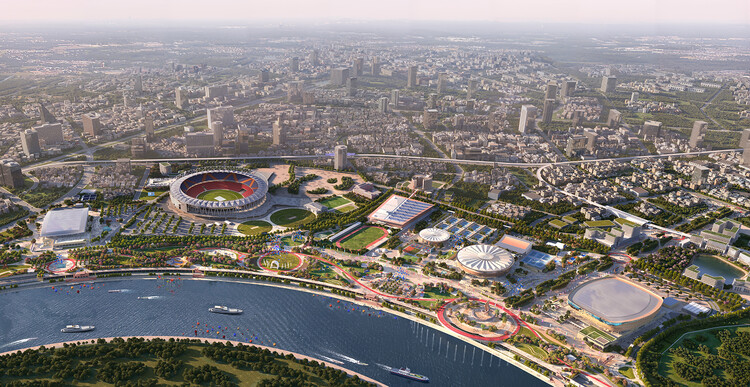
The master plan is organized around a central green boulevard that structures movement across the site and links a series of major venues: an International Tennis Centre, an Indoor Arena, an Aquatic Centre, and a National Institute of Sports Excellence. A mandala-based grid informs the spatial layout, coordinating pedestrian routes, landscaped podiums, and shaded public spaces. The design emphasizes climate-responsive strategies, including tree-lined corridors, recessed plazas, and passive cooling measures integrated into the buildings' envelopes. Landscape is treated as connective infrastructure, mediating between large-capacity venues and the surrounding riverfront while maintaining visual and physical continuity with the stadium.
At the center of the enclave, the International Tennis Centre is planned as a multi-court complex comprising a 10,000-seat main stadium, secondary show courts with capacities of 5,000 and 3,000, and eight additional match courts. A lightweight tensile roof and suspended soffits are designed to provide shading while enabling natural ventilation. Circulation is organized around a central fan plaza that connects the courts and distributes spectators during major tournaments. The complex is designed to operate as a year-round tennis club, featuring both indoor and outdoor courts, hospitality spaces, and ancillary facilities to ensure ongoing public use.
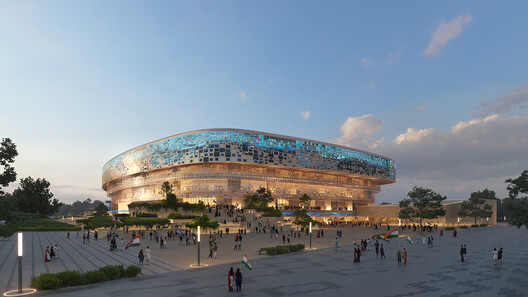
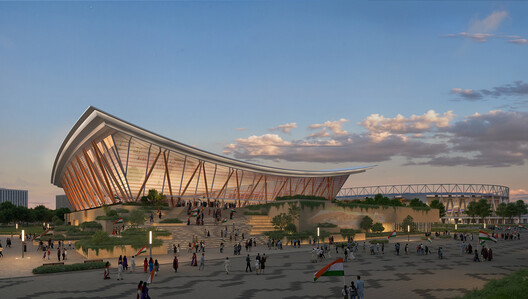
The 18,000-seat Indoor Arena, positioned at the eastern edge of the site, is designed with flexibility to host concerts and other large-scale events. Its facades are articulated with bronze-anodized aluminum jali screens that reference regional architectural elements such as jharokhas and chhajjas, providing solar shading and filtering daylight into interior concourses. To the west, the Aquatic Centre will accommodate up to 12,000 spectators during major competitions, with a reduced post-event capacity of 4,000. An exposed structural exoskeleton, double-glazed curtain walls, and overhanging roof elements support passive environmental control.
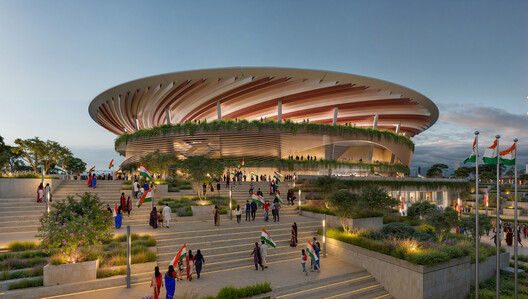
Between the Tennis Centre and Narendra Modi Stadium, the National Institute of Sports Excellence is conceived as a dedicated training campus incorporating gymnasiums, recovery areas, and biomedical facilities. The Sabarmati riverfront is reconfigured as a Games Plaza capable of hosting ceremonial events, later transitioning into a public park with community sports courts and open green areas. Across the enclave, the architectural approach prioritizes adaptable venues, shaded public realms, and landscape integration, framing the project as a long-term urban intervention that extends beyond the temporal demands of international sporting events.
During 2025, several large-scale sports infrastructure projects were announced, many slated for completion between 2028 and 2030. In Riyadh, Populous is designing the King Salman Stadium, planned as the largest venue for the FIFA World Cup 2034 and scheduled for completion in 2029. In Egypt, Gensler revealed a 42,000-seat stadium for Al Ahly SC between Cairo and Alexandria, forming part of a broader sports city masterplan expected by 2029. In Tirana, OMA won the competition to renovate Selman Stërmasi Stadium within a wider urban redevelopment strategy. Meanwhile, Heatherwick Studio and MANICA Architecture presented plans for a 62,000-seat stadium anchoring the Birmingham Sports Quarter in Birmingham, targeted for completion ahead of the 2030–2031 season.