On a hot afternoon in May, when the air over western India turns metallic with heat, no one remembers façade composition. They remember where the shade falls. They remember which corridor breathed. They remember the house that was cooler than the street. What stays in memory is comfort beyond the form. Repeated thermal preference stabilizes into spatial configuration, and over time, those configurations become building types.
Heritage is usually catalogued by what can be drawn, not by what changed temperature. In heat, buildings are learned first through skin, only later through sight. Generations learn, through their bodies, what works. Shade reduces glare and radiant heat. Air movement shifts perception by several degrees. Thick walls slow temperature swings. Over time, these experiences accumulate into a spatial preference. What feels right is repeated. What is repeated stabilizes into type.




Building science has given language to what vernacular architecture practiced intuitively. Adaptive comfort research, incorporated into standards like ASHRAE 55, shows that occupants in naturally ventilated buildings accept a wider temperature range than those in sealed, air-conditioned environments. When people can open a window, move into shade, or occupy a breezier threshold, they tolerate warmer air. A room feels cooler when the occupant can move, open, or shade, even when the air stays warm. Heat transfer sets the limits; human control shifts the tolerance within them.
Once comfort patterns settle at the scale of the body, they begin shaping buildings. Geometry becomes a climate instrument. Consider the historic pol houses of Ahmedabad's old city. Their narrow, shaded streets are not quaint accidents of medieval planning; they are calibrated urban canyons. The height-to-width ratios reduce direct solar penetration for most of the day, lowering radiant load at street level. Shared party walls reduce exposed surface area, limiting heat gain. Inside, internal courtyards act as vertical lungs: hot air rises and escapes, drawing cooler air through lower openings. Documentation from CEPT University has shown measurable temperature differences between shaded pol streets and adjacent exposed roads, demonstrating how morphology moderates microclimate. Here, heritage is airflow choreography.
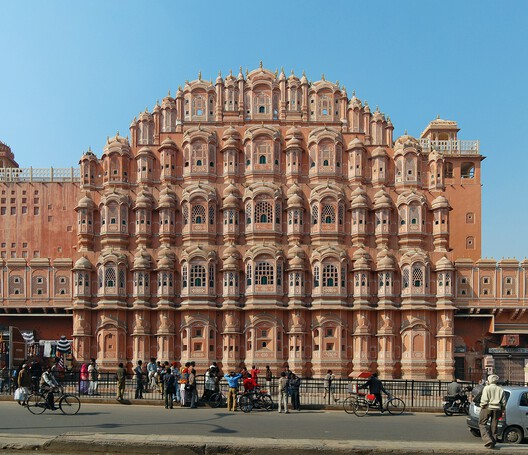
This logic operates at the scale of the envelope as well. Architectural elements often dismissed as ornament are, in fact, environmental filters. The perforated façade of Jaipur's Hawa Mahal is widely photographed as an icon of Rajasthan. Yet its nearly 1,000 small openings function as a ventilation device. The dense screen diffuses direct sunlight, reducing glare and radiant heat, while pressure differentials across the façade induce airflow through the galleries. The depth of each aperture further shades interior surfaces. Strip away its pink sandstone identity, and the environmental system still stands. The depth that pleases the eye is the same depth that blocks the sun.
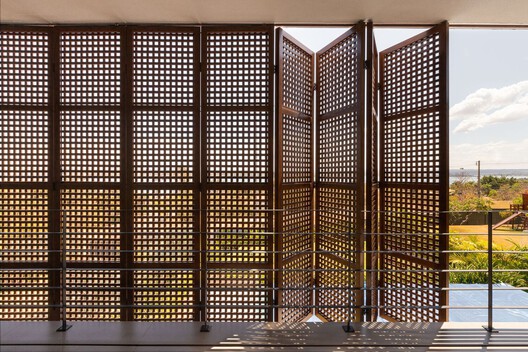
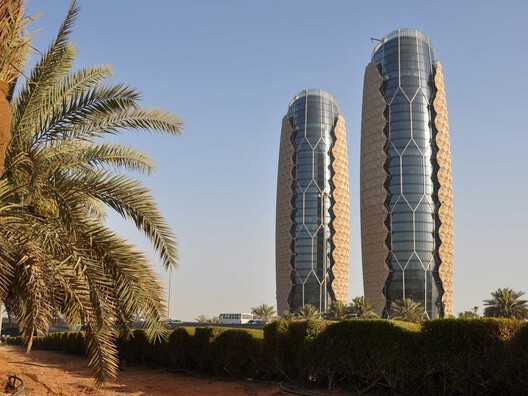
Modern engineering has begun to validate what these precedents encoded. In Abu Dhabi, the Al Bahr Towers reinterpret the traditional mashrabiya as a dynamic shading system. Their responsive façade opens and closes in relation to solar exposure, significantly reducing solar gain on the glazed curtain wall behind. Energy modeling published by the project team reports substantial reductions in cooling loads compared to a fully exposed glass façade. The movable screen regulates solar exposure using the same shading and pressure-differential principles as fixed mashrabiya screens. Automation changes actuation, not environmental function; the façade still limits solar gain before it reaches the glazing.
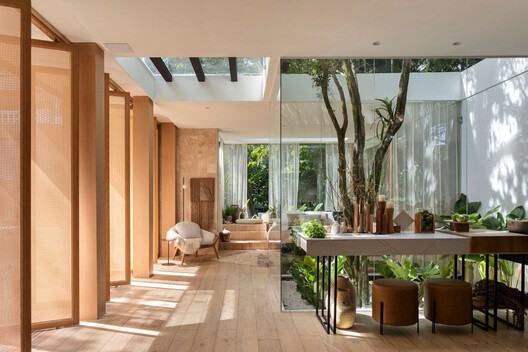
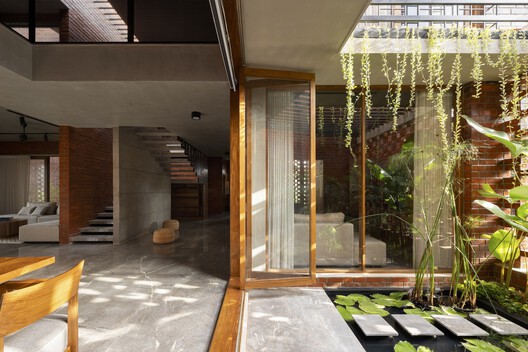
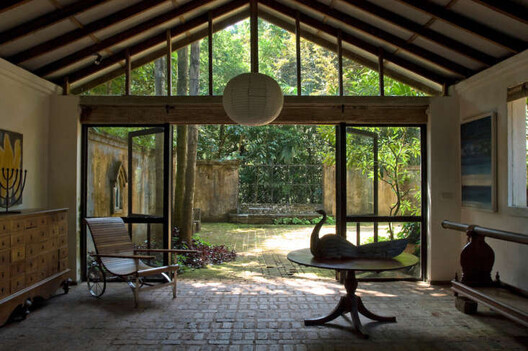
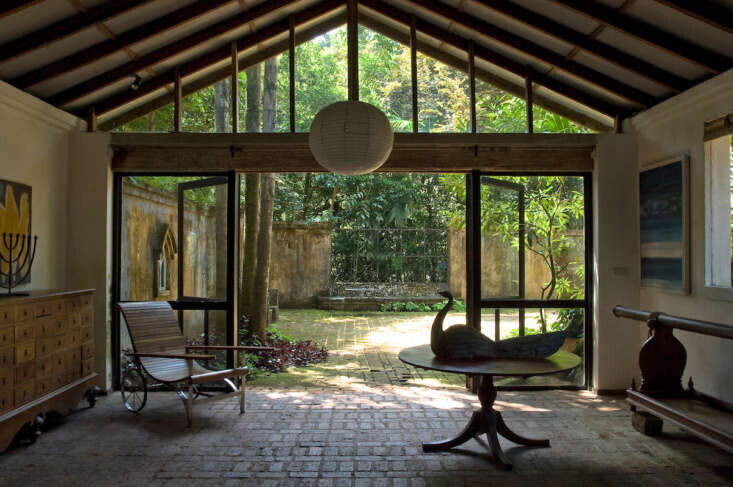
The persistence of these patterns becomes even more evident when materials change. Timber gives way to reinforced concrete. Stone becomes glass. Yet courtyards, verandahs, and transitional thresholds continue to surface in regions where heat remains the primary constraint. In Sri Lanka, Geoffrey Bawa's courtyard houses translated vernacular cooling strategies into modern forms. Deep verandahs shade mass walls from high-angle sun. Cross-ventilation corridors align with prevailing breezes. Water courts temper the immediate microclimate through evaporation. Bawa did not replicate historical style; he reactivated environmental geometry in a new material language. The forms changed language, but the air moved as it always had.
Today, this operational logic is resurfacing under new pressures. The International Energy Agency projects India's cooling demand to grow dramatically in the coming decades as incomes rise and temperatures climb. The India Cooling Action Plan acknowledges the energy burden of mechanical air-conditioning in a warming climate. At the same time, urban heat island studies across Indian cities record temperature differentials of several degrees between dense built cores and surrounding rural areas. Higher ambient and nighttime temperatures increase cooling hours and reduce the effectiveness of passive heat release.
In response, contemporary housing across Ahmedabad, Chennai, and Bengaluru has quietly reintroduced passive measures. Semi-open stairwells are being used as exhaust shafts: warm air rises through them and pulls replacement air from shaded lower openings, reducing indoor temperature without mechanical extraction. Research emerging from institutions such as IIT Madras and CEPT University suggests that passive cooling strategies in composite climates can significantly reduce mechanical dependency when properly integrated into design. Across decades and materials, the same cooling moves keep reappearing.
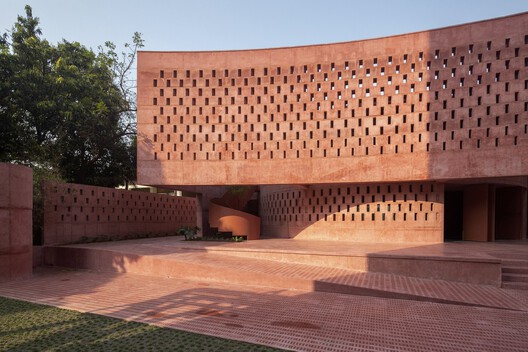
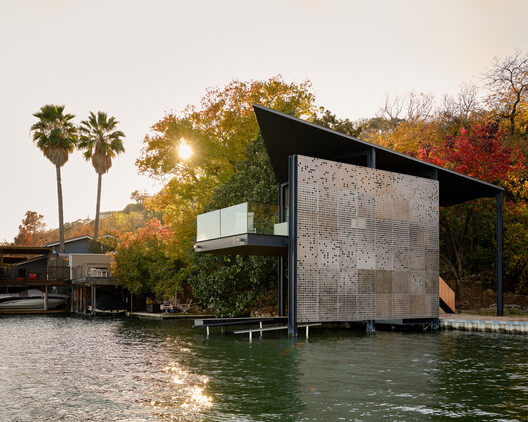
As temperatures rise, old cooling habits become useful again. As glass towers multiply in hot regions, shading devices return. As sealed envelopes drive up energy demand, operable systems reappear. Heat quietly keeps what works and abandons what does not. It trims away what does not perform and allows what works to endure, sometimes quietly, sometimes in plain sight. This reframes how we understand heritage. Evaluation can shift from stylistic retention to whether a spatial element measurably reduces heat gain or improves air exchange. A courtyard remains relevant where it lowers the surrounding surface temperature and enables vertical air movement. Perforated envelopes remain useful where they reduce radiant load while permitting ventilation. When summers grow harsher, the spaces that softened them stay in use.
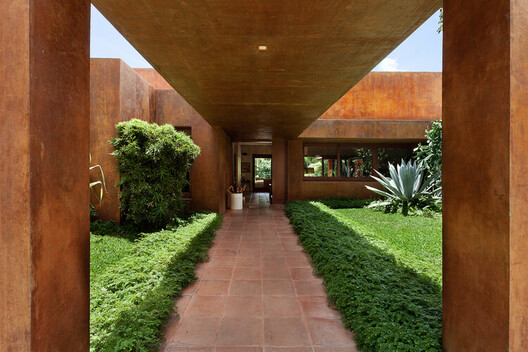
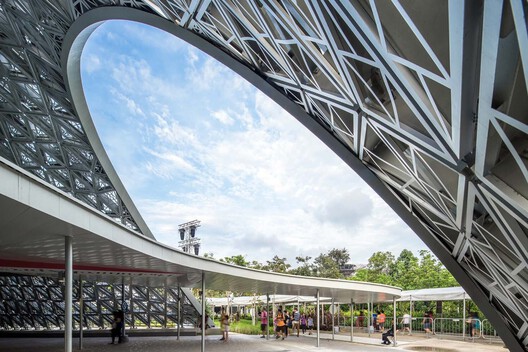
Architecture likes to announce change, even when performance repeats. Yet in hot climates, especially, innovation frequently looks like refinement of inherited environmental intelligence. Simulation software now models what narrow streets already achieved. Parametric façades optimize what carved screens once calibrated by hand. Policy frameworks codify what vernacular builders practiced through experience. Environmental performance provides a repeatable design reference independent of stylistic reproduction. If comfort leaves memory, and memory shapes form, persistent climatic constraints repeatedly produce similar spatial responses across periods and materials. Styles change, materials evolve, and technologies advance. But the human body still seeks shade on those hot May afternoons. And wherever that instinct persists, certain spatial logics will persist with it.
In a warming world, repetition also comes from heat, not tradition alone. Thermal heritage is less about preserving images of the past and more about sustaining the intelligence that allowed those images to survive. If we read buildings not just as objects but as environmental instruments, past solutions remain active wherever the climate still asks the same questions.
This article is part of the ArchDaily Topic: Rethinking Heritage: How Today's Architecture Shapes Tomorrow's Memory. Every month we explore a topic in-depth through articles, interviews, news, and architecture projects. We invite you to learn more about our ArchDaily Topics. And, as always, at ArchDaily we welcome the contributions of our readers; if you want to submit an article or project, contact us.