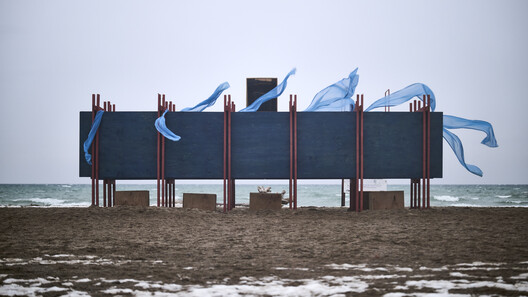
The annual Winter Stations design competition returns to Toronto for its twelfth edition, once again transforming the lifeguard stations of Woodbine Beach into temporary works of public art. On view from February 16 to March 30, 2026, this year's exhibition is organized under the theme Mirage, inviting participants to examine perception, illusion, and the shifting boundaries between what is seen and what is constructed. Selected from more than 300 international submissions, three winning proposals from Canada, the United States, and a Germany–Ukraine collaboration are presented alongside two installations developed by university teams. Installed along the frozen shoreline of Lake Ontario, the projects reinterpret seasonal infrastructure as platforms for spatial experimentation during the winter months.
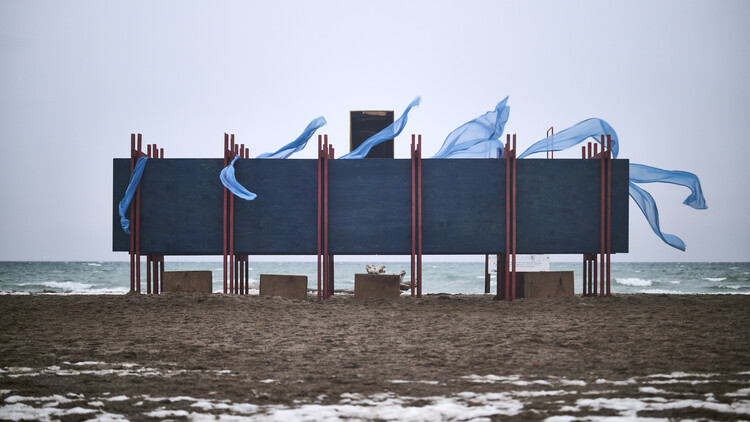
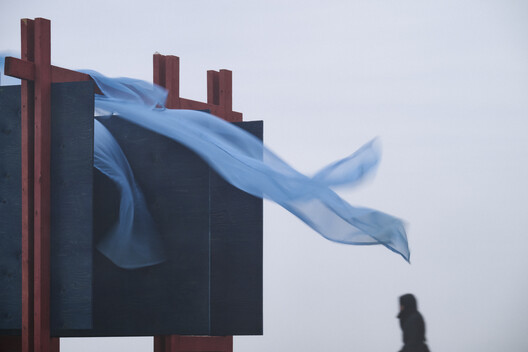
Since its inception in 2015, Winter Stations has positioned the lifeguard towers as recurring frameworks for architectural and artistic intervention, encouraging designers to engage with climate, materiality, and public space. The 2026 theme reflects on the conditions of contemporary visual culture, including the influence of artificial intelligence and digital mediation on perception. Rather than treating the beach as dormant in winter, the exhibition frames it as an active civic landscape, where temporary structures foster gathering and dialogue. The selected installations respond to these questions through reflective surfaces, refracted light, framed views, and evolving material states, each proposing a distinct approach to the idea of mirage as both an optical phenomenon and cultural metaphor.
Discover below the five winning designs for the 2026 Winter Stations, along with short descriptions.
Related Article
Festival Concéntrico 2026 Announces Three Selected Urban Installations From Its International Open CallsCHIMERA by Denys Horodnyak, Ukraine & Enzo Zak Lux, Germany
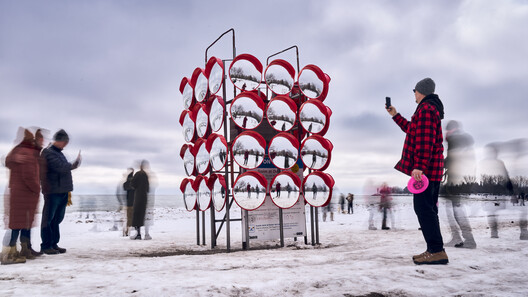
CHIMERA reflects on the fragmentation of physical and digital realities. Visitors encounter a shifting constellation of mirrored surfaces that produce multiple, overlapping versions of themselves and the surrounding shoreline. As one moves around the installation, reflections collide and separate, revealing the delicate imbalance between control and security in mediated environments. The project positions perception as unstable and layered, using light, reflection, and spatial sequencing to question the reliability of a single point of view. Developed by Berlin-based designers Denys Horodnyak and Enzo Zak Lux, the installation translates abstract concerns about identity and simulation into a built structure that interacts directly with the winter landscape.
Embrace by Will Cuthbert, Canada
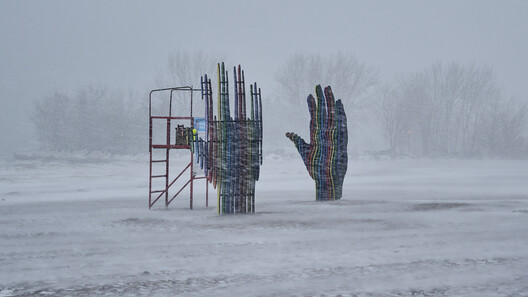
Embrace is conceived as an invitation to behold and to be held. Composed of prismatic, hand-like forms arranged around the lifeguard station, the installation refracts light and color across its surfaces, offering a shifting visual experience as visitors circulate through the structure. By encouraging changes in viewpoint, the project proposes a vibrant re-reading of the winter beach, where subtle variations in sunlight generate new chromatic effects throughout the day. The installation frames fragments of sky, snow, and water, producing layered reflections that respond to both movement and atmosphere. Through its geometry and optical qualities, Embrace transforms the act of looking into a participatory spatial encounter.
SPECULARIA by Andrew Clark, United States
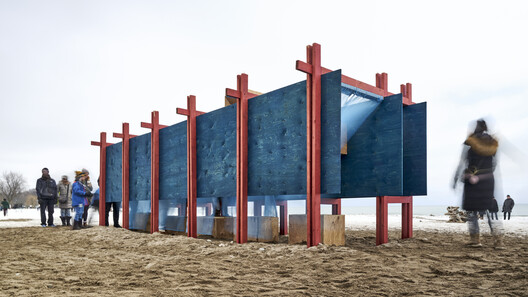
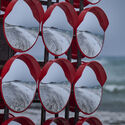
SPECULARIA houses five framed openings oriented toward the lake, each offering a distinct visual condition. One aperture presents a direct and unobstructed view, while the others isolate and rearrange fragments of the surroundings, stripping them of context and altering perceptions of distance and direction. By juxtaposing clarity with distortion, the installation explores the tension between deception and reality embedded in the act of framing. Developed by Portland, Maine–based interdisciplinary designer Andrew Clark under the name TORNADO SOUP, the project employs straightforward architectural gestures, alignment, enclosure, and reflection to produce perceptual ambiguity along the shoreline.
Crest by University of Waterloo: Clay te Bokkel, Isabella Ieraci, Matthew Lam, Sasha Rao, Simon Huang, Oskar Peng, and David Shen, Canada
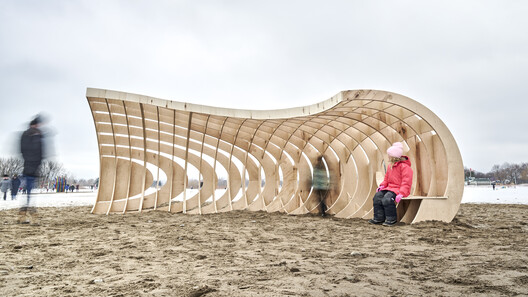
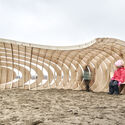
Crest emerges from the sand and snow as a sweeping wave positioned just before breaking. Designed by students from the University of Waterloo, the installation initially appears as a pile of driftwood washed ashore; upon closer approach, its wavy plywood geometry gradually becomes legible. The structure envelops visitors within a curving form that frames views of the horizon while offering moments of pause and gathering. Individual components appear and disappear depending on the direction of arrival, generating a subtle illusion of movement within a static structure. In merging with the beachscape, Crest situates architectural form within the rhythms of wind, snow, and shifting light.
Glaciate by Toronto Metropolitan University, Department of Architectural Science, Canada, in collaboration with Ming Chuan University, School of Design, Taiwan: Finn Ferrall, Nicholas Kisil, Marko Sikic, and Vincent Hui
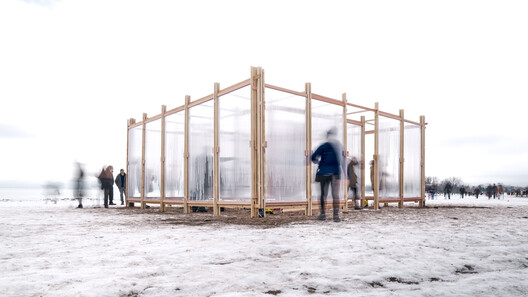
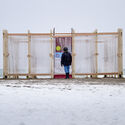
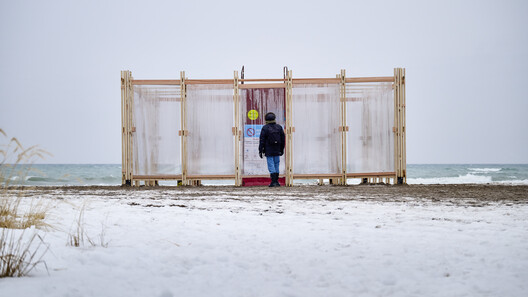
Glaciate, developed by students and faculty from Toronto Metropolitan University in collaboration with Ming Chuan University, unfolds as a corridor of vertical polycarbonate panels filled with water drawn from the adjacent lake. As temperatures fluctuate, the water freezes and thaws, transforming the panels into ice lenses that cycle between transparency, translucency, and opacity. A nearby red lifeguard stand appears intermittently through fragments and flashes of color, never fully visible or fully concealed. From within the corridor, the surrounding beach is refracted into a mirage-like landscape. By incorporating the natural freeze–thaw cycle into its material logic, the installation positions climate itself as an active agent in shaping perception.
Since its early editions, Winter Stations has invited designers to reimagine underused winter infrastructure, most notably the lifeguard towers, as platforms for bold, site-specific experimentation. Through temporary installations, the festival reframes the cold-season waterfront as a space for exchange, reflection, and shared experience. In other news, exploring the intersection of architecture, art, and the public realm, the international open calls for Festival Concéntrico have recently announced three selected urban installations to be developed and exhibited in Logroño from June 18–23, 2026, further underscoring the role of temporary structures in activating city space. Meanwhile, in Milan, the Cultural Olympiad continues to unfold through exhibitions, performances, and public art initiatives that frame culture as an urban-scale project embedded within major institutions and everyday civic life.