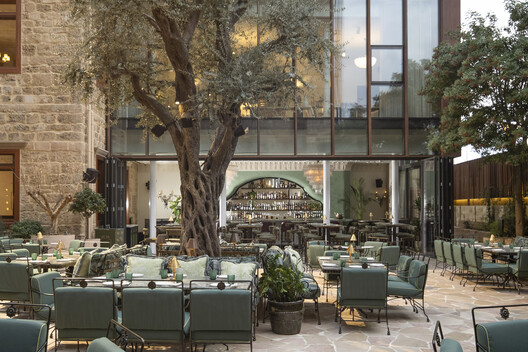
Hospitality-driven programs, specifically coffee shops and social hubs, are partly defined by their role as "third places": social anchors that bridge the gap between private and public life. Unlike residential or commercial office programs that require rigid partitioning for privacy and utility, they rely on expansive, open-plan environments. This allows for an architectural strategy of minimal intervention, allowing the structural envelope to remain intact. By avoiding the subdivision of space, architects maintain uninterrupted sightlines to original masonry, timber frames, or decorative ceilings, ensuring the building's historical narrative remains the protagonist. Simultaneously, the commercial activity provides the necessary maintenance and public engagement to ensure the site's continued existence.
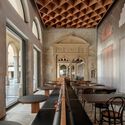
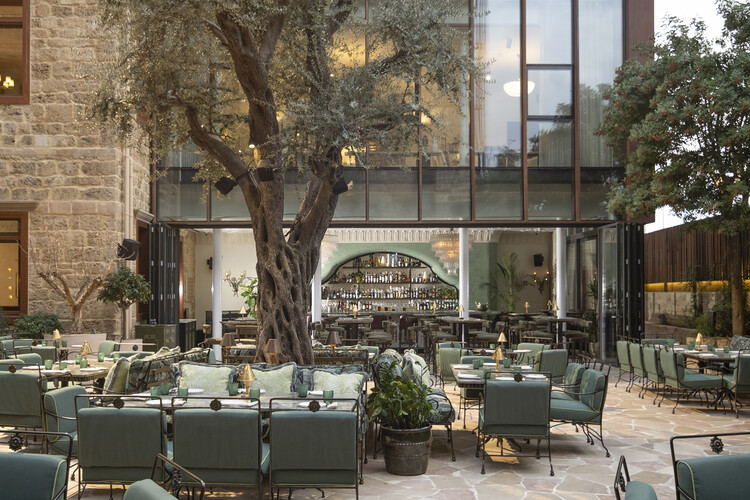
Across diverse latitudes, from the Mediterranean to the Sea of Japan, the coffee shop typology is a recurring method for the preservation of heritage buildings. These strategies share a common reliance on legibility. Rather than mimicking historical styles, they employ material contrast, using industrial elements like steel, glass, and brick to distinguish contemporary interventions from the original fabric. Similarly, the implementation of this typology allows for common technical solutions, such as the creation of a "technical core" (the bar and services) as a concentrated insertion. This leaves the remainder of the historic shell untouched and visually accessible. Furthermore, the transition of the building from a private or industrial enclosure to a public asset is beneficial for the commercial program, as it provides access to interiors previously closed to the public.


