Across South America, architecture endures through the materials it uses, those that persist over time. Bamboo, brick, wood, and concrete appear across regions, connecting climate, labor, and culture in ways that ensure their persistence through generations. Their continuity does not depend solely on preservation or heritage. It depends on use.
In this context, cultural memory does not reside primarily in monuments or images, but in practice. It survives in repeated gestures: laying bricks, tying guadua joints, assembling wood frames, casting slabs that anticipate another floor. These actions are transmitted less through manuals than through participation. Over time, they form systems of knowledge embedded in habit and necessity. Materials endure not because they symbolize the past, but because they continue to work.
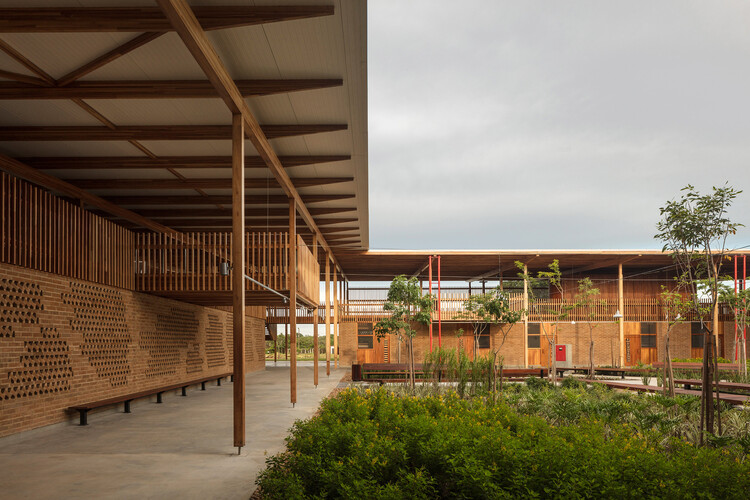
Brick offers one of the clearest examples of this constructive continuity. Introduced through colonial systems and later industrialized, it became central to urban growth across the continent. Its modular logic accommodates uncertainty: walls can rise gradually, floors can be added over time, and facades can remain open to future expansion. In cities such as Lima, Bogotá, and Asunción, brick defines not only architecture but the process. Housing is often built incrementally, responding to shifting economic conditions and family needs. The city thickens through repetition.
Colombian architect Rogelio Salmona insisted that materials are not neutral choices but responses to place. In his work, brick was understood as a consequence of geography, climate, and collective labor rather than a stylistic preference. This position reflects a broader regional condition: brick persists because it remains embedded in how cities are constructed and inhabited. It carries the memory of manual labor and collective effort within its very texture.
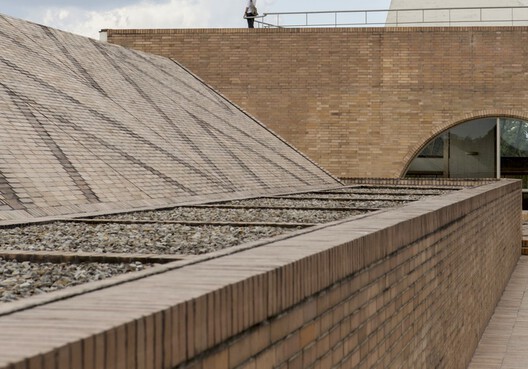
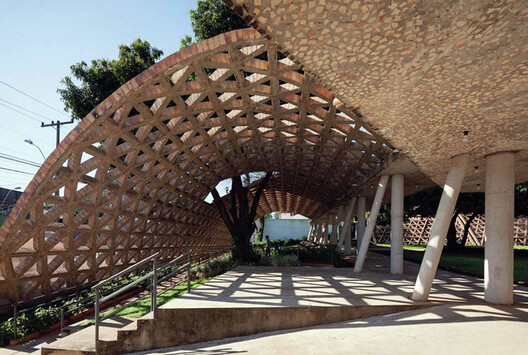
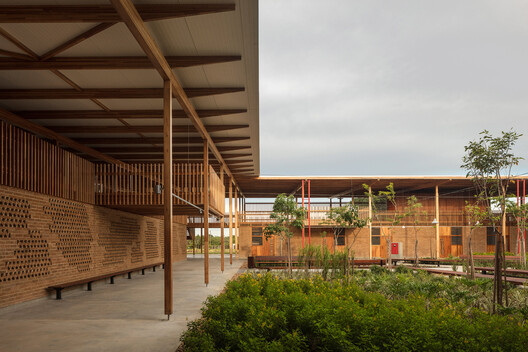
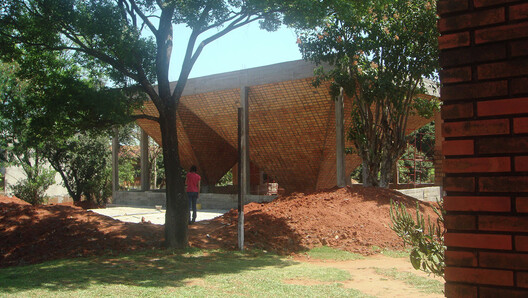
The Teletón Children's Rehabilitation Center by Gabinete de Arquitectura reinforces this continuity, showing how brick remains a shared material language across both domestic and public architecture. Through repetition and mass, brick becomes a structure, an enclosure, and a climate mediator simultaneously. The Environmental Classroom by Taller Síntesis similarly demonstrates how porous masonry regulates airflow and light using techniques long present in local construction cultures. In both cases, brick is not reinvented; it is intensified. Heritage operates through continuity of use rather than through preservation of form.
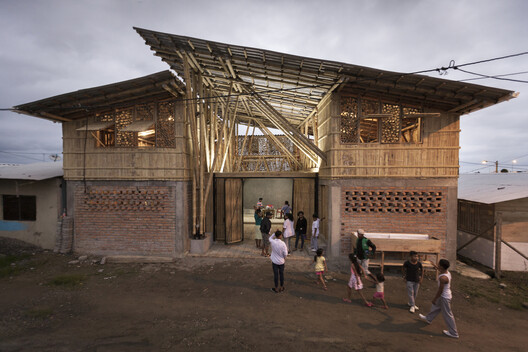
Bamboo, particularly the guadua species, represents another long-standing building tradition across the continent. In coastal and seismic regions of Ecuador and Colombia, guadua construction has evolved through generations of adaptation to humidity, heavy rainfall, and shifting ground. Its flexibility reflects knowledge shaped directly by territory.
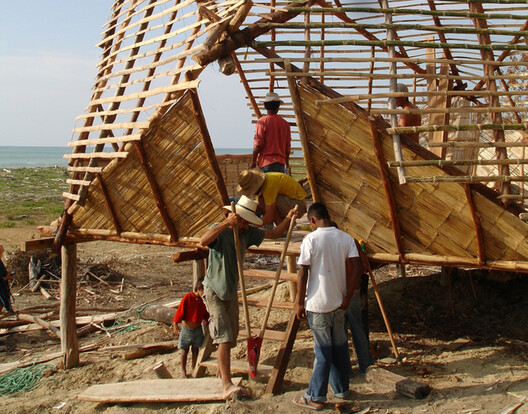
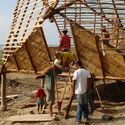
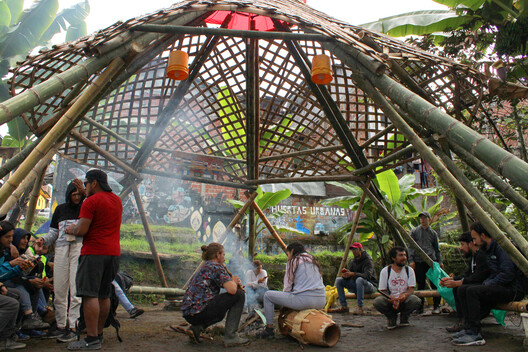
This type of construction depends heavily on shared, embodied knowledge. Techniques are learned through participation: how to cut, join, tie, and anchor fibers efficiently. The Nueva Esperanza School by Al Borde demonstrates how this knowledge remains active in contemporary practice. Built collaboratively and with limited resources, its structure draws directly from ongoing building cultures. In Colombia, the Classroom Apu Kumanday by República Portátil further confirms that guadua is not a relic of the past but a viable structural system capable of supporting present needs. Here, heritage is not an aesthetic reference; it is constructive continuity.
Wood construction follows a similar logic of persistence. In southern Chile, Brazil, and parts of the Andean region, wood has long mediated humidity, rainfall, and temperature through its structural system of frames and joints. Ventilation and shading are not added technologies; they are embedded in the way wood is assembled. The material carries ecological knowledge accumulated over centuries of inhabiting forested and tropical landscapes.
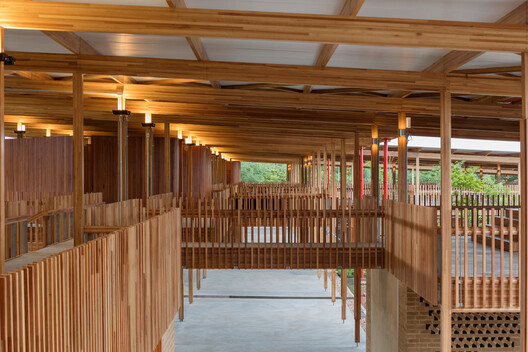
The Children Village by Rosenbaum + Aleph Zero translates this logic into educational infrastructure, using repetitive wooden frames to create shaded, climate-responsive environments. The Chamanga Cultural Center, developed with Atarraya Taller de Arquitectura and academic collaborators, was built through collective effort, with construction itself becoming part of the rebuilding process. In these contexts, wood is not just a symbolic gesture. It reflects long-standing ways of building that respond directly to climate and territory.
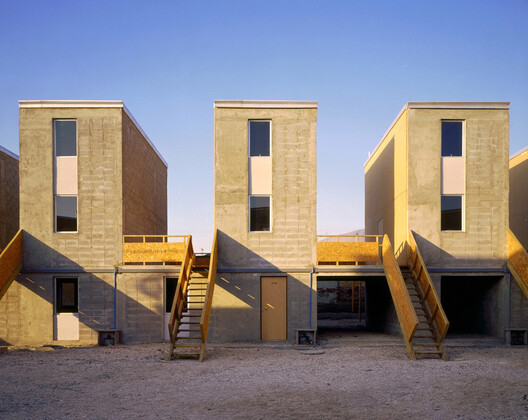
Concrete occupies a particular place within this material landscape. While it arrived through processes of modernization, it did not remain confined to large infrastructural or institutional projects. Over time, it became part of the everyday language of construction across the continent. Reinforced concrete frames allow buildings to grow gradually. A slab may anticipate another floor; a column may remain exposed, waiting for extension. The material accommodates uncertainty. It supports expansion rather than fixing form.
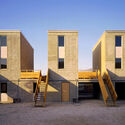
The ECLAC-CEPAL Building in Santiago, designed by Emilio Duhart, reflects one dimension of this history, when concrete became associated with regional ambition and collective development. At the same time, projects such as Quinta Monroy Housing by ELEMENTAL reveal another. There, the structure is intentionally incomplete, allowing residents to expand and transform their homes over time. Concrete ceases to be a symbol of permanence and becomes a framework for change.
Across the region, materials remain in use even as others are introduced. Brick, bamboo, wood, and concrete overlap and adapt, shaping cities through everyday construction. Materials overlap rather than replace one another. South American architecture is characterized by layering. This layered condition reflects a cultural logic. Materials persist because they remain accessible, adaptable, and socially embedded. They respond to climate, economic realities, and collective labor structures. Their endurance does not depend on nostalgia but on relevance.
In South America, architecture is sustained not by isolating heritage as an image, but by allowing it to evolve through use. Cultural memory is constructed daily, in unfinished facades awaiting expansion, in bamboo joints tied by hand, in wood frames shaped by humidity, in concrete columns prepared for another floor. Materials do not simply record history. They carry it forward, embedding the past within the present through repetition and adaptation. Continuity, in this sense, is not static. It is built.
This article is part of the ArchDaily Topic: Rethinking Heritage: How Today's Architecture Shapes Tomorrow's Memory. Every month we explore a topic in-depth through articles, interviews, news, and architecture projects. We invite you to learn more about our ArchDaily Topics. And, as always, at ArchDaily we welcome the contributions of our readers; if you want to submit an article or project, contact us.