This week's news brings together developments in professional recognition, cultural programming, and large-scale urban strategy, reflecting the multiple scales at which architecture shapes contemporary discourse. As the field anticipates the next Pritzker Architecture Prize announcement, conversations around authorship, civic responsibility, and long-term impact unfold alongside the American Institute of Architects' 2026 Honorary Fellowship appointments, situating individual achievement within broader institutional frameworks. At the same time, updates from Riyadh to London foreground the role of architecture in both enabling new cultural platforms and safeguarding post-war heritage. Complementing these narratives, the reassignment of the 2029 Asian Winter Games and progress on expansive public landscapes highlight how cities are aligning infrastructure delivery, environmental resilience, and territorial planning with long-term economic and social agendas.

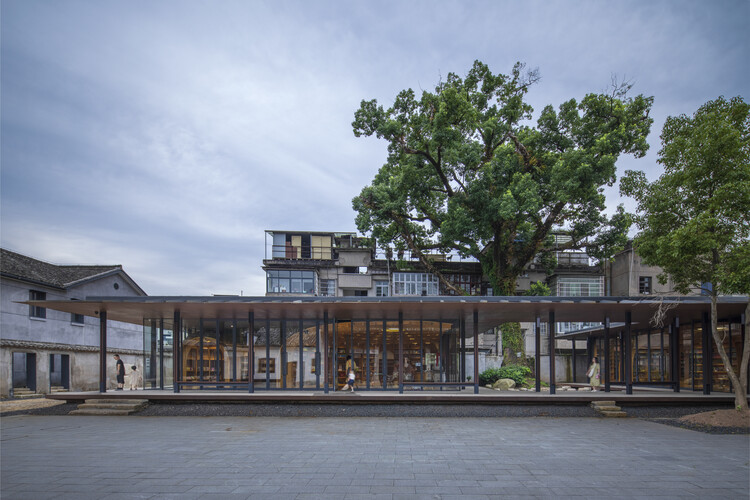
Recognition and Professional Milestones
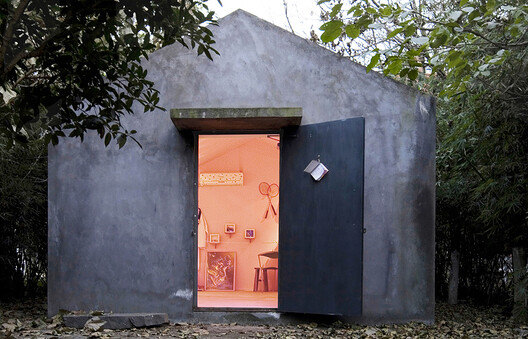
As the architecture community looks toward the 2026 edition of the Pritzker Architecture Prize, anticipation has renewed discussion around how excellence, authorship, and long-term impact are defined within the discipline. Recent laureates, including Liu Jiakun, Riken Yamamoto, and David Chipperfield, reflect a trajectory that increasingly positions social responsibility, environmental stewardship, and civic engagement as central criteria of architectural significance. Extending this conversation beyond institutional juries, ArchDaily has launched its annual reader poll, inviting a global audience to weigh in on who should be recognized in 2026. At the same time, leadership developments connected to the prize's founding family have entered public discourse, as Thomas Pritzker, executive chairman of Hyatt Hotels Corporation, announced he will step down and not seek reelection to the company's board.
Related Article
Who Should Win the 2026 Pritzker Prize?Cultural Infrastructure and Adaptive Reuse
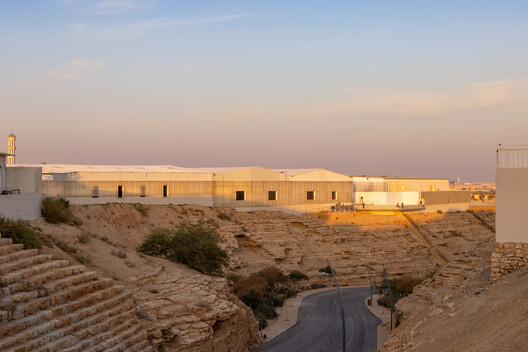
In Riyadh, the third edition of the Diriyah Contemporary Art Biennale has opened at JAX District, a rehabilitated industrial area positioned near the UNESCO World Heritage Site of At-Turaif. Bringing together more than 65 artists, the exhibition foregrounds themes of movement and transition while embedding curatorial narratives within an adaptive reuse framework. Scenography design by Formafantasma, the Biennale operates within a broader cultural agenda in Diriyah, positioning architecture as an active medium in exhibition-making and reinforcing the role of repurposed industrial districts as contemporary cultural platforms.
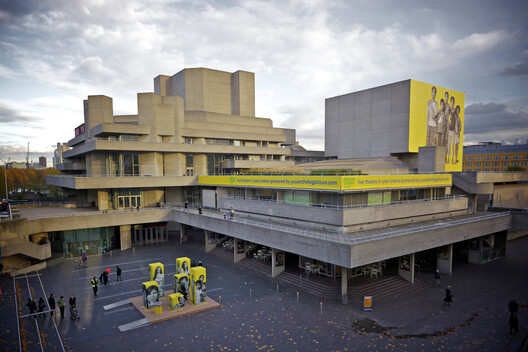
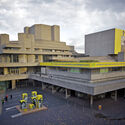
Questions of preservation and legacy also surfaced in the United Kingdom, where Southbank Centre has been granted Grade II listed status following a decades-long campaign advocating for its protection. Designed between 1963 and 1968 by the London County Council's Architects' Department, the Brutalist complex, comprising the Hayward Gallery, Queen Elizabeth Hall, and Purcell Room, among other elements, now falls under formal heritage oversight. The designation reinforces the growing recognition of post-war architecture as part of the national historic fabric, situating modern cultural infrastructure within broader conservation frameworks.
Urban Strategy, Landscape, and Mega-Events
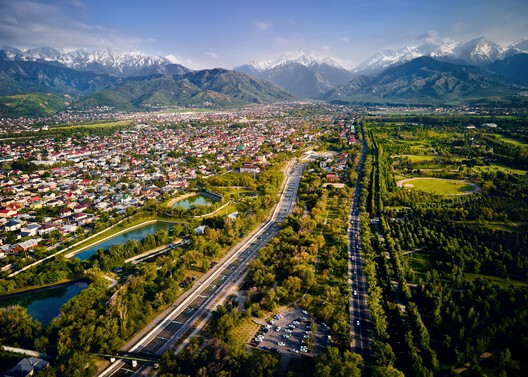
Large-scale territorial planning also shaped this week's news. Almaty has been confirmed as the host of the 2029 Asian Winter Games following the withdrawal of Trojena, part of Saudi Arabia's NEOM development. Formalized by the Olympic Council of Asia, the reassignment reflects broader considerations around construction timelines, infrastructure readiness, and climate suitability. The decision aligns with recent Olympic models, including the Milano-Cortina 2026 Winter Olympics, which prioritize the reuse of existing venues and the adoption of distributed hosting strategies. In parallel, construction continues on King Salman Park in Riyadh, a 16.9-square-kilometre public landscape developed on the site of the city's former airport. Led by Omrania in collaboration with Henning Larsen, the master plan organizes the park around branching valleys inspired by regional wadi systems, integrating ecological restoration, cultural venues, and mixed-use districts within a transit-oriented framework.
On The Radar
SOM and Hassell Reveal Masterplan for Bradfield City, Australia's First New City in Over a Century
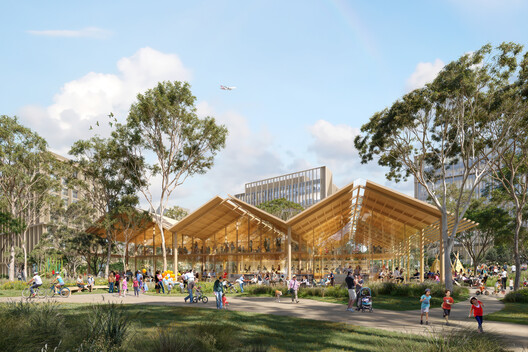
In Western Sydney, Skidmore, Owings & Merrill (SOM) and Hassell have unveiled the master plan for Superlot 1, the foundational 5.7-hectare precinct of Bradfield City, described as Australia's first entirely new city in over a century. Developed in collaboration with cultural design partners Djinjama and COLA Studio, the proposal positions the district adjacent to the Western Sydney International Airport, envisioning a mixed-use urban core with more than 1,400 homes, including affordable housing, alongside academic, commercial, and public programs. Structured around a 15-meter-wide "Green Loop" that links Moore Gully's natural systems to the built environment, the plan foregrounds climate-responsive strategies, low-carbon materials, and design principles informed by Indigenous understandings of Country.
ZHA and C.Y. Lee & Partners to Design Taipei's National Innovation, Creativity and Finance Center
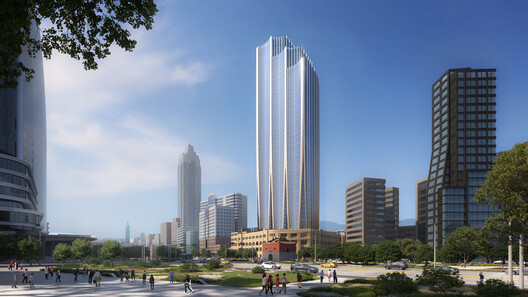
Following an international competition, Zaha Hadid Architects, in collaboration with C.Y. Lee & Partners, has been selected to design the National Innovation, Creativity and Finance Center (NICFC) in Taipei's Beimen district. Envisioned as a 175,000-square-metre mixed-use civic and financial hub near Taipei Main Station and the historic Beimen Gate, the project will consolidate four institutions under Taiwan's Financial Supervisory Commission, including the stock and futures exchanges. The scheme integrates a five-storey podium that responds to the scale of the adjacent 1930 Taipei Beimen Post Office, which will be restored and transformed into a museum and cultural venue, with a 47-storey tower inspired by the fluted geometry of Taiwan's native Phalaenopsis orchid. Prioritizing walkability under the city's Western Gateway Project, the design introduces interconnected plazas and a sheltered public courtyard, while a pleated, climate-responsive façade system enhances environmental performance in Taipei's humid subtropical climate.
Pepe Gascón Arquitectura, SAAS Architecture, and Davide Macullo Architects Design Shqiponja Square Building in Tirana
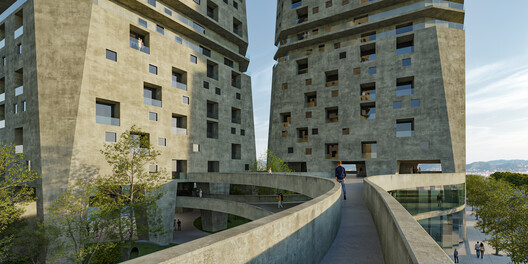
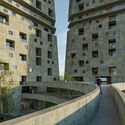
In Tirana, Albania, the Shqiponja Square Building by Pepe Gascón Arquitectura in collaboration with SAAS Architecture and Davide Macullo Architects proposes a 95,000-square-metre mixed-use development scheduled for completion in 2029, comprising three residential towers rising above a two-level commercial and office podium to anchor a new urban center. Defined by an organic, amoeba-shaped base that fosters movement and social interaction, the towers transition from diamond-shaped to octagonal plans, creating a dynamic skyline while enhancing privacy and cohesion. A central circular green plaza integrates playgrounds, terraces, and public gathering areas, linking private residences with the surrounding city fabric, while facades inspired by monolithic rock formations, referencing Cappadocia's historic dwellings, adopt muted gray-green tones that respond to Tirana's mountainous landscape.
This article is part of our new This Week in Architecture series, bringing together featured articles this week and emerging stories shaping the conversation right now. Explore more architecture news, projects, and insights on ArchDaily.