

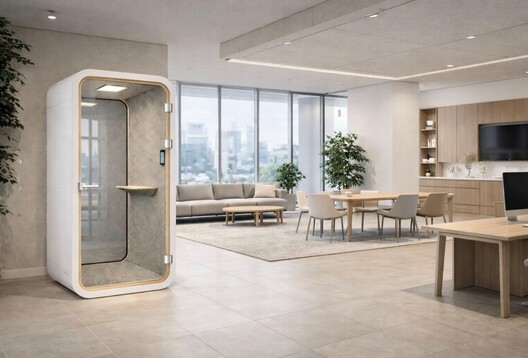
Contemporary workplaces promise collaboration, yet they increasingly struggle to provide spaces for privacy. In an era dominated by open-plan layouts, small acoustic spaces like phone booths and focus pods have become essential for maintaining productivity and privacy. However, the paradox of "booking conflicts" alongside "underutilized spaces" has turned these areas into operational challenges. The question, then, is how workplaces can balance efficiency, productivity, and individualized user experiences within increasingly complex environments.
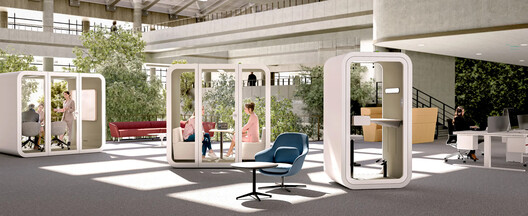
Acoustic pods function as essential spaces for calls, focused work, and private conversations. Yet their management often reveals a structural tension. Systems based on rigid advance booking tend to suppress spontaneity, while first-come-first-served approaches frequently result in disputes, uncertainty, and idle time. At the core of this imbalance lies a fundamental mismatch: traditional scheduling models fail to reflect the fragmented, short-term, and often unpredictable ways these spaces are actually used. Addressing this issue requires more than optimizing availability. It also involves rethinking the quality of the experience inside the pod. Preferences related to ventilation, lighting modes, or furniture configurations also play a crucial role in shaping whether these spaces truly support concentration and comfort. Designing for efficiency, therefore, must go hand in hand with designing for adaptability and user-centered control.
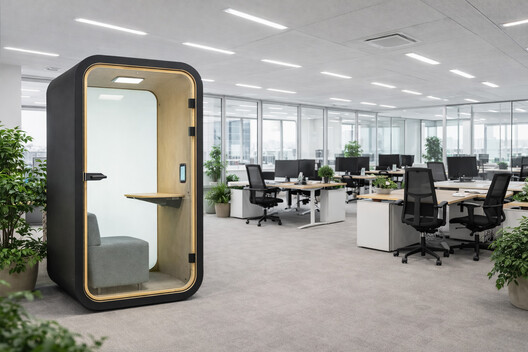
Dancoo's smart booking system proposes redefining the rules by visualizing time as a resource and integrating a dynamic buffer. In this way, these spaces become responsive tools for instant focus and collaboration. The smart booking solution—backed by filed patents—features an intuitive, visual interface. Inside the pod, an interactive touchscreen displays time as a series of modular blocks, each representing a 15-minute interval. Users can reserve time simply by tapping or sliding to combine these blocks, making the process as straightforward as arranging building blocks.
Two key rules guide the scheduling structure. First, all bookings must begin on the hour, quarter-hour, half-hour, or three-quarter hour, aligning schedules to a shared rhythm and eliminating wasted gaps between reservations. Second, a dynamic "courtesy window" (for example, 15–30 minutes) is reserved exclusively for immediate, on-site use. This protects the space from remote bookings and ensures availability for those who need it right away.
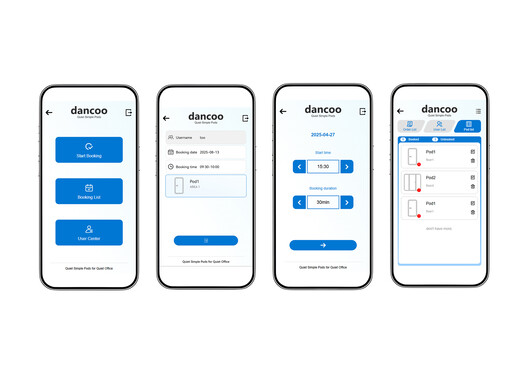
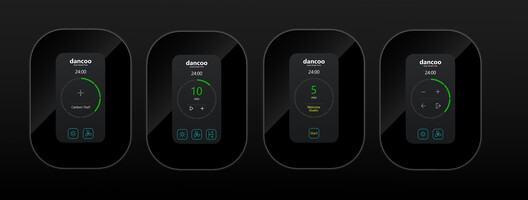
More than just an interface upgrade, this approach represents an algorithmic rethinking of how space is accessed. Through an administrative dashboard, facility managers can adjust the courtesy window dynamically based on real-time data, such as historical usage patterns and peak demand. The system can even apply smart algorithms to recommend optimal settings—automatically extending the buffer during busy periods to preserve walk-up availability and shortening it during slower times to maximize utilization. The result is a self-adjusting management strategy that responds to actual user behavior.
For spontaneous users, a clear three-color status light outside the pod—green for available, amber for an upcoming reservation, and red for occupied—makes it easy to locate and claim a space, with the assurance of a minimum period of uninterrupted use. For planners, the visual timeline provides clarity and supports efficient scheduling.
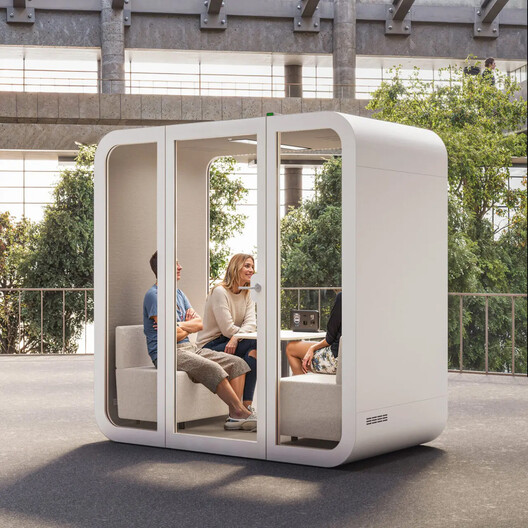
Dancoo's system transforms the acoustic pod from a passive resource into an active, intelligent hub within the workplace ecosystem. A catalog featuring a wide range of office soundproof pods and booths offers the opportunity to rethink how spaces are used. Balancing flexibility with structure and spontaneity with planning, the system underscores an important design insight: beyond acoustics and aesthetics, user experience and access flow play a critical role in office environments. When operational complexity is translated into intuitive interactions and adaptive logic is embedded, technology recedes into the background, allowing the true purpose of the space to take center stage, enabling focused work and seamless conversation.


