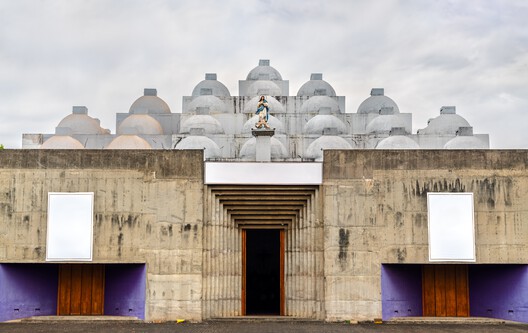
On December 23, 1972, Managua, the capital of Nicaragua, was struck by a 6.3-magnitude earthquake. In a matter of minutes, its urban core, which for decades had functioned as a compact political and economic center, abruptly collapsed. In the reconstruction process that followed, the authorities sought not simply to rebuild but to reorganize. Their objective was to decentralize the city and prevent future paralysis by dispersing functions across multiple zones. Among the most significant architectural outcomes of this shift was the new Metropolitan Cathedral. Its modernist language symbolized both institutional continuity and urban transformation. In doing so, it embodied Managua's transition from a Spanish-style, centralized urban grid to a contemporary, decentralized metropolis.
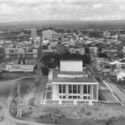
Interestingly, Managua's designation as capital was itself the result of political compromise. Throughout the Spanish period and early republic, León and Granada were dominant and rival centers of power. In 1855, Managua, then a relatively small settlement on the southern shore of Lake Xolotlán, was declared capital precisely because of its intermediate location between the two cities.
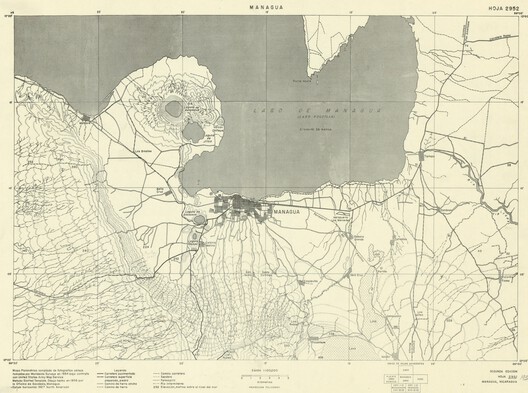
By the late nineteenth century, the city had consolidated national prominence and developed into a thriving administrative center. However, its urban trajectory would be repeatedly interrupted by seismic disasters. The first major rupture occurred with the 1931 earthquake, which destroyed much of the city. Reconstruction efforts, however, did not alter its underlying urban logic. Managua was rebuilt according to the traditional Spanish urban model: a dense orthogonal grid organized around a central plaza, and anchored by a church.
Related Article
Tegucigalpa’s Modernist Revolution: Metroplan and the Shift in the Urban Identity of 1970s HondurasThat church was the Cathedral of Santiago Apóstol. Although its façade evoked European neoclassicism, its structure reflected early twentieth-century industrial engineering. Prefabricated in Belgium, its iron framework was shipped to Nicaragua and assembled under the supervision of Swiss engineer Pablo Dambach. This hybrid system proved resilient at the time, enabling the cathedral to withstand the 1931 earthquake even before it was completed.
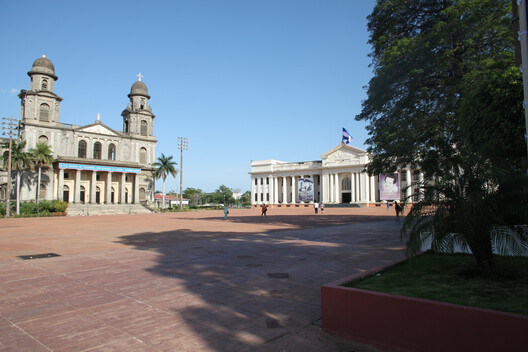
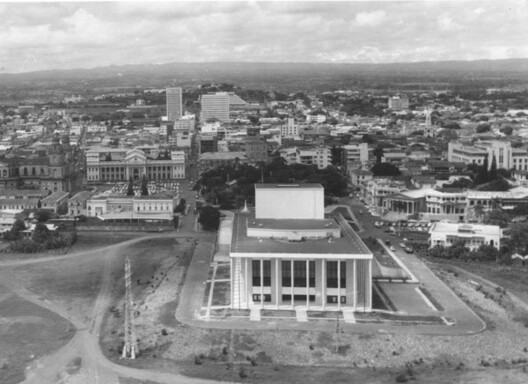
The second and most disastrous event was the 1972 earthquake. The result was the loss of thousands of lives along with the massive destruction of the urban fabric. The old Santiago Apóstol Cathedral did not fall but had become structurally unstable, left with its clock frozen at 12:35 a.m., the time of the disaster. The magnitude of the earthquake forced authorities to completely rethink how they built cities, which led urban planners to dismantle the old urban tradition. The response introduced a new planning doctrine: "deconcentration." Rather than restoring the historic center, authorities promoted spatial dispersion. The downtown area was reclassified as seismically vulnerable and therefore unsuitable as a centralized "nerve center." Hence, economic, governmental, and residential functions were gradually redistributed across the metropolitan territory.
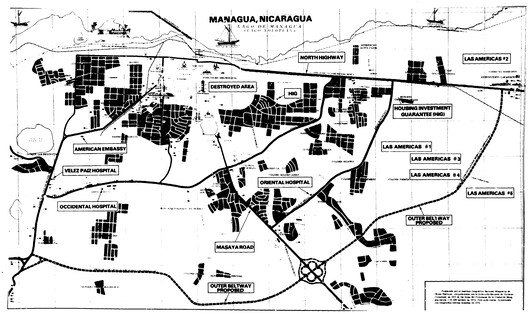
This policy reshaped daily life, with commercial activity migrating toward new corridors, residential development expanding into peripheral zones, and the former center deteriorating into vacant lots. Most of the old downtown remained empty, and the old cathedral was fenced off from the public. For the next two decades, Managua lacked an active cathedral serving as the seat of the archdiocese.
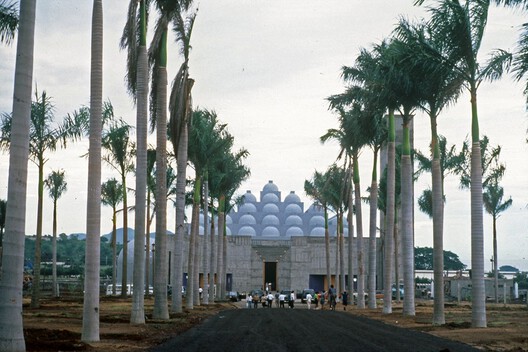
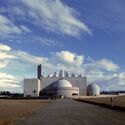
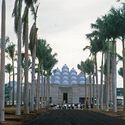
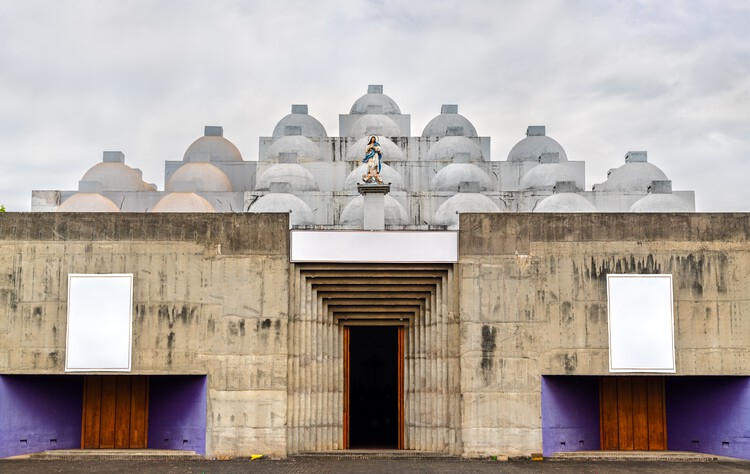
In the early 1990s, the initiative for a new metropolitan cathedral identified a site southeast of the former core. Situated on higher ground to mitigate seismic risk, this location reflected Managua's post-1972 inland migration away from the lakeshore. Rather than attempting to reconstitute the destroyed historic nucleus, planners placed the cathedral within a decentralized urban fabric. The architectural design was commissioned from Mexican architect Ricardo Legorreta with significant financial backing from the United States businessman Tom Monaghan. Inaugurated in 1993, it rejected the verticality and ornamentation of European neoclassicism. Instead, Legorreta utilized horizontality, mass, and material austerity to define the building's presence within the expanding metropolitan territory.
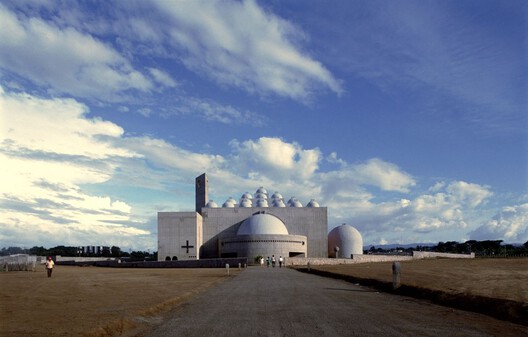
The cathedral's primary feature, sixty-three concrete domes, serves as both a structural and environmental solution. Seismically, these domes are tied to a continuous reinforced-concrete frame, creating a rigid "antiseismic box" engineered for Managua's high-risk geological context. Environmentally, the domes facilitate natural ventilation and controlled daylighting via the stack effect, addressing the tropical climate without relying on mechanical cooling. By replacing traditional religious ornament with a language of shadow and filtered light, the building functions as an example of critical regionalism, where material honesty is dictated by climatic and structural necessity.
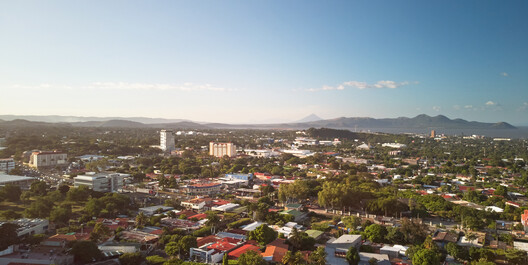
Today, Managua's two cathedrals function as architectural witnesses to a century of urban transformation. The former represents a centralized, colonial-inspired capital: dense, institutional, and politically concentrated. The latter embodies a decentralized metropolis defined by dispersion and modernist expression. In this context, the Metropolitan Cathedral operates not merely as a religious structure but as a new symbol within a reconfigured city. Together, the two buildings demonstrate how architecture can both reflect and actively shape urban memory in the aftermath of disaster and political change.
This article is part of the ArchDaily Topic: Rethinking Heritage: How Today's Architecture Shapes Tomorrow's Memory. Every month we explore a topic in-depth through articles, interviews, news, and architecture projects. We invite you to learn more about our ArchDaily Topics. And, as always, at ArchDaily we welcome the contributions of our readers; if you want to submit an article or project, contact us.


