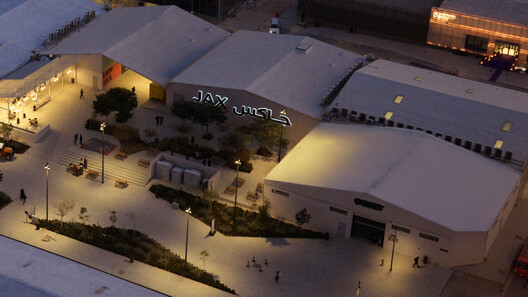
The third edition of the Diriyah Contemporary Art Biennale opened on January 30, 2026, and will remain on view through May 2, 2026, in Riyadh, Saudi Arabia. Organized by the Diriyah Biennale Foundation, the Biennale takes place at JAX District, a former industrial area in Diriyah near the UNESCO World Heritage Site of At-Turaif. Titled "في الحِلّ والترحال" / In Interludes and Transitions, the exhibition is led by Co-Artistic Directors Nora Razian and Sabih Ahmed, while Milan-based architect Sammy Zarka contributed as the Associate Architect and Exhibition Designer. The exhibition scenography is designed by Formafantasma, and the event brings together more than 65 artists from over 37 countries, including more than 25 newly commissioned works.
Structured around ideas of movement, continuity, and transformation, In Interludes and Transitions draws on histories of migration and exchange that connect the Arab region with broader geographies. Rather than advancing a singular narrative, the exhibition unfolds through a sequence of spatial and conceptual transitions, bringing together practices that engage with sound, performance, materiality, and embodied forms of knowledge. As part of the Foundation's broader mandate, which also includes the Islamic Arts Biennale and year-round educational programs, the event operates within a wider framework of cultural infrastructure and adaptive reuse, positioning JAX District as a site for contemporary artistic production within a historically layered context.
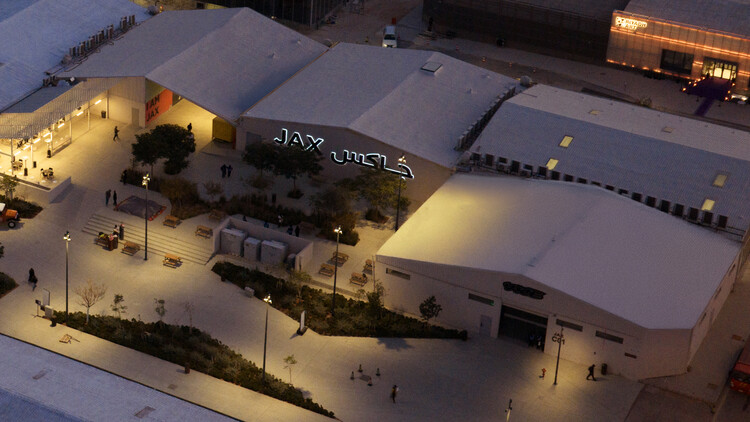
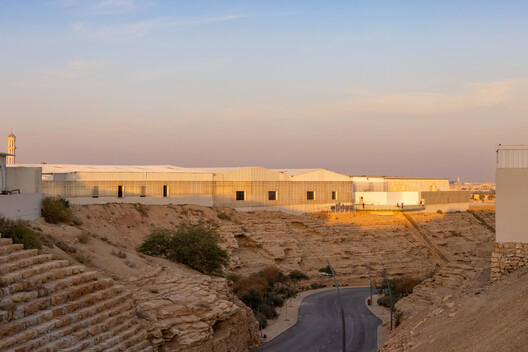
JAX District provides the physical framework for the Biennale. Comprising rehabilitated concrete warehouses and open courtyards, the district offers large, flexible volumes suited to temporary exhibition architecture. Its industrial fabric supports a range of spatial conditions, from enclosed galleries to transitional outdoor areas, allowing artworks to engage directly with scale, circulation, and context. Through its engagement with JAX's industrial architecture and Diriyah's broader cultural landscape, the Biennale situates architecture as an active component of exhibition-making, foregrounding questions of adaptive reuse, spatial sequencing, and the relationship between large-scale cultural events and evolving urban environments.
Related Article
"The Designer Should Challenge The Context:" In Conversation with Formafantasma at Milan Design Week 2024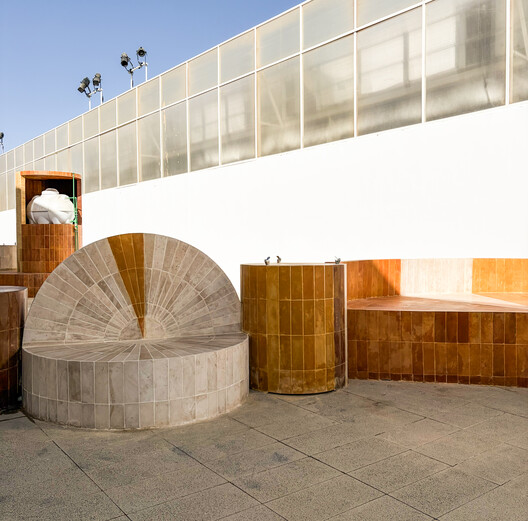
Within this context, Formafantasma's scenography engages directly with JAX's industrial fabric. Described by the studio as a "weightless arrangement of color and form," the approach "grew directly from an engagement with JAX's former industrial fabric, its large, raw warehouse volumes and utilitarian geometry." Rather than introducing conventional walls or rigid segmentation, the design inserts "floating planes and textile elements that hover within the existing structure," activating the air between floors, courtyards, and facades and encouraging visual and physical flow throughout the site. In this way, "color and form become agents of spatial choreography rather than static backdrops," dissolving the heaviness often associated with repurposed industrial architecture and replacing it with a more fluid, porous spatial experience. The intervention celebrates the "rawness and scale of JAX's industrial bones," including expansive volumes, concrete shells, and structural rhythms, while curved canvases, shifting partitions, and calibrated color fields soften the site's orthogonal language. By working with "bending planes that subtly guide movement," the scenography creates moments of pause, reflection, and friction, abstracting the industrial shell into perceptual cues rather than imposing a dominant overlay.
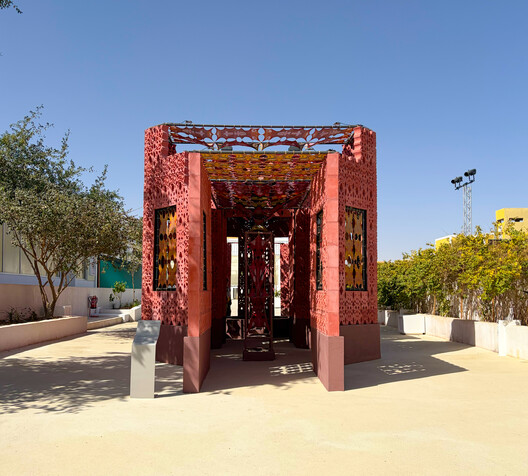
Spanning the Biennale's 12,900-square-meter campus, from halls to courtyards and outdoor terraces, the Formafantasma treats JAX's scale and heterogeneity "as a generator rather than a limit." Existing industrial thresholds informed a scenographic strategy conceived as "a continuous sequence of spatial gestures that connect without severing." Textile partitions and wooden frames modulate sound, sightlines, and passage, respecting each micro-environment while maintaining a legible visitor experience across the site. This continuity forms what the designers describe as "a shared vocabulary of floating elements, shifting planes, and porous boundaries" that adapts to indoor and outdoor conditions without imposing a monolithic overlay. While research and analytical observation informed the process, Formafantasma emphasizes that exhibition design "is not only an intellectual or methodological exercise," but is shaped equally by intuition and by "a close reading of the artworks." Collaboration with Nora Razian and Sabih Ahmed was iterative from the outset, with the Biennale's theme providing a conceptual anchor and requiring that flow be embodied "not just metaphorically, but structurally," through porous boundaries, acoustic permeability, and calibrated rhythms of presence and absence that align spatial form with curatorial intent.
Within this spatial framework, multiple installations further articulate the relationship between architecture, materiality, and movement. Among them are The Source by Augustina Woodgate; AGBA – 8 Stone Cave by Yussef Agbo-Ola (Olaniyi Studio); and Pavilion Prototype III: Camera Obscura #0 Mafadi by George Mahashe.
The Source / Augustina Woodgate
The Source by Agustina Woodgate is part of an ongoing series of site-specific public drinking fountains that examines the geopolitical, ecological, and social dimensions of water access through local materials and regulatory frameworks. Developed following field research conducted in 2025 in Al Ahsa, the world's largest oasis, the project draws on visits to industrial family farms, the last functioning irrigation canal, and former public springs. Woodgate became particularly interested in the historical archives of Al Ahsa's gravity-based irrigation network, an engineering system over 2,000 years old that was collectively managed, with water rights traditionally allocated through time slots regulated by sundials. The work situates itself within a region shaped by UNESCO World Heritage designation, rapid urbanization, and shifting agricultural practices.
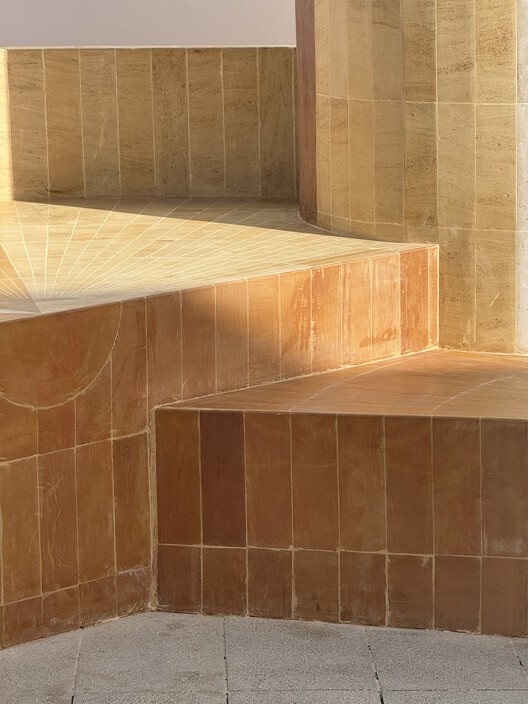
Composed of circular modules, the installation references aerial views of center-pivot irrigation systems, in which long rotating sprinklers water crops in radial patterns across desert landscapes. Common in Saudi agriculture, this method extracts deep groundwater from the Wasia-Biyadh-Aruma aquifers, part of the Arabian Aquifer System formed during wetter climatic periods of the Pleistocene. In The Source, the infrastructural logic of water distribution is made visible: tanks, green PVC pipes delivering drinking water, and white pipes redirecting wastewater for irrigation remain exposed.
AGBA - 8 Stone Cave / Yussef Agbo-Ola (Olaniyi Studio)
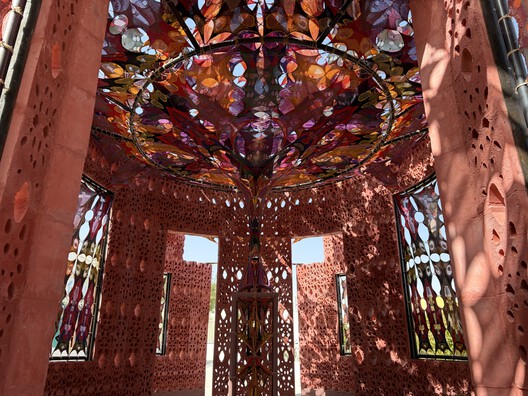
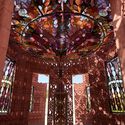
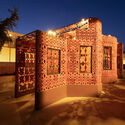
Newly commissioned for the Biennale, AGBA: 8 Stone Cave by Yussef Agbo-Ola (Olaniyi Studio) is conceived as a sacred architectural-sculptural environment that honors the transmission of ancestral knowledge. Drawing from the Yoruba concept of abba, elders as vessels of wisdom and continuity, the work resonates with the Saudi tradition of Al-Qatt Al-Asiri, a form of interior wall decoration practiced by women in the Asir region, where sacred geometries and motifs are passed down through generations. Developed through site-specific research conducted in Abha and Riyadh in 2025, the installation reinterprets local iconographies and materials through Agbo-Ola's hybrid design language, positioning architecture as a carrier of memory and intergenerational exchange.
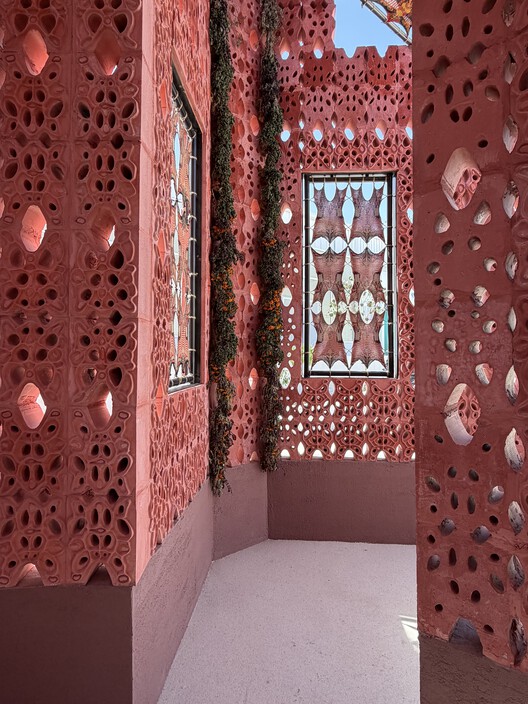
The structure is composed of two interrelated systems described as "skin" and "bone." Its outer skin, a lightweight fabric developed by the artist, references multiple elements embedded in Saudi cultural and ecological landscapes, from the geometric patterns of Al-Qatt Al-Asiri and the herbs and flowers worn by Qahtan tribesmen known as the "Flower Men," to the shell of the Red Sea's hawksbill turtle and the golden-backed weaver bird. The bird, symbolizing flight, movement, and transition, echoes the Biennale's thematic concerns. Supporting this membrane is a clay-brick "bone" structure inspired by insect exoskeletons and traditional ventilation bricks common across the Arabian Gulf.
Pavilion Prototype III: Camera Obscura #0 Mafadi / George Mahashe
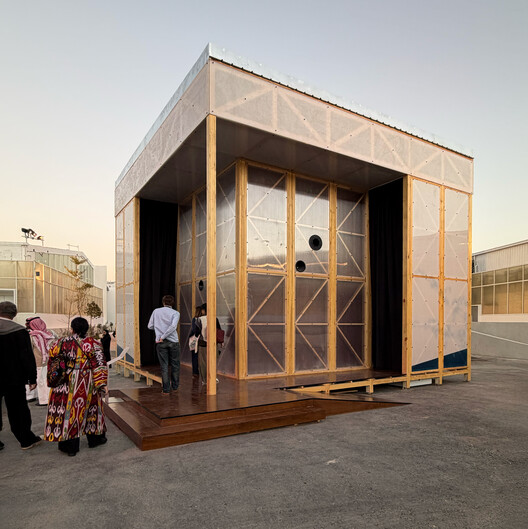
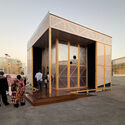
Pavilion Prototype III: Camera Obscura #0 Mafadi by George Mahashe takes the form of a timber camera obscura, transforming the pavilion into an immersive optical chamber. Extending the artist's long-term projects Camera Obscura #0 and - defunct context (both ongoing since 2019), the work functions as a laboratory for rethinking the museum, intangible heritage, and their publics. Visitors enter what resembles the interior of a conventional camera, where projected images, near and distant, cascade across suspended translucent screens. The installation stages a luminous choreography of place, positioning viewers not as passive observers but as witnesses within a spatial field shaped by light, projection, and perception.
At the core of the work lies Mafadi, meaning "salt" in Khelobedu, understood as both material and metaphor. The installation reflects on salt as a cultural and technical substance linked to water and desalination, an inquiry that began after Mahashe visited Saudi Arabia's salt flats and encountered the infrastructures of desalination. These systems resonated with his cultural understanding of salt as a cleanser and mediator of ancestral dreams. Here, desalination is framed as analogous to rainmaking, an act of removal and return intertwined with sovereignty and survival. More than an architectural object, the pavilion operates as a porous archive: a gathering space in which ancestral knowledge, contemporary infrastructures, and speculative futures refract and converge.