

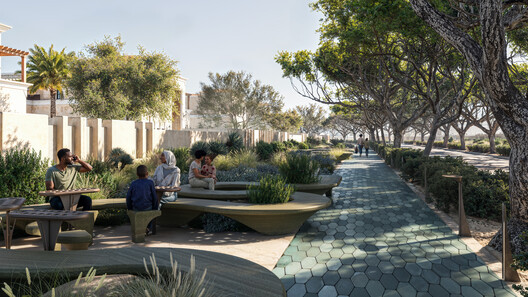
Buildner has announced the results of the Dubai Urban Elements Challenge, a landmark international design competition organized in strategic collaboration with Dubai's Roads and Transport Authority (RTA). With a total prize fund of 2,000,000 AED (approximately €500,000), the initiative represents one of the most significant publicly funded global design competitions focused on urban transformation.
The competition was conceived as a forward-looking procurement and innovation platform for one of the world's fastest-evolving metropolitan environments. Participants were invited to propose modular, climate-responsive urban elements—seating systems, shading devices, lighting infrastructure, wayfinding components, rest areas, and micro-retail structures—designed to enhance pedestrian life and strengthen Dubai's public realm identity.
Responding to Dubai's extreme climate, multicultural demographics, and rapidly expanding infrastructure network, entrants were challenged to develop scalable and durable solutions capable of deployment across diverse urban typologies. The response was global in scope and ambition. The competition received 558 submissions from architects and designers worldwide, demonstrating the capacity of a well-structured international competition to mobilize innovation at scale. Assessed by an international jury comprising leading experts in the industry, the Dubai Urban Elements Challenge brought together senior representatives from the RTA, academic leaders in urban studies, civil engineers with extensive experience in large-scale infrastructure delivery, specialists in public realm transformation, and senior figures from globally recognized architecture firms, including Snøhetta and Calatrava International.
The Roads and Transport Authority has initiated studies to evaluate how selected winning proposals can be implemented as built prototypes across key areas of the city. The objective is to establish a cohesive, high-performance family of urban elements capable of redefining the pedestrian experience and contributing to the evolving visual and spatial identity of Dubai. By aligning municipal ambition, financial commitment, and global design expertise, the Dubai Urban Elements Challenge demonstrates how international competitions can serve as powerful engines for urban innovation. Buildner continues to collaborate with public and private partners worldwide to develop competition platforms that combine global reach, substantial prize funds, and measurable implementation potential.
The winning entries explore a diverse range of formal languages and functional strategies: from poetic reinterpretations of local geometries to robust infrastructural systems shaped by climate, memory, and movement. Each proposal demonstrates how thoughtful design at the micro-scale can generate lasting urban value.
Projects:
First Prize Winner
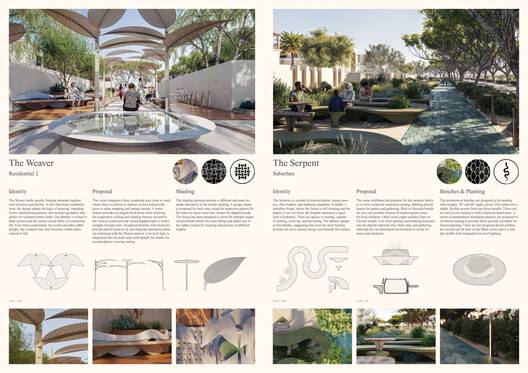
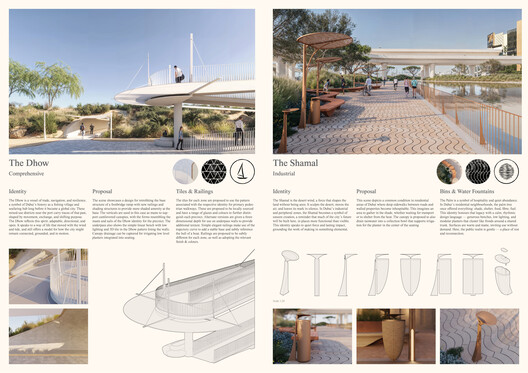
Project title: A Thread Through Time
Author: Oliver Charles Hessian, from the United Kingdom
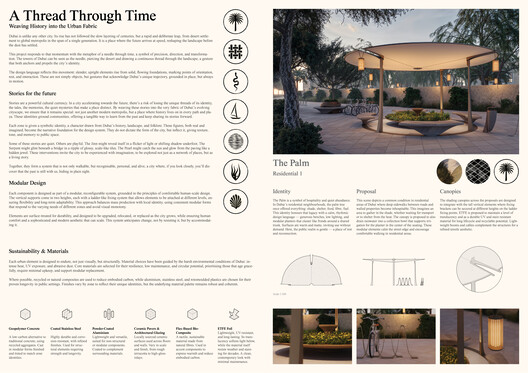
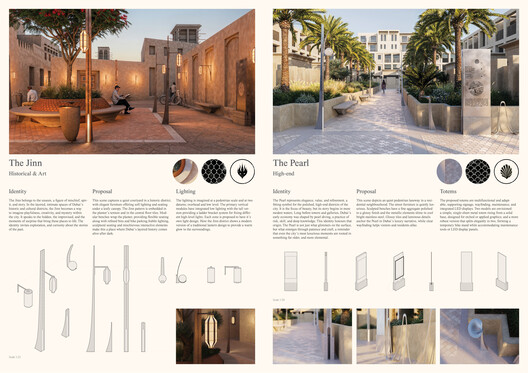
This project proposes a family of urban elements designed as a continuous narrative woven through Dubai's public realm. Drawing on symbols rooted in local history, landscape, and cultural memory, the system translates motifs such as the palm, weaving, serpents, pearls, and maritime references into site-specific benches, canopies, lighting, railings, bridges, and wayfinding elements. Rather than operating as isolated objects, the interventions function as a coherent kit of parts, calibrated to different urban conditions across residential, suburban, industrial, and civic zones. Material choices and construction strategies respond to climate, durability, and maintenance demands, with an emphasis on shade, comfort, and longevity in extreme environmental conditions. Together, the elements establish a recognizable yet adaptable urban language that aims to connect past narratives with contemporary public life, embedding cultural storytelling directly into everyday spatial experience.
Second Prize Winner
Project title: Breathing Masonry
Author: Mohammad Ayesh, from Saudi Arabia
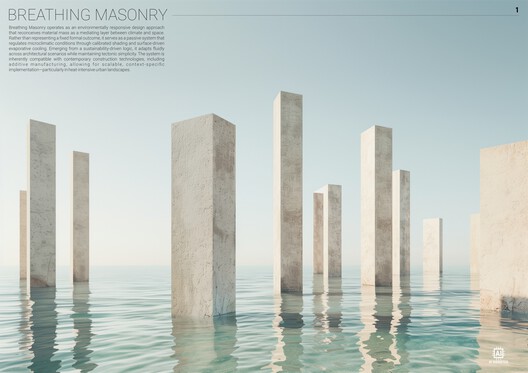
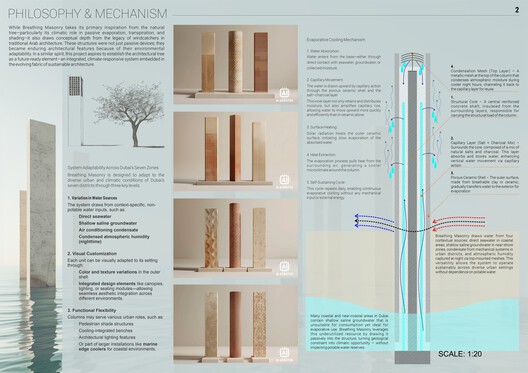
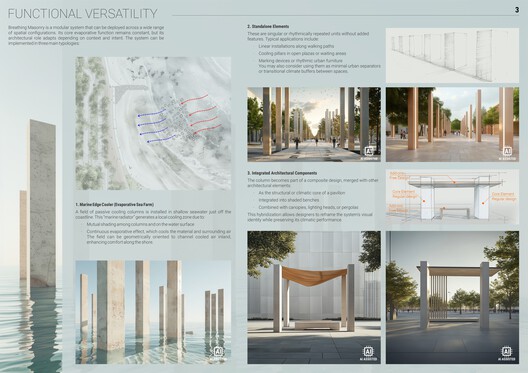
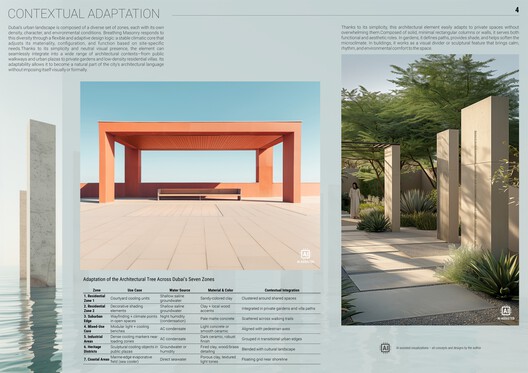
This proposal introduces Breathing Masonry as a modular, climate-responsive architectural system designed to operate across Dubai's diverse urban and environmental conditions. Drawing inspiration from the natural logic of trees and the passive cooling principles of traditional Middle Eastern architecture, the project rethinks material mass as an active mediator between climate and public space. Through evaporative cooling, capillary water movement, and surface-driven heat exchange, the system creates localized microclimates without reliance on mechanical energy. Conceived as a family of adaptable vertical elements, the proposal can function as cooling columns, shading structures, urban markers, or integrated components within larger architectural assemblies. Its strength lies in its scalability and contextual flexibility, allowing deployment from coastal zones to dense urban corridors while maintaining a consistent tectonic language. By combining environmental performance with symbolic clarity, the project positions itself as an infrastructural yet expressive response to Dubai's climatic challenges and rapid growth.
Third Prize Winner
Project title: echo
Authors: Julieta Derdoy and Matias Fidel Moyano, from Argentina
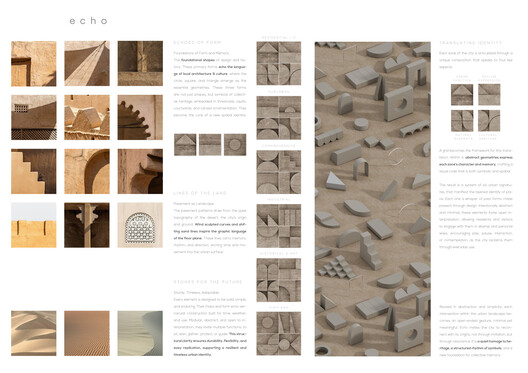
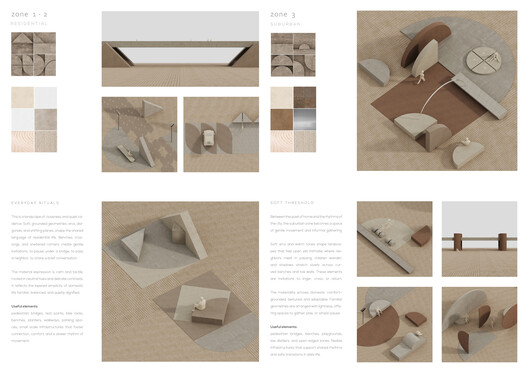
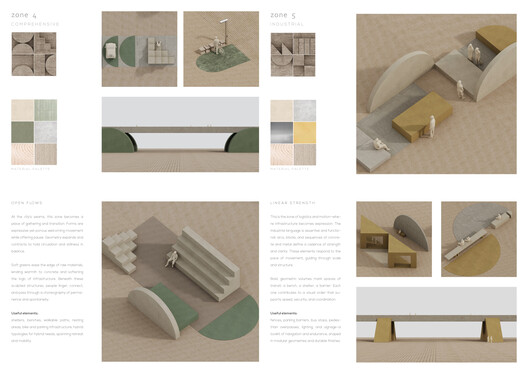
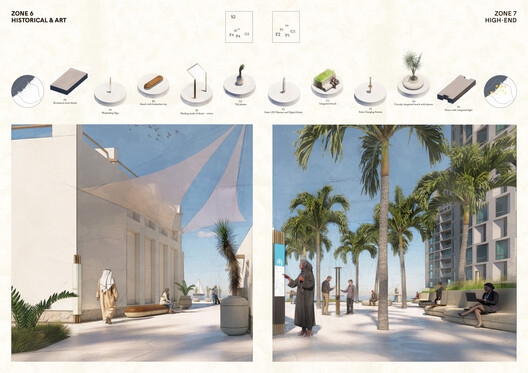
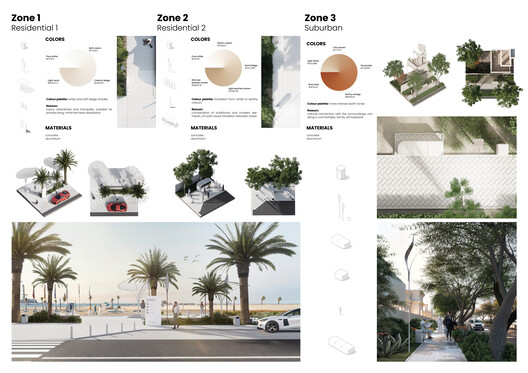
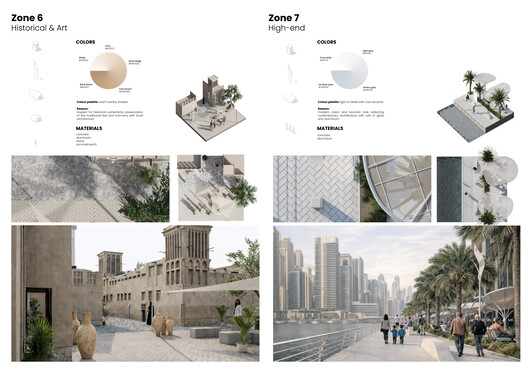
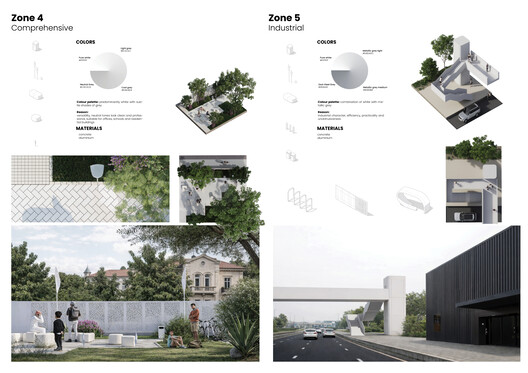
This proposal establishes a modular, scalable urban furniture system rooted in abstraction and symbolism. Drawing on the geometry and textures of local architecture, the design introduces a refined material and formal language across seven urban zones, each tailored to a specific context—from residential to industrial and high-end areas. The result is a coherent and calm spatial identity, where curved and rectilinear elements shape micro-interventions for pause, gathering, or flow. The project's strength lies in its graphic elegance, unified design grammar, and sensitivity to transition, rhythm, and proportion. However, despite its clarity, the system occasionally feels detached from site specificity and cultural particularity, relying more on formal consistency than contextual immersion.
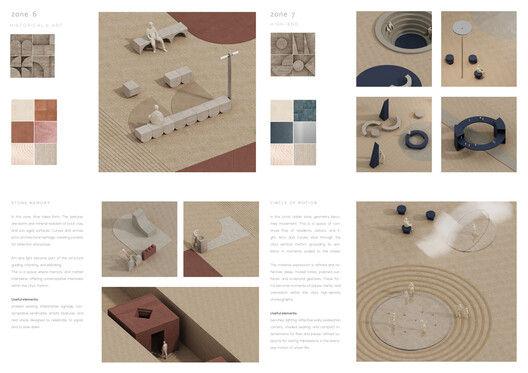
Highlighted Submissions
Project title: Dubai Urban Design Elements
Authors: Thomas W Harrington, from Australia
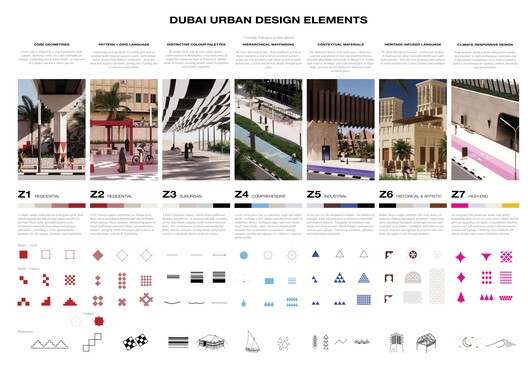
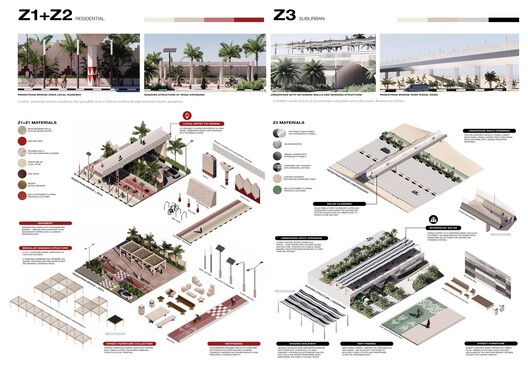
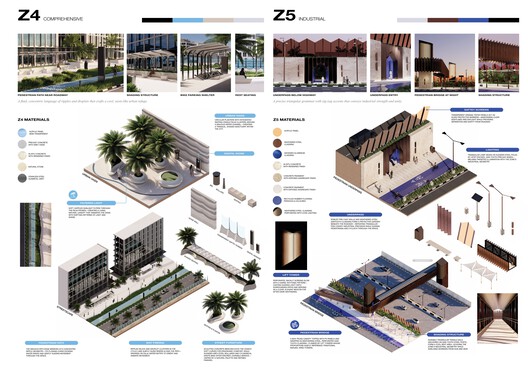
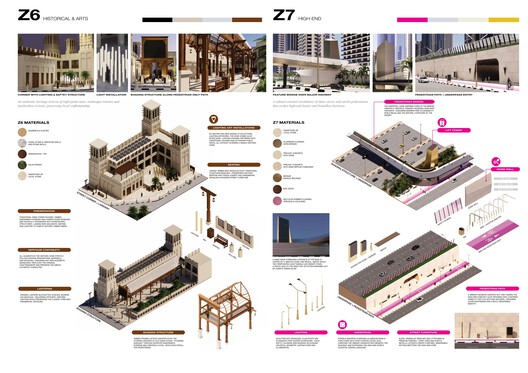
This scheme operates through a modular family of benches, shading structures, lighting, bridges, underpasses, screens, and wayfinding components, each calibrated through distinct geometries, color palettes, and material logics tied to specific urban conditions. Climate performance is central, with layered canopies, filtered light, ventilation strategies, and robust finishes responding to heat, dust, and intensive daily use. Cultural references are embedded through abstracted patterns, proportions, and construction details, allowing continuity without overt symbolism. Elements scale seamlessly from street furniture to infrastructural crossings, reinforcing legibility and spatial identity. As a coordinated kit of parts, the system supports pedestrian comfort, safety, and orientation while enabling phased implementation and long-term maintenance consistency across the city.
Project title: NOOR_The Calligraphic Light of Form
Authors: Roxana-andreea Irimia and Mihai Bogdan Ionită of AEK Design Studio, from Romania
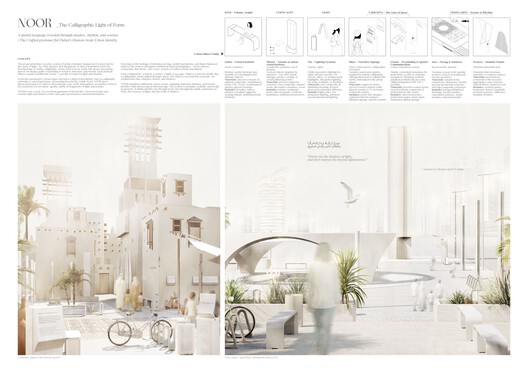
NOOR presents a modular urban furniture system unified by soft geometries, chamfered profiles, and a restrained palette of textured concrete, sand-cast aluminum, and translucent surfaces. Tailored to seven distinct urban zones, each element—from benches and bike racks to shaded shelters and signage—is calibrated to local conditions through material variation and compositional hierarchy. Drawing inspiration from vernacular architecture and the shadow-play of mashrabiya and arcades, the design emphasizes visual lightness, clarity, and civic dignity. A suite of shaded resting areas, water-harvesting canopies, and integrated charging stations supports pedestrian comfort and climate responsiveness. Public amenities feature tactile surfaces and inclusive details to support wayfinding, safety, and narrative engagement. Components are standardized for mass production, durability, and reconfiguration, with a systemic design language that enables both repetition and adaptation.
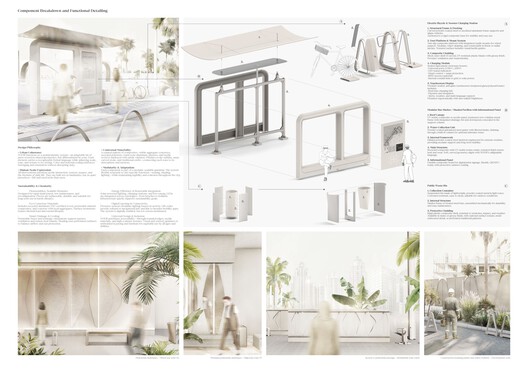
Project title: DIUS
Authors: Róbert Gallo, from the United Kingdom
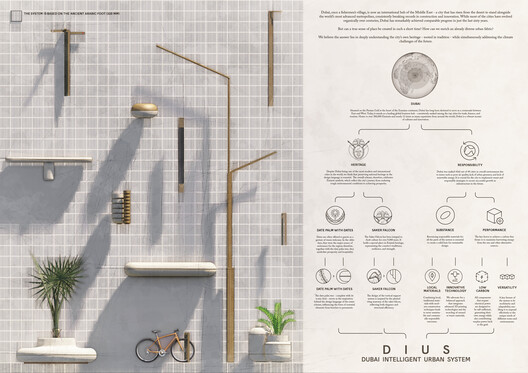
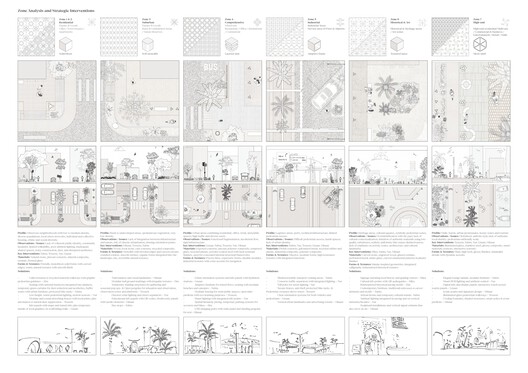
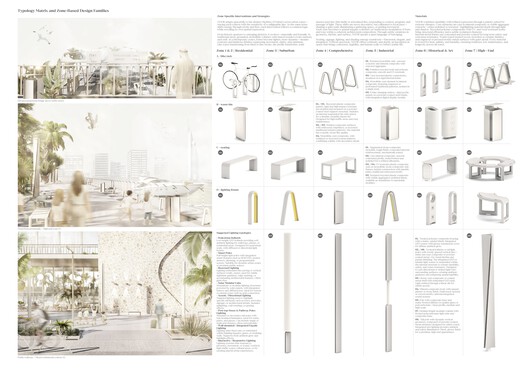
The Dubai Intelligent Urban System (DIUS) outlines a coherent family of modular elements spanning lighting, seating, paving, greenery, and signage, developed around a 280mm grid derived from the ancient Arabic foot. The proposal emphasizes flexibility, local materials, and reduced carbon footprint through interchangeable components that adapt across seven urban zones. Street furniture incorporates renewable and recycled materials, with solar-powered lighting, kinetic shading systems, and seating integrated with planters and bike racks. A consistent formal language based on soft curves and minimal joints links elements like smart lampposts, pedestrian lights, and multifunctional benches. Shading devices track the sun, paving materials embed recycled glass and aggregates, and greenery modules support biodiversity and cooling. The system also enhances existing structures with bio-reactive algae tiles and upgraded underpass walls, offering a comprehensive, scalable design for future-ready urban infrastructure.
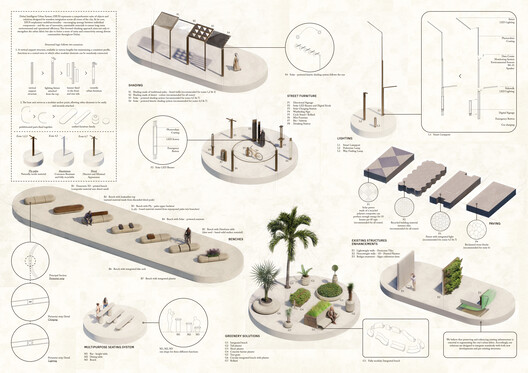
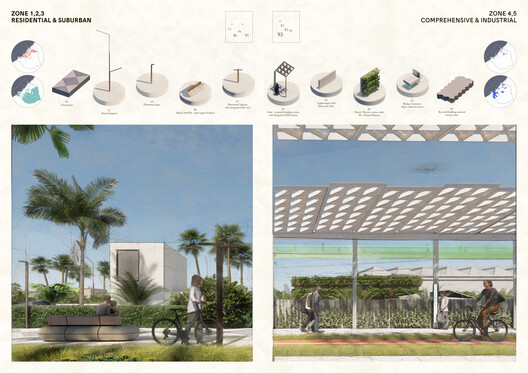
Project title: Emergent Micro-Urbanisms
Authors: Henry Stuart Crothers, from Australia
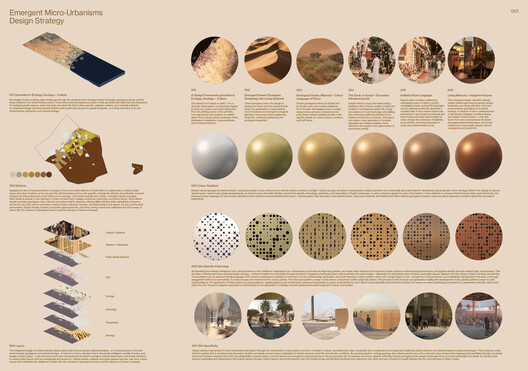
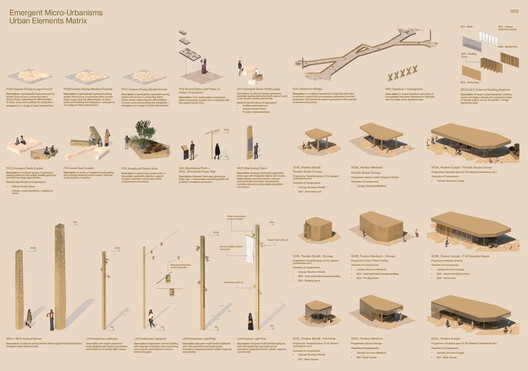
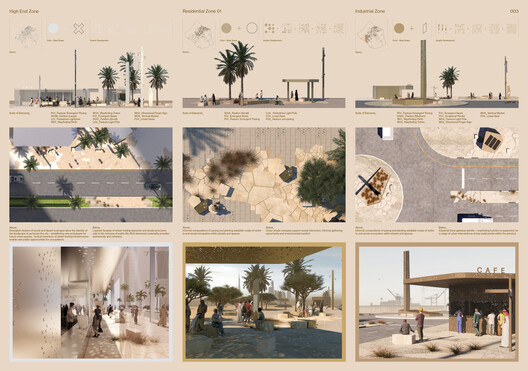
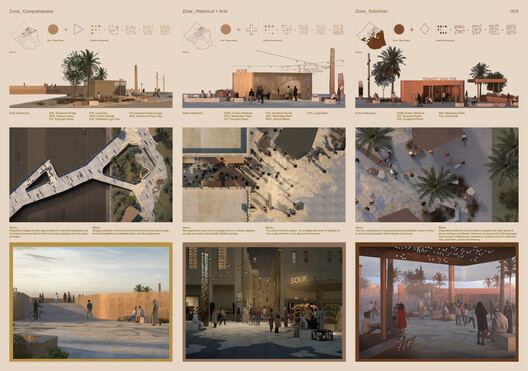
A comprehensive design strategy is first outlined through seven thematic lenses, from geological sands and socio-economic infrastructures to adaptive futures, before translating these into an urban design matrix of over 25 site-specific elements. These include textured concrete pavers, extruded aluminum light poles with pattern perforations, mesh-clad pavilions, linear seating, and sculptural planters. Each item is assigned a color gradient based on sand hues, and a pattern logic that responds to local climatic conditions and neighborhood identities. Zones across the city receive tailored suites of elements that assemble into streetscapes emphasizing porosity, shade, and pedestrian connectivity.
Project title: Urban Fabric of Dubai
Authors: Abdulkadir Eren Öztürk and Damla Turan Sutcu, of company SKAB, from Turkey
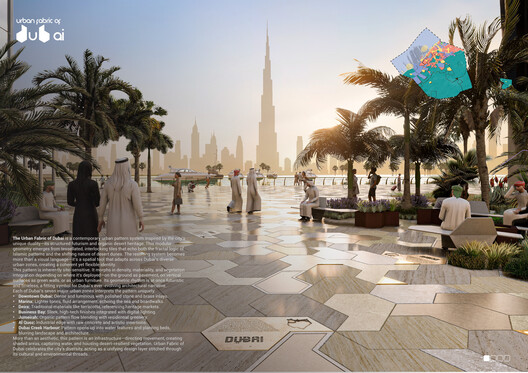
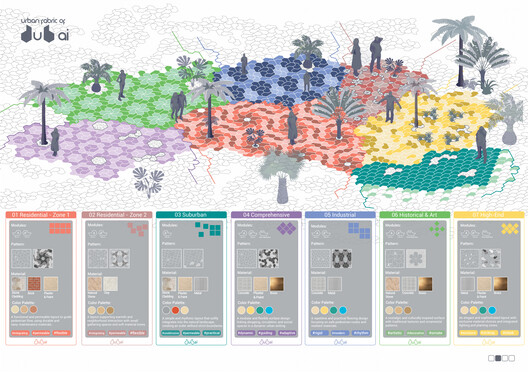
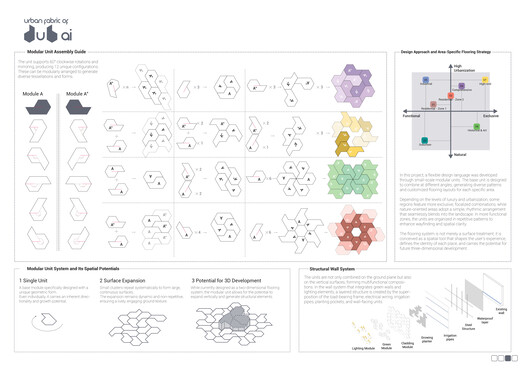
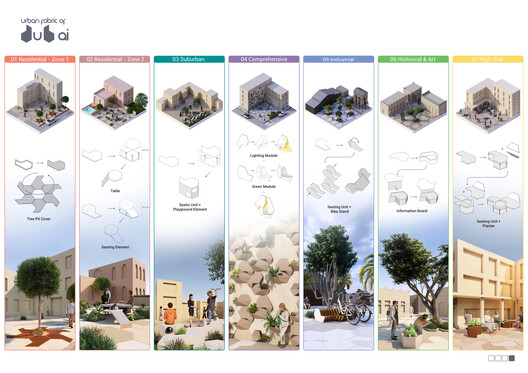
The Urban Fabric of Dubai is a modular public realm system designed to unify the city's diverse neighborhoods through a shared spatial language rooted in Dubai's dual identity of futuristic ambition and desert heritage. Using two interlocking base tiles rotated and mirrored in 60° increments, the design generates twelve tessellation configurations that define surfaces, vertical structures, and 3D modules across the seven distinct urban typologies. Each area features a customized material palette (stone, brick, concrete, plaster, brass, metal) and unique modular components such as seating, lighting, bike racks, green walls, and playgrounds, tailored to local needs and context. A full-scale flooring strategy maps these typologies across Dubai's territory, defining transitions and wayfinding through patterns, textures, and vegetation. With potential for 3D structural expansion, this proposal positions flooring not as surface treatment but as connective tissue linking place, identity, and user experience.
Project title: The Brass Thread
Authors: Nicholas Michael Adams, from New Zealand
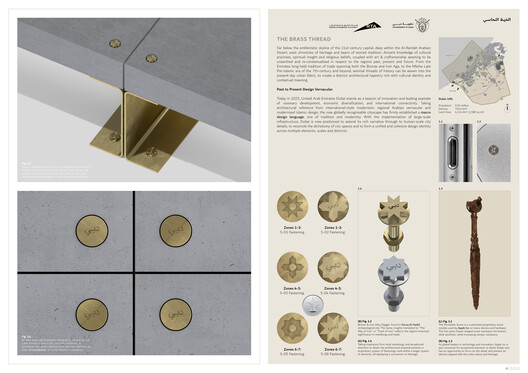
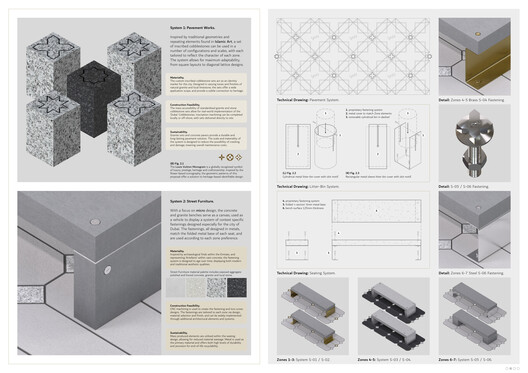
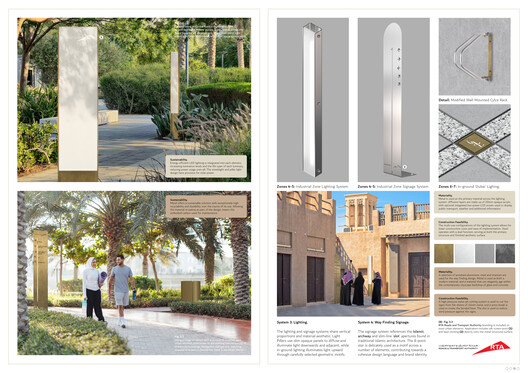
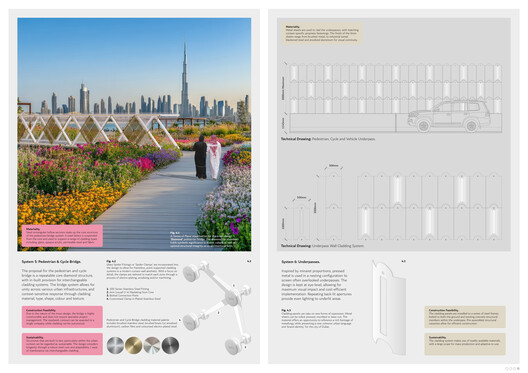
The Brass Thread proposes a network of public realm elements unified through a distinctive brass fastener system used across benches, bins, signage, and lighting components. Drawing on geometric motifs and archeological references, the design integrates materials such as concrete, granite, and anodized metal, with each element tailored to its context. Pavement units use modular cobblestones marked with etched motifs, while benches incorporate recessed metal panels to display context-specific patterns. Signage and lighting columns adopt shared proportions and detailing, with provisions for solar power and LED integration. A modular bridge structure employs diamond-shaped segments with interchangeable cladding, and underpass panels are configured to conceal infrastructure while introducing ambient lighting and cultural ornamentation.
Project title: The Ghaf Line
Authors: Róbert Lipták, Nikoleta Mitríková, and Jakub Demčák, Slovak University of Technology in Bratislava (STU), from Slovakia
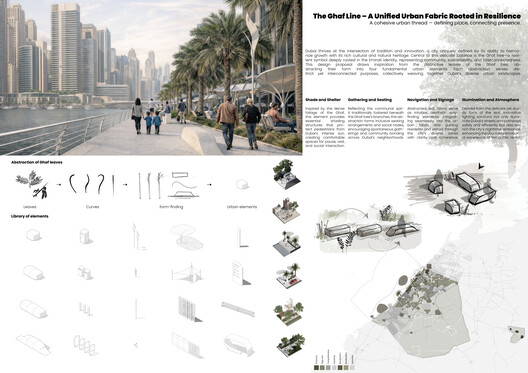
This proposal establishes a cohesive, city-wide design language for Dubai through a modular system of urban elements inspired by the native Ghaf tree. Abstractions of the tree's leaves inform the geometry of seating, shading structures, lighting, and signage, offering a culturally grounded yet contemporary identity. The design operates at multiple scales, from street-level installations to district-wide coherence. It introduces a curated library of modular elements deployed across eight defined urban zones, each adapted to local architectural and social contexts, from historical areas with rammed earth and warm tones to high-end districts with cool, sleek finishes. A single system accommodates contrasting needs: enhancing walkability, reducing solar exposure, and encouraging spontaneous community interaction. The intervention aligns material and color palettes with context-specific atmospheres while ensuring urban continuity.
Buildner's other ongoing competitions include The Unbuilt Award 2026, celebrating visionary unbuilt projects across three scales, with a €100,000 prize fund; and The Next House: USA, which invites innovative ideas for a new American suburban prototype: a home that is compact yet generous, adaptable yet grounded, replicable yet sensitive to place.


