Designing With, Not For: CatalyticAction’s Participatory Practice

Sponsored Content

Architecture is often evaluated through finished forms, yet some practices operate in a different register, one where design unfolds through relationships, time, and use rather than through a single outcome. For CatalyticAction, participation is not a parallel social activity, but the means through which spaces are conceived, constructed, and sustained over time.

Based between Beirut and London, the practice has worked across the Middle East and Europe, developing public spaces, schools, playgrounds, and everyday urban infrastructures through long-term collaboration with local communities. Grounded in participatory research and collective decision-making, this approach was recognized through ArchDaily's 2025 Next Practices Awards, highlighting a mode of practice where architecture is understood as a shared, evolving process rather than a fixed object. In this context, architectural value is measured through continuity, use, and collective ownership, rather than through form alone.


Designing With, Not For: CatalyticAction’s Participatory Practice - Image 2 of 26Designing With, Not For: CatalyticAction’s Participatory Practice - Image 3 of 26Designing With, Not For: CatalyticAction’s Participatory Practice - Image 4 of 26Designing With, Not For: CatalyticAction’s Participatory Practice - Image 5 of 26Designing With, Not For: CatalyticAction’s Participatory Practice - More Images+ 21

Founded in 2014, CatalyticAction brings together architects, researchers, artists, builders, educators, and practitioners from multiple disciplines. Their work is structured around an integrated approach that combines design and construction with participatory research, community engagement, and advocacy. Participation frames every stage of a project, from identifying needs and co-designing spatial strategies to implementation, activation, and long-term stewardship.


Related Article

20 Practices Shaping the Future of Architecture: Winners of the ArchDaily 2025 Next Practices Awards

Designing With, Not For: CatalyticAction’s Participatory Practice - Image 23 of 26
CatalyticAction Team. Image Courtesy of CatalyticAction

Instead of focusing solely on form as an isolated result, the practice highlights durability, adaptability, and social relevance. By working closely with communities, employing local labor, and using context-appropriate materials and construction techniques, CatalyticAction produces spaces that are embedded in their environments and capable of evolving with their users. In this sense, the work strengthens relationships and shared responsibility as much as it produces physical space.

By placing the community at the heart of the design process, we ensure that the spaces created are not just built for the people but with the people. —Joana Dabaj, co-founder of CatalyticAction

This approach also shifts how time is understood in architecture. Projects are not understood as complete once construction ends, but as frameworks that continue to change through use, care, and appropriation. Maintenance, activation, and everyday adaptation are therefore treated as integral elements of design, rather than as secondary considerations.

Designing With, Not For: CatalyticAction’s Participatory Practice - Image 21 of 26
Ibtasem Playground 2015, CatalyticAction. Image Courtesy of CatalyticAction

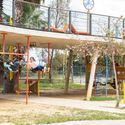
Across its work, this principle unfolds consistently, regardless of scale or typology. Early interventions such as the Ibtasem Playground in the Bekaa Valley demonstrate how co-design operates not as a symbolic gesture, but as a shared act of making. Conceived and built with children and their families, the project framed play as a form of civic presence, introducing safe and culturally resonant elements into an otherwise precarious environment. Simple play structures built with locally available materials were shaped through workshops with children, ensuring that swings, climbing elements, and gathering areas responded directly to their ideas and daily routines.

Designing With, Not For: CatalyticAction’s Participatory Practice - Image 22 of 26
Jarahieh School 2016, CatalyticAction. Image Courtesy of CatalyticAction

This same logic extends to educational architecture. At Jarahieh School, learning spaces were co-designed and constructed with students, teachers, and caregivers using locally sourced materials. The school functions not simply as a building for instruction, but as a collective environment shaped by those who use it daily, capable of adapting as needs evolve.

Designing With, Not For: CatalyticAction’s Participatory Practice - Image 24 of 26
Beirut Public Stairs, Vendome Stairs, CatalyticAction. Image © Ahmad Shinder

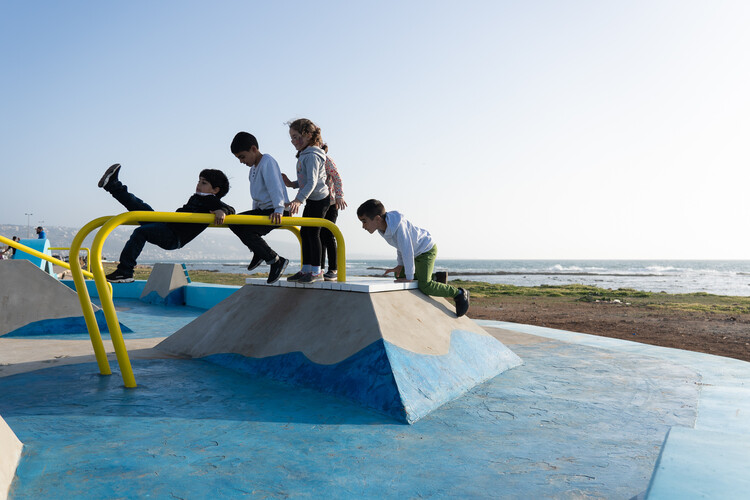
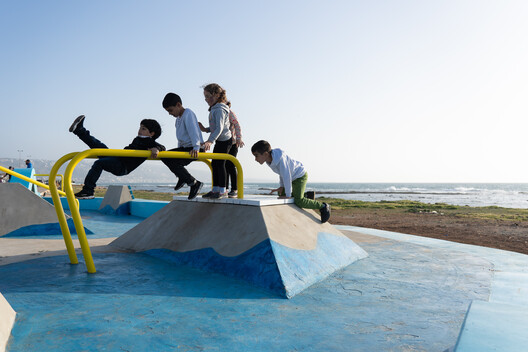
In dense urban neighborhoods, the approach shifts scale without changing structure. The rehabilitation of Beirut's Public Stairs reimagines everyday infrastructure as shared space, transforming vertical connectors into places of encounter, play, and rest. Through the insertion of integrated seating, shade structures, and subtle play elements along the stairways, circulation becomes an opportunity for pause and interaction within the city's steep fabric. Along the northern coast, Mauj reactivates a neglected stretch of the El Mina corniche through a participatory process that brings together residents of different ages and abilities. Wave-inspired benches, climbing structures, and accessible ramps translate collective input into spatial gestures that encourage movement and gathering along the waterfront. In both cases, design amplifies how communities already inhabit their surroundings, rather than imposing new spatial hierarchies.

Designing With, Not For: CatalyticAction’s Participatory Practice - Image 26 of 26
Mauj Public Space 2022, CatalyticAction. Image © Ahmad Shinder

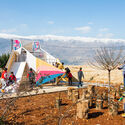
The work in Karantina further illustrates how this framework operates in contexts marked by trauma and instability. Following the Beirut port explosion, the rehabilitation of Karantina Park positioned public space as a site of collective recovery. Through co-design, residents, schools, and local authorities shaped a park that supports gathering, play, and everyday use, reinforcing continuity in a fragmented urban landscape. New play elements, shaded seating areas, and durable steel and concrete structures were introduced to ensure long-term use, while the layout responded directly to how the community had inhabited the space before the explosion.

Designing With, Not For: CatalyticAction’s Participatory Practice - Image 4 of 26
Karantina Park Rehabilitation 2020-2021, CatalyticAction. Image Courtesy of CatalyticAction

Questions of gender and access to public space are addressed within the same methodological structure. In the recent Safe Spaces for Girls project in Karantina, co-design was used to explore how adolescent girls experience and navigate the city, translating their reflections into built interventions that respond to issues of safety, visibility, and belonging. A mural, a shaded outdoor living area, and a streetscape installation incorporating seating and reflective elements materialized their perspectives, making their presence in public space both visible and spatially anchored.

Designing With, Not For: CatalyticAction’s Participatory Practice - Image 25 of 26
Safe Spaces for Girls 2024, CatalyticAction. Image © Youssef Itani

Across these varied contexts, the underlying framework remains consistent: co-design as process, public space as social infrastructure, and long-term stewardship as part of design itself. Projects are not conceived as completed objects, but as environments that continue to evolve through use, feedback, and shared responsibility over time.

Designing With, Not For: CatalyticAction’s Participatory Practice - Image 9 of 26
Karantina Park Rehabilitation 2020-2021, CatalyticAction. Image Courtesy of CatalyticAction

Beyond construction, the practice extends this exchange into research and knowledge sharing. Lessons learned through built work are translated into tools and guidelines that inform future projects and contribute to broader conversations on inclusive and participatory design. Research does not sit alongside practice; it grows from it, reinforcing a continuous relationship between making, learning, and adaptation.

Designing With, Not For: CatalyticAction’s Participatory Practice - Image 3 of 26
Karm El Arees Safe Public Park 2021, CatalyticAction. Image Courtesy of CatalyticAction

Recognized through ArchDaily's 2025 Next Practices Awards, CatalyticAction's work suggests an expanded understanding of architecture: one that is measured not only through form, but through continuity, collective agency, and everyday life.

This article is presented by Buildner. As sponsor of ArchDaily's 2025 Next Practices Awards, Buildner—the world's leading architecture competition organizer—helps architects get what they enter competitions for: recognition, opportunity, and progress.

Exercise your creativity now: the Buildner UNBUILT Award 2026 is open to all, with a €100,000 prize fund. Submit your unrealized designs and celebrate your creativity now.


Related Article

20 Practices Shaping the Future of Architecture: Winners of the ArchDaily 2025 Next Practices Awards

Image gallery

See allShow less
About this author
Cite: Daniela Andino. "Designing With, Not For: CatalyticAction’s Participatory Practice" 23 Feb 2026. ArchDaily. Accessed . <https://www.archdaily.com/1038730/designing-with-not-for-catalyticactions-participatory-practice> ISSN 0719-8884

You've started following your first account!

Did you know?

You'll now receive updates based on what you follow! Personalize your stream and start following your favorite authors, offices and users.