

Preserving historic buildings requires simultaneously addressing technical, environmental, and regulatory demands while maintaining the material, cultural, and symbolic continuity of what already exists. As the understanding consolidates that the most sustainable building is the one that is already standing, and that preservation also involves construction knowledge, material traditions, and the social fabrics from which they emerged, these same buildings are increasingly confronted with more rigorous contemporary parameters. Energy efficiency, safety, carbon emission reduction, and regulatory compliance have become unavoidable references, placing architecture before a central tension: how to update what already exists without breaking the continuity that sustains its heritage value.

Intervening in historic heritage thus becomes particularly challenging. In addition to dealing with multiple layers of history, complex technical decisions, and different possible paths of intervention, architects are confronted with buildings conceived in another time, based on constructive, environmental, and technological logics profoundly different from those of today. Systems that once did not exist need to be introduced, performance must be improved, and often entire elements must be updated or created, all without compromising what gives the building its identity and meaning. Retrofit, in this sense, ceases to be merely a technical updating operation and takes on a mediating role, balancing contemporary performance demands with the permanence of material and spatial values, while recognizing that not every solution that is efficient from a regulatory standpoint is necessarily appropriate in heritage terms. The central question shifts from how much can be added or replaced to how to intervene, with what degree of legibility, reversibility, and respect for existing constructive logics.
From this perspective, materials assume a decisive role, becoming critical instruments capable of stitching past and present together and of translating, in concrete terms, the decisions made throughout the intervention process. They can operate through contrast or mimicry, reinforcing or questioning the relationship between the existing and the new. In many heritage protection contexts, where preservation focuses primarily on façades, contemporary buildings are organized behind historic envelopes, requiring material choices to be even more conscious and legible. The introduction of new materials, such as concrete, steel, glass, or high-performance systems, can either reinforce the historical reading of a building or erase it entirely. When employed carefully, these materials do not compete with the existing heritage, but rather reveal its layers, make the time of intervention explicit, and extend the building's lifespan, without resorting to uncritical imitation or excessive neutralization.

An example of this approach can be seen in the Argo Contemporary Art Museum and Cultural Centre in Tehran. Installed in a former industrial brewery, the project preserves the exposed brick walls and the raw atmosphere of the original structure while introducing a new spatial organization through exposed concrete and metal elements. These new materials do not attempt to reproduce the existing language, but explicitly assume their contemporary condition, creating a controlled contrast that makes the passage of time legible. This logic also extends to the structural system introduced in the retrofit. The new supporting structure, developed by structural engineer Behrang Bani Adam, establishes a restrained dialogue between traditional metal roofs (halabi), recurrent in Tehran's vernacular architecture, and the new concrete slabs and roofs that "float" over the exhibition spaces. These performative roofs reinterpret a local constructive element, creating distinct lighting atmospheres for the cultural programs below.


A similar strategy appears in the conversion of the Gösserhalle (GOH Conversion) in Austria, where a former industrial structure is adapted to new uses through the precise introduction of contemporary systems and a new spatial organization inserted within the historic envelope. The exterior walls of the original building were preserved, and a combination of concrete, wood, and metal was used to enable a new autonomous volume capable of meeting current requirements of use, comfort, and safety. The removal of the existing roof allows for the insertion of a three-story building that houses offices and a restaurant, fully contained within the original perimeter. Between the old envelope and the new construction, an interval of approximately three meters is established, an intermediate space that makes explicit the distance and the relationship between old and new. Far from being residual, this "in-between" operates as a spatial, environmental, and constructive device, explored through criteria of performance, material rationality, and economy of means. Based on modular prefabricated elements and the combination of concrete, wood, and metal, the project makes the time of intervention legible and transforms the adaptation of the existing building into a conscious architectural experience, without resorting to mimicry.

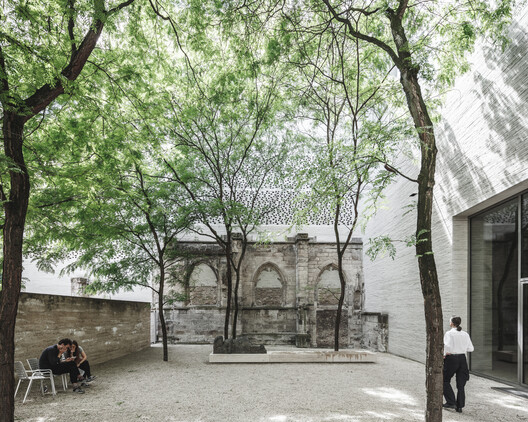
This logic of material mediation finds a particularly precise formulation in the Kolumba Museum in Cologne, designed by Peter Zumthor. Built over the ruins of the Gothic Church of St. Columba, destroyed during World War II, the project does not separate past and present into autonomous volumes, nor does it resort to literal reconstruction. Instead, it constructs continuity through materiality. The new light-gray brick walls envelop, traverse, and incorporate the existing remains, creating a thick, quiet, and deeply sensory architecture in which ruin, contemporary structure, and exhibition space coexist without explicit hierarchy. The new building does not imitate the historical language but engages in dialogue through material proximity, rhythm, and mass, allowing time to be perceived not as rupture, but as superposition. At Kolumba, retrofit asserts itself less as a technical or formal gesture and more as an ethical stance, in which materials operate as sensitive mediators between memory, contemporary use, and architectural experience.

The Cassina Innovation House expands this discussion by shifting the debate from strictly historical heritage to the field of cultural and productive legacy. The transformation of a building constructed in 1896, in ruins since the 1960s, into a space for research, work, and experimentation began with the conscious acceptance of the ruin as a value, preserving degraded façades and traces of time as active elements of historical reading. The project articulates preservation and updating through the insertion of new materials, systems, and a clearly contemporary industrial metal structure, without erasing the building's original identity. A lush tropical garden is implanted behind the main façade, creating a central void crossed by walkways that connect different levels and evoke the Amazonian landscape, fusing the memory of the ruin with an atmosphere associated with technology and contemporaneity. This spatial operation also plays a decisive role in the building's environmental performance: the reduced width of the structure and the central void allow for cross-ventilation on all floors, complemented by ventilated openings, wide eaves, and, on the east façade, a double-skin ventilated façade solution with tempered glass louvers. Through the superposition of historical ruin, tropical garden, and new constructive systems, the Cassina Innovation House synthesizes different economic cycles of Manaus, from the rubber era to the industrial district and into the digital economy, and highlights retrofit as a practice capable of articulating time, territory, productive memory, and innovation.


Finally, the House of the Weimar Republic in Germany makes explicit the limits and possibilities of retrofit in contexts of high symbolic load. Located opposite the Weimar National Theatre, the building, a former carriage depot dating from 1823 and protected as heritage, carries a history marked by successive transformations. Its adaptation for exhibition use required the incorporation of contemporary systems for climate control, accessibility, and safety, all inserted in a precise and controlled manner, without competing for prominence with the existing structure. New materials appear as complementary layers, allowing the original building to remain at the center of the spatial and narrative experience. A decisive role is played by the ruin of the adjacent former arsenal, whose preserved walls articulate with the new museum extension, establishing a physical and symbolic continuity between past and present. The extension adopts a deliberately restrained stance: a light, clear structure in exposed concrete maintains distance from the historic building, connecting to it through equally discreet circulation elements. Inside, simple surfaces and sustainable materials reinforce an atmosphere of sobriety and presence, while the extension's façade, composed of continuous white tubes, functions as a contemporary "skin" that expands the program without eclipsing the existing heritage. In this balance between formal restraint and constructive clarity, retrofit asserts itself not as an iconic gesture, but as an instrument of mediation between memory, public use, and historical narrative.

It becomes evident that the continuity of architectural heritage does not depend on the literal preservation of all its elements, but on the ability to understand which materials, spaces, and constructive logics concentrate its cultural value over time. When treated as a critical practice rather than merely a technical response, retrofit allows buildings to traverse new temporal layers without losing their identity. By introducing contemporary materials in a legible, compatible, and, whenever possible, reversible manner, architecture acknowledges that heritage is not a fixed state, but a process in constant negotiation.
This article is part of the ArchDaily Topic: Rethinking Heritage: How Today's Architecture Shapes Tomorrow's Memory. Every month we explore a topic in-depth through articles, interviews, news, and architecture projects. We invite you to learn more about our ArchDaily Topics. And, as always, at ArchDaily we welcome the contributions of our readers; if you want to submit an article or project, contact us.

