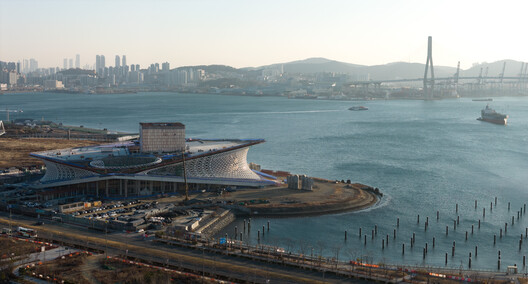
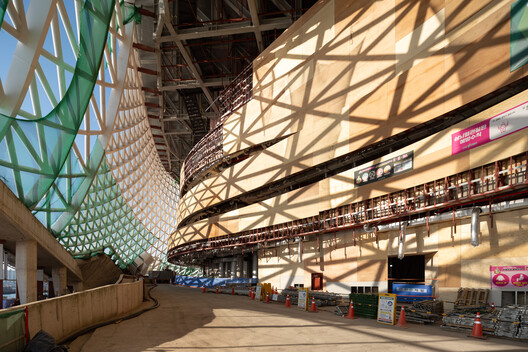
Commissioned in 2012 following an international design competition, Snøhetta's Busan Opera House is under construction on the city's North Port waterfront, with major works scheduled for completion in late 2026 and an opening planned for 2027. Conceived as the first opera house in South Korea's second-largest city, the project redefines the traditional opera house as an open and inclusive civic institution. Rather than operating solely as a venue for performance, the building is envisioned as a public destination that supports everyday use, collective experience, and long-term cultural engagement within Busan's evolving urban landscape.

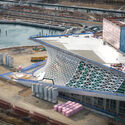
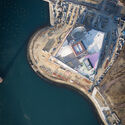
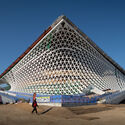
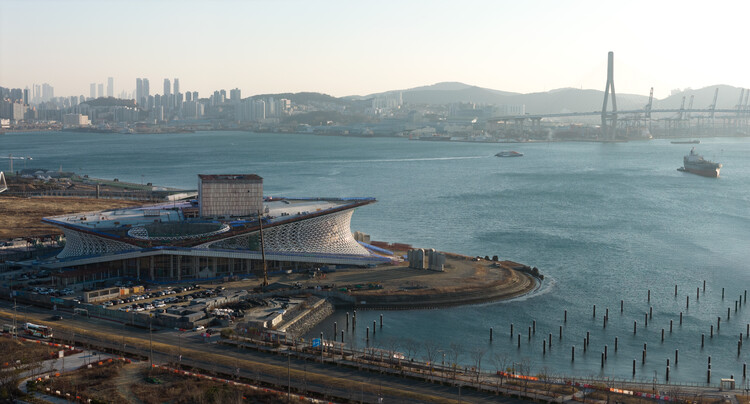
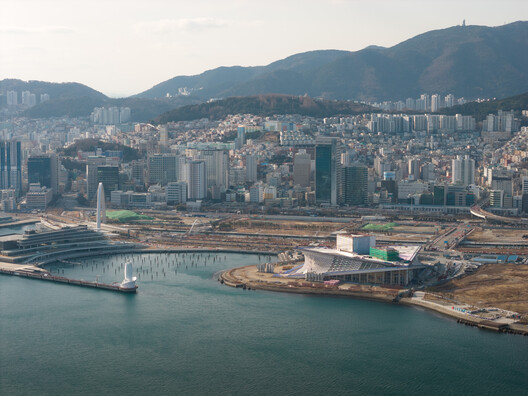
Situated on reclaimed land, the opera house plays a key role in transforming a formerly industrial waterfront into an accessible public realm. The 48,000-square-meter building integrates performance spaces with plazas, promenades, and a publicly accessible rooftop, reinforcing connections between the city, the park, and the sea. Programmatically, it includes a 1,800-seat main auditorium, a 300-seat multipurpose theater, rehearsal facilities, and public amenities. Multiple entrances from both the urban side and the waterfront establish the building as a continuous architectural gesture, extending its civic presence beyond the interior and into the surrounding landscape.
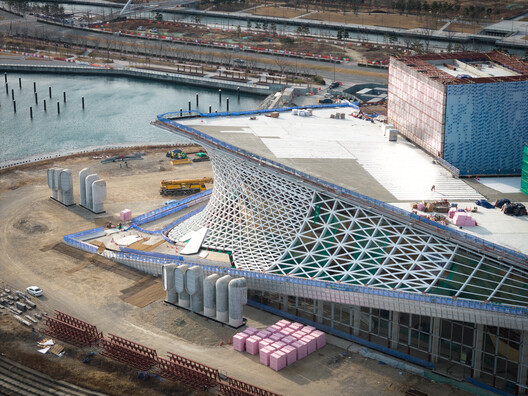
The architectural concept is defined by two opposing, continuous surfaces that shape the building's geometry. A lower, arching plane anchors the structure to the ground, bridging the city and the sea, while an upper plane opens upward toward the sky. The opera house is formed within the tension between these two elements, where land and water converge. The building's four corners extend toward the harbor, visually reinforcing its maritime context, while two diagonally lifted corners mark the main public entrances and guide visitors into a fluid circulation system around the structure.
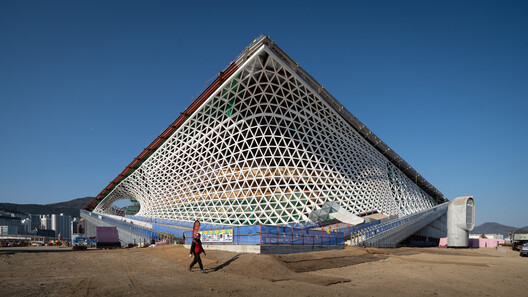
At ground level, the opera house is conceived as an open and permeable civic space. A public promenade wraps around the building and connects to surrounding plazas, while the main foyer extends along two sides, orienting interior spaces toward the waterfront. This level accommodates key front-of-house functions, including the main foyer, restaurant, and access to the parterre, blurring the boundary between interior and exterior. The arrangement supports transparency and accessibility, allowing the building to function as part of the public realm even outside performance hours.
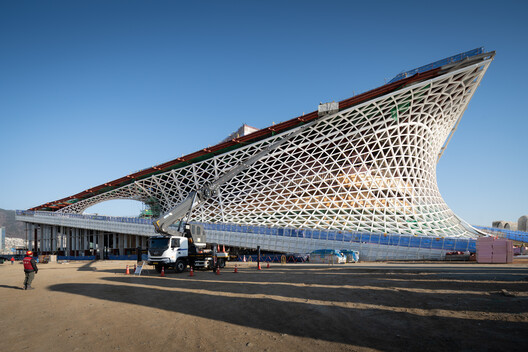
At the core of the project, the main opera hall is designed as a finely calibrated acoustic environment. Its form and materiality are engineered to support world-class operatic performance, with solid cherry wood panels shaping the interior to enhance resonance, warmth, and clarity. Above, gently sloping circulation leads visitors to a walkable rooftop landscape, conceived as a second public realm. Open to all, the rooftop offers panoramic views of the surrounding mountains and ocean, providing a contemplative counterpoint to the activity below and returning the building's footprint to the city as shared civic space.
In other construction updates from around the world, Snøhetta, in collaboration with the Beijing Institute of Architectural Design (BIAD), has broken ground for the Beijing Art Museum in Tongzhou District, Beijing, with completion and public opening expected in 2029. Meanwhile, Zaha Hadid Architects' Yidan Center in Shenzhen, China, has reached its full height and will serve as the headquarters of the Chen Yidan Foundation and the Yidan Prize, both focused on advancing lifelong learning and educational innovation. In Europe, construction has also commenced on the Innovation Park Artificial Intelligence (IPAI) Campus in Heilbronn, Germany, designed by Dutch architecture firm MVRDV.