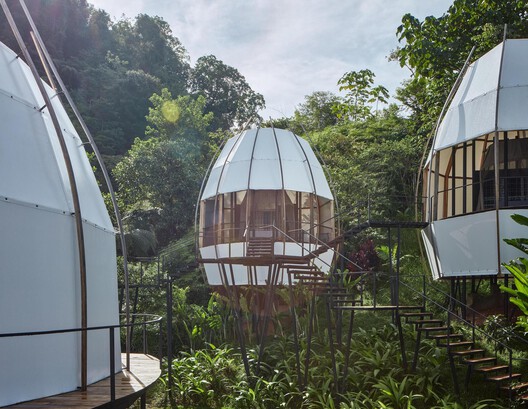
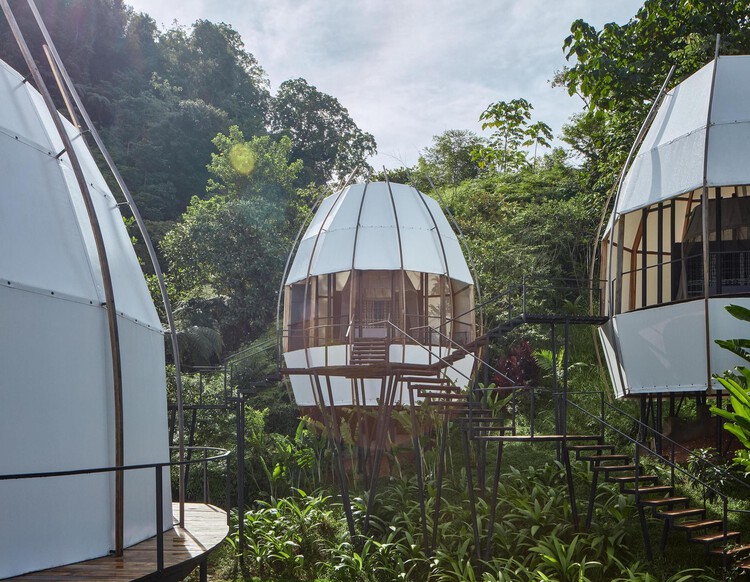
In the coastal and jungle regions of Costa Rica, high humidity and intense solar radiation dictate an architectural strategy centered on permeability rather than enclosure. Unlike the airtight envelopes required in cold climates to retain heat, Costa Rican architecture uses the building envelope as a climatic filter to maximize air exchange. The primary mechanism for managing these thermal gradients seems to be the oversized roof overhang. By extending the roof plane significantly beyond the floor plate, architects create a permanent buffer of deep shade that reduces solar gain and lowers the ambient temperature before air enters the structure. This strategy, combined with permeable or non-existent walls, allows for constant airflow. This is a critical technical requirement for humidity control and the prevention of material degradation through mold and rot.


The use of permeable envelopes also redefines the programmatic layout and functional use of the sites as well. In these cases, the traditional distinction between interior living areas and the exterior environment is eliminated. This is seen in some projects as expansive terraces, which become the primary functional space of the project. These shaded platforms serve as the central zones for social interaction and daily activity, protected from precipitation and direct radiation while maintaining total visual continuity with the landscape. Consequently, the architecture functions not as a closed volume, but as a shaded, ventilated volume that prioritizes natural cooling and site-specific views as the primary drivers of the user experience.