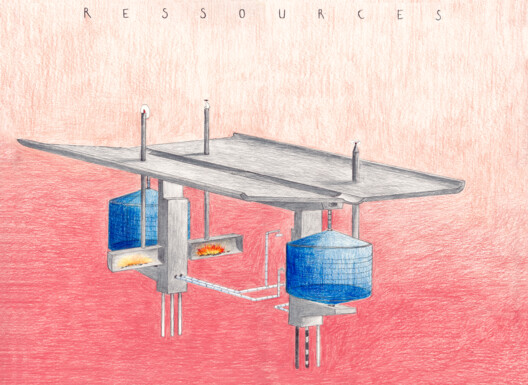
Founded in 2022 by Clément Masurier and based in Paris, France, Géométral is an architectural practice defined by design strategies that are linked to the landscape, which it treats as a primary determinant of form. The studio, one of the winners of the ArchDaily 2025 Next Practices Awards, approaches each project as a small universe that combines program, atmosphere, and spatial narratives. Rather than a single signature style, they focus on crafting moods and situations tailored to each context and user.
In its early stages, the studio lacked a built portfolio and responded by developing "fictional architectures" situated on real topographies. This exercise was not merely an aesthetic pursuit but a methodological anchor, as it allowed the firm to establish a rigorous process of site analysis and typological testing before receiving physical commissions. By treating imaginary projects with the same technical scrutiny as real ones, the studio developed a library of formal responses to environmental constraints that now dictate their built work.
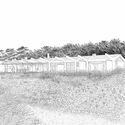
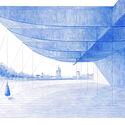
In that sense, central to Géométral's design process is the communicative power of the hand-drawn sketch. Unlike photorealistic renderings, which often fixate on finished surfaces, the studio's drawings prioritize spatial intent and atmospheric behavior. For Masurier, the drawing is an instrument of investigation that coexists with technical phases rather than being replaced by them. It allows the observer to focus on spatial hierarchies, the flow of light, and the overall feeling of a room without the distraction of artificial textures from 3D models.
Related Article
20 Practices Shaping the Future of Architecture: Winners of the ArchDaily 2025 Next Practices AwardsAt the same time, this led the studio to develop its own writing style for describing projects. They draw from the idea that architecture is a protagonist in a graphic narrative. Instead of neutral technical specs, the text focuses on how one experiences the "rhythms of solitude" or "seasonal change." These narratives are built by identifying the sensory core of a site, such as the smell of salt spray or the heat of the sun on stone, and using those elements to contribute to the architectural program.


The transition to technical execution occurs when the atmospheric goals of the sketch and narrative are translated into structural requirements. For example, determining the specific depth of a vault or the thickness of a stone wall to achieve a desired thermal performance. The hand drawing and its related narratives serve as the conceptual north, ensuring that as the project moves into the rigid coordination of site logistics and technical details, the original intent is not lost to utilitarian decisions.
Les Bômes - Maison de famille
This design process is evident in the contrast between their coastal and rural projects. For example, on Ré Island, the Atlantic's volatility dictated a "light-touch" approach, resulting in the Les Bômes residence: a linear, elevated structure on pilotis that minimizes soil disruption and maximizes cross-ventilation. Conversely, in rural or Mediterranean contexts, the strategy shifts toward thermal inertia and enclosure. These choices demonstrate a move away from universal "international style" solutions toward situated architecture, where the site's specific wind patterns, solar orientation, and geological makeup provide the blueprint for the plan.


Barba Jupiter - Atelier pour un peintre
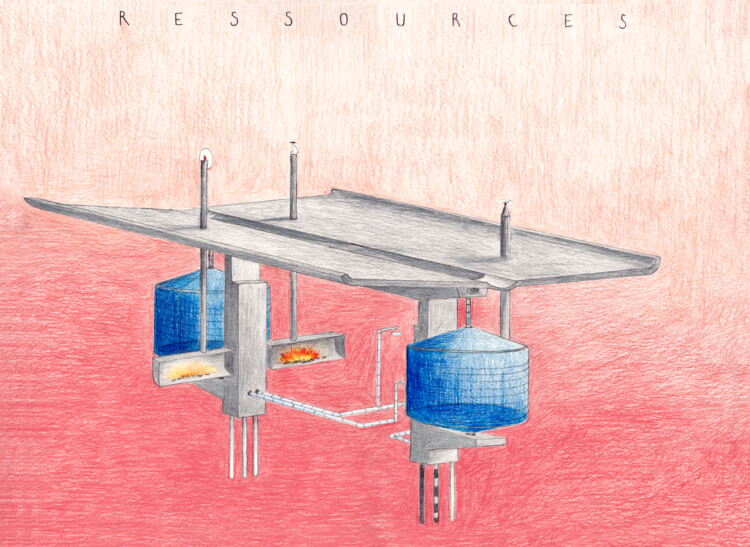
Another example is the Barba Jupiter studio-house on Porquerolles Island. The site's isolation, accessible only by boat, transformed the construction process into a study of resource autonomy. The architectural response utilized Mediterranean archetypes like thick stone massing and vaulted ceilings to create a passive cooling system independent of the grid. This project exemplifies the studio's "narrative" approach to habitation: the text and drawings describe the building not as an object, but as a climatic tool. By integrating solar energy generation and rainwater harvesting directly into the structural language of the overhanging roof, Géométral ensures that the building functions as a self-sufficient extension of its fragile ecosystem.


Le Banana Split - Restaurant & Hôtel Renovation
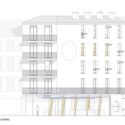
In the rehabilitation of a historical hotel in La Rochelle, Géométral demonstrates a mastery of structural augmentation. To modernize a cramped, load-bearing masonry building facing the Old Port, the studio added an exo-structure onto the original volume. This external skeleton assumes the primary vertical loads, liberating the interior from its restrictive geometry and allowing for open-plan social spaces. On the ground floor, a ribbed timber structure—modeled after an inverted boat hull—provides the wide-span capacity necessary to merge the restaurant program with the public quay, while modular, kinetic windows physically extend the internal square footage toward the horizon.


Daikokubashira - Atelier
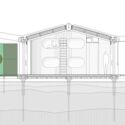
The studio's research into structural archetypes reaches a point of radical reduction in the Daikokubashira atelier in rural Brittany. Designed for an energy engineer, this detached workspace abandons the traditional masonry of the surrounding French countryside to explore the Japanese concept of the "heart pillar." Architecturally, the project functions through a centralized structural system, where a single vertical datum supports the entire roof load via a primary beam assembly. This configuration creates a free plan, liberating the exterior envelope from structural requirements and allowing for a continuous, high-transparency facade that maximizes natural luminosity. By isolating the program into a self-sufficient pavilion—relying on a wood-burning stove for thermal management and integrated rainwater harvesting—Géométral demonstrates how a singular, "absolute center" can define an entire environmental and professional micro-territory.


This article is presented by Buildner. As sponsor of ArchDaily's 2025 Next Practices Awards, Buildner—the world's leading architecture competition organizer—helps architects get what they enter competitions for: recognition, opportunity, and progress.
Exercise your creativity now: the Buildner UNBUILT Award 2026 is open to all, with a €100,000 prize fund. Submit your unrealized designs and celebrate your creativity now.