

Architectural heritage is often described as what survives time. Yet survival does not explain why certain buildings are preserved while others disappear. Many works now protected as cultural heritage were once criticized, contested, or openly rejected; they were accused of being socially misguided, materially flawed, or symbolically excessive. Over time, however, these same shortcomings have become central to their meaning as heritage emerges as a slow and unstable process of interpretation.
Contemporary architecture operates under intense scrutiny, pressured by environmental responsibility, social equity, economic volatility, and accelerated technological change. Buildings are expected to perform ethically, efficiently, and symbolically, often simultaneously. As a result, architectural failure is no longer an exception but an increasingly common condition. Projects age faster, materials reveal limitations sooner, and urban strategies quickly fall out of sync with shifting political, social, and environmental realities.

Against this backdrop, the question of heritage can no longer be reduced to what deserves preservation based on architectural merit alone. It becomes necessary to ask what aspects of today's built environment might endure as meaningful records of our time, even when they fall short of their original ambitions. If heritage is continuously constructed rather than inherited, then failure (material, social, systemic, climatic) may play a central role in shaping what is ultimately kept, transformed, or reinterpreted. Rather than disqualifying architecture from legacy, failure may become one of its most revealing conditions.
Related Article
How to Save a Building from Demolition: Emerging Procedures to Uncover the Potential of Existing Structures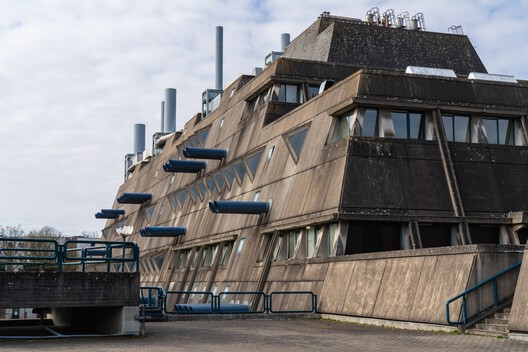
Failure
Failure is rarely a definitive condition. It is a mismatch between intention and outcome, or between one set of values and another that emerges late; a verdict produced by distance that separates a project from its brief, its political context, and the expectations that once made it appear necessary. The history of preservation theory has long acknowledged this instability. Early twentieth-century debates already recognized that monuments could be valued for contradictory reasons: their historical testimony, their age and material decay, their ongoing use, or their symbolic resonance.
Seen through this lens, failure becomes a productive condition. It reveals the assumptions embedded in design decisions and exposes the limits of architectural ambition. Alois Riegl's early distinction between different "values" of monuments (historical, age-related, use-related) remains useful because it describes heritage as a contested field where reasons to keep something can contradict one another. A building may be disliked and still be protected; it may be functionally compromised and still become central to the way a period is understood; it may even be preserved against the grain of public taste because it has become a document.
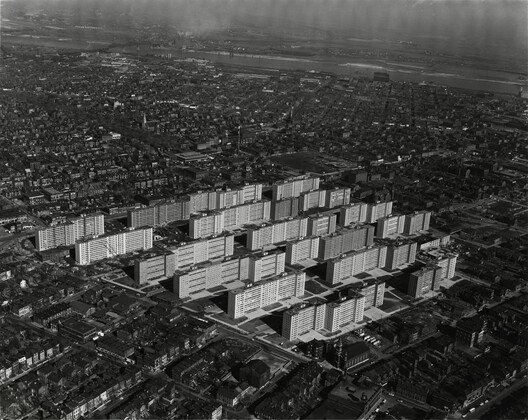
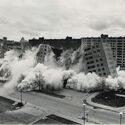
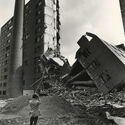
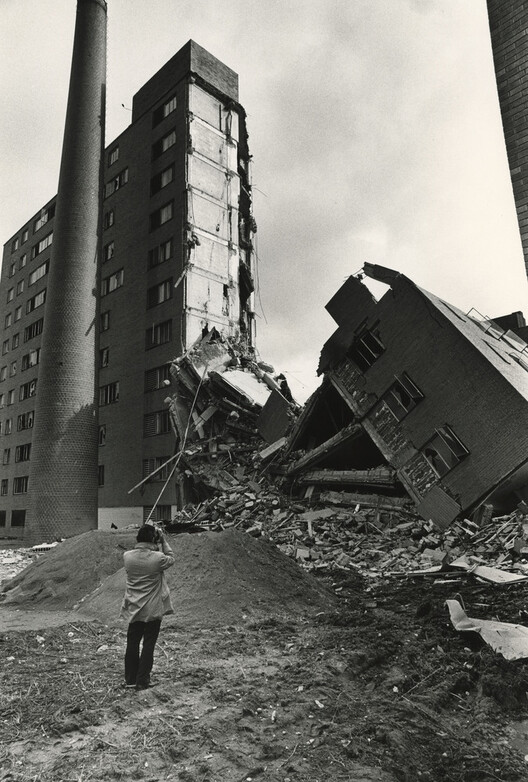
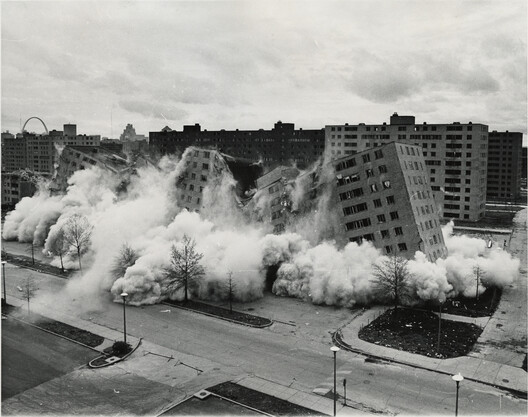
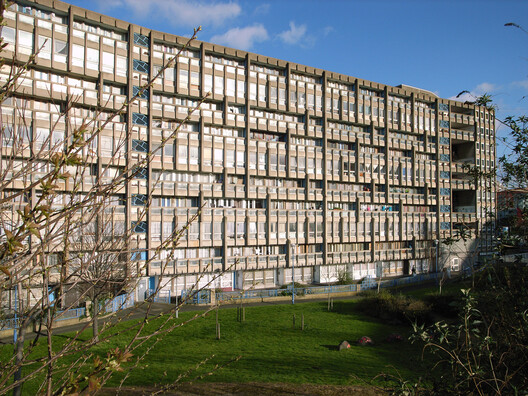
Modern and postwar architecture provides a dense archive of these reversals. The demolition of Pruitt–Igoe became a shorthand for the collapse of a certain modernist promise, yet what that "failure" indexed was the fragility of social policy, segregation, disinvestment, and the assumption that architecture could stand in for welfare infrastructure. In the United Kingdom, Robin Hood Gardens moved through a similar cycle (criticized, defended, and ultimately demolished) as it became less a settled case than a public argument about what counts as heritage when a building is socially contested, technically costly, and symbolically loaded. In both cases, the building's afterlife mattered as much as its formal intentions, because the controversy itself became a cultural record. This is where failure becomes productive for a heritage lens. It exposes the limits of architectural agency and, at the same time, clarifies what architecture can uniquely make visible. A "successful" building can disappear into the smoothness of performance and image; a struggling one tends to disclose the systems it depends on.
Programmatic and urban failures operate similarly. When an urban renewal scheme empties streets instead of activating them, or when a civic complex is perceived as hostile rather than public, the building becomes a witness to a political imagination of the city. Think of the long and uneven reception of many brutalist civic buildings; their endurance is tied to shifting ideas of what a public institution should look like, how it should welcome, and what it should symbolize. In these cases, the charge of failure often masks a deeper disagreement about representation and belonging. The building becomes a proxy for a broader argument, and that argument is precisely what later attaches heritage value to it.
Failure also surfaces in a more contemporary register as the accelerated obsolescence of environments built to serve logistical, digital, and commercial systems. These are buildings designed around throughput (goods, data, bodies) rather than around civic presence. They rarely enter canonical narratives, yet they structure everyday life at a metropolitan scale. Their future heritage potential lies in the likelihood that they will age quickly and awkwardly, becoming spatial fossils of a specific economic order. Here, "failure" does not need to take the form of collapse as it can be simple redundancy, abandonment, or the inability to be repurposed without radical transformation. Heritage is often produced when a building becomes impossible to ignore, either because it persists despite critique or because its shortcomings reveal the conditions of its making. What is preserved, in those moments, is not only an object but a set of questions that the object keeps open.
Social Failure
Failure also manifests at the social scale, where architecture is asked to do political work while being judged as if it were autonomous. Large housing estates, infrastructural megastructures, and ambitious civic complexes were often built as spatial answers to social questions. When these projects later become stigmatized, underfunded, or isolated, the label of "failure" tends to fall on form and material. Yet the social life of architecture is rarely determined by design alone. It is shaped by tenancy regimes, welfare policies, policing, maintenance budgets, and the slow drift of urban economies. In other words, social failure is often a mismatch between architectural ambition and the systems meant to sustain it.
Postwar housing remains the clearest arena for this tension because it sits at the intersection of public responsibility and private life. Estates that were conceived as collective infrastructures of dignity are frequently recast, decades later, as evidence of institutional neglect. The question is not only whether certain spatial concepts worked, but whether the political and economic conditions required for them to work were ever maintained. That shift matters for heritage because it reframes what is being evaluated. A building can be criticized as a social environment while still functioning as a historical document of policy, ideology, and the limits of architectural agency.
The afterlife of Robin Hood Gardens demonstrates how "failure" can become a public argument about value rather than a settled diagnosis. Designed by Alison and Peter Smithson and completed in 1972, the project became emblematic of both the ambitions and controversies of postwar housing, facing years of dispute over listing, demolition, and the meaning of preservation when a building's social reputation is unstable. What remained after demolition were fragments, campaigns, and a cultural afterlife that extended into museums and exhibitions, turning a contested estate into a lens through which to debate housing politics, architectural intent, and the changing criteria of heritage.
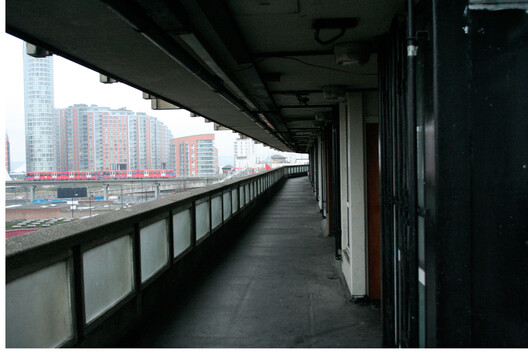
What makes social failure particularly complex is that these environments are rarely empty. They are inhabited, adapted, and reinterpreted by their residents in ways that exceed architectural scripts. Everyday practices often override the didactic logic of planning, informal repairs, personalization, social routines, and small appropriations that recompose space from the inside out. The result is a form of value that coexists with spatial shortcomings. A building may be considered unsuccessful in the abstract and yet remain meaningful as a lived framework. In this sense, the failure lies less in the object than in the way public systems treat the object over time. When maintenance collapses, when services are withdrawn, when communities are displaced through policy or market pressure, architecture becomes the visible surface of an invisible decision.
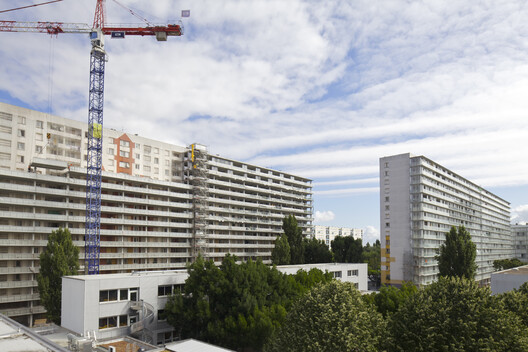
This is where contemporary renovation strategies have transformed the terms of the debate. Over the last two decades, a set of architectural practices has treated social housing not as a resource to be upgraded without destroying social continuity. The work of Lacaton & Vassal, together with Frédéric Druot, is often discussed for its formal clarity, yet its deeper claim is that social transformation can preserve occupation, avoid displacement, and treat existing residents as the primary stakeholders of architectural change. In Bordeaux, the transformation of three inhabited blocks at Cité du Grand Parc used extensions that added winter gardens and balconies, increasing space and comfort while keeping the buildings occupied during the process. Continuity is itself a value worth protecting, and the project's success depends on refusing the tabula rasa.
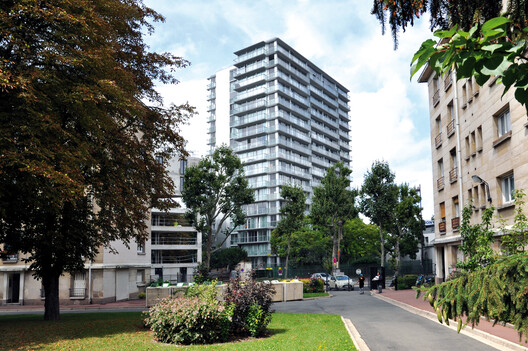
A similar logic underpins the transformation of the Tour Bois-le-Prêtre in Paris, where a new envelope and added balconies redefined living conditions without the social rupture of demolition and relocation. These projects offer a disciplined rebuttal to the idea that failed housing must be replaced. They suggest that what is often called "failure" is, in practice, an argument about investment and commitment. When the state or city is willing to sustain an environment through time (by repairing, adding, and adjusting) architecture can recover its social promise without being rewritten from scratch.
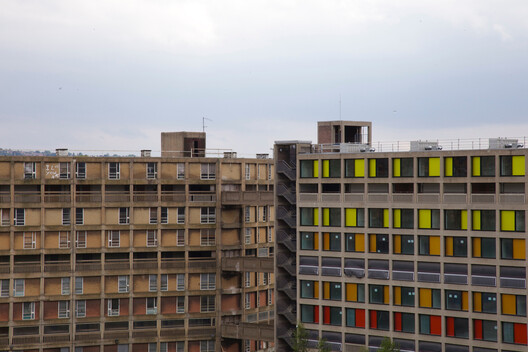
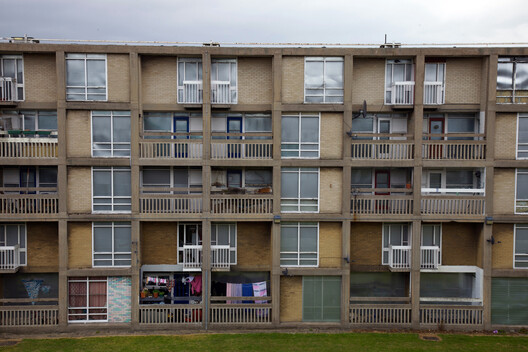
At the same time, not every rehabilitation produces social continuity. The redevelopment of certain estates demonstrates a different tension: when "saving" a building becomes inseparable from rebranding it. Park Hill in Sheffield shows how a contested modernist estate can re-enter public legitimacy through refurbishment, heritage designation, and new development coalitions. Yet such cases also raise uncomfortable questions about who the renewed heritage is for, and what kind of community the renewed project actually supports. Social failure can be displaced rather than resolved, shifted from material neglect to affordability, from stigma to gentrification, from demolition to selective inclusion. Here, heritage risks becoming a tool for cultural capture, preserving form while changing the social contract that gave the form its original meaning.
Systemic Failure
Technologies age rapidly, standards shift, and entire spatial configurations lose relevance as flows are rerouted elsewhere. Unlike monuments or civic buildings, infrastructures are rarely designed to endure symbolically since their success depends on seamless operation. Their ideal state is discretion. Failure, however, reverses that condition. When systems stall, relocate, or collapse, their spatial frameworks suddenly surface, exposing the material and territorial logic that once sustained everyday life.
This moment of failure is particularly revealing. Abandoned warehouses, obsolete transport hubs, decommissioned power plants, or data centers rendered redundant by new technologies do not simply mark the end of an operational cycle. They offer a condensed reading of how contemporary societies organized production, circulation, and control. These environments translate abstract systems (global supply chains, digital exchange, energy extraction) into built form. Their architectural value lies less in authorship or formal intention than in their capacity to register scale, redundancy, security, and territorial reach.
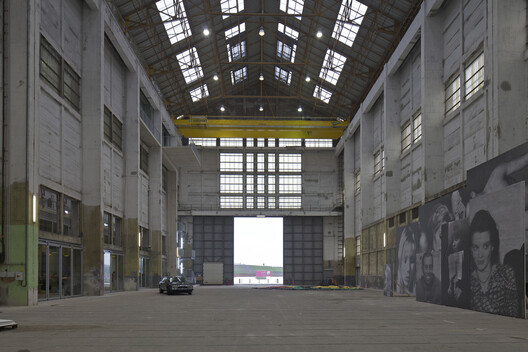
Architectural discourse has traditionally struggled to account for this type of environment. Heritage frameworks tend to privilege legibility, representation, and formal coherence, qualities that infrastructural spaces actively resist. They are often generic, dispersed, and optimized for performance rather than expression. Yet this apparent neutrality is precisely what makes them powerful historical documents. Infrastructures show how architecture participates in regimes of efficiency, risk management, and optimization that shape the contemporary city more decisively than iconic buildings. They make visible the spatial consequences of economic abstraction.
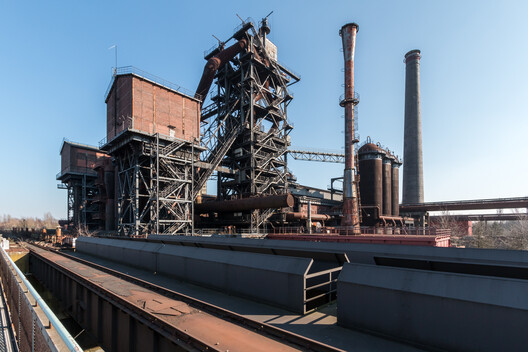
Projects such as the Landschaftspark Duisburg-Nord demonstrate how infrastructural failure can be reinterpreted without erasing its systemic logic. The former steelworks was not preserved as a monument to industry, nor neutralized into a park that denies its origins. Instead, its spatial and material structure (networks of pipes, voids, and oversized volumes) was retained as a readable framework, allowing new uses to coexist with industrial memory.
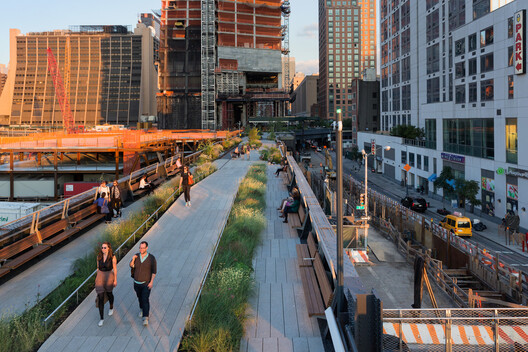
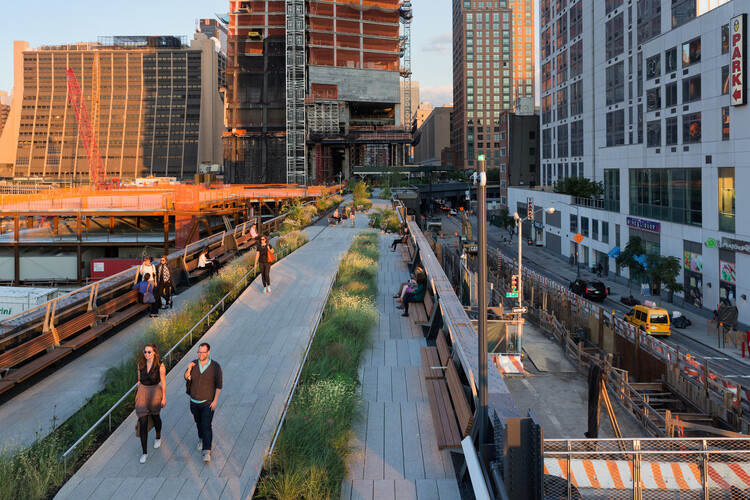
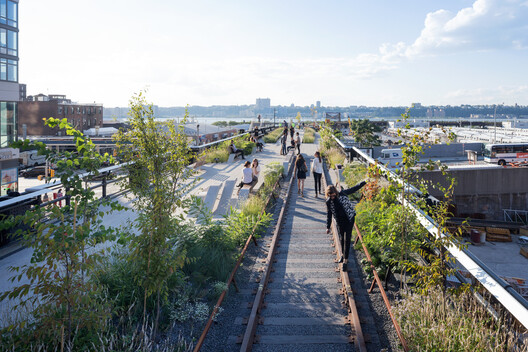
A similar condition can be observed in obsolete mobility infrastructures. Decommissioned rail yards, elevated highways, and logistical corridors often enter public consciousness only once their function ceases. The High Line in New York is frequently cited, but its success tends to obscure a more general phenomenon as infrastructures acquire cultural visibility only after they stop working. Their transformation into public space raises a critical question for this kind of heritage: What should be kept? The structure itself, the spatial logic of the system, the territorial footprint, or the memory of the flow that once animated it? What is being preserved, the object, the trace, or the memory of movement?
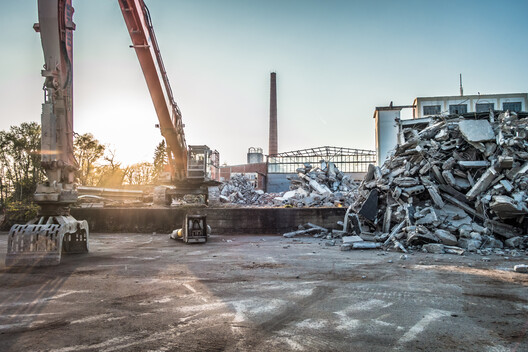
Power plants, oil terminals, and extraction sites are among the most spatially dominant yet culturally marginalized architectures of the modern era. When decommissioned, they often occupy vast territories marked by contamination, restriction, and political conflict. Projects that engage these sites highlight a different approach to heritage. Preservation, here, is inseparable from accountability as the architectural residue becomes evidence of how energy regimes shaped land, labor, and settlement patterns.

Ethical Failure
Climate change introduces a form of failure that unsettles many of the assumptions on which heritage practice has been built. Architecture conceived for relatively stable environmental conditions is now exposed to flooding, heat stress, water scarcity, and accelerated material degradation. In some contexts, preserving a building in its original form may directly conflict with the need to adapt, retreat, or transform.
These conditions force a difficult reappraisal. When does the effort to protect the past become an obstacle to collective survival? When does adaptation, alteration, or even disappearance better honor the knowledge embedded in a place? In climate-vulnerable territories, heritage may no longer reside primarily in objects, but in transferable intelligence as spatial strategies, construction logics, and patterns of settlement that can migrate across contexts even when the original fabric cannot. What persists is not necessarily the building, but the lesson it carries; the question is no longer how long a building can last, but how meaning, care, and responsibility can extend beyond its physical lifespan.
Taken together, the failures explored throughout this article suggest that architectural legacy is no longer anchored in ideals of completion or coherence. Instead, it emerges through endurance, adaptability, and interpretation. The works most likely to matter in the future may not be those that fully realized their original ambitions, but those that remain capable of communicating the circumstances of their making (the systems they relied on, the compromises they embodied, and the limits they exposed). This perspective also reframes authorship as if failure is not an exception but a condition; architecture cannot be understood as a closed statement. Buildings become open propositions, shaped as much by what happens to them as by what was intended for them.
Heritage after failure, then, is not about celebrating mistakes or lowering expectations. It is about recognizing architecture as a cultural practice embedded in uncertainty, negotiation, and change. As societies decide what to keep, adapt, or let go, the decisive question may no longer be what represents us at our best, but what allows future generations to understand how we built, lived, and struggled within the limits of our moment. Today's failures may become tomorrow's most precise record.

This article is part of the ArchDaily Topic: Rethinking Heritage: How Today's Architecture Shapes Tomorrow's Memory. Every month we explore a topic in-depth through articles, interviews, news, and architecture projects. We invite you to learn more about our ArchDaily Topics. And, as always, at ArchDaily we welcome the contributions of our readers; if you want to submit an article or project, contact us.


