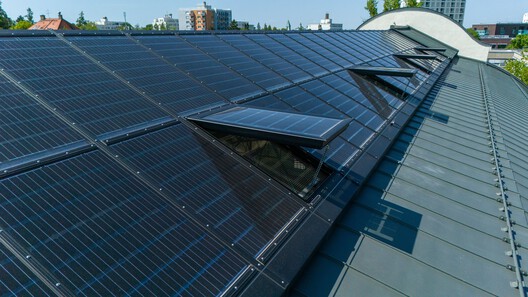
From the large industrial roofs and galleries of the 19th century to the contemporary atriums of museums and public buildings, glass has been a recurring material in shaping large and monumental interior spaces. More than a technological or engineering solution, these horizontal glazed planes introduce a distinct luminous quality: light that comes from above. Unlike lateral daylight entering through façades, zenithal light is more evenly distributed, reduces harsh shadows, and lends spaces a sense of continuity and openness that is difficult to achieve otherwise.
Across cultures, light entering from above has often been linked to transcendence and divinity, giving these interiors a heightened symbolic dimension. Historically, this form of lighting has shaped collective, productive, and public spaces, positioning the roof as an active element that organizes space, directs movement, and defines the experience of occupation. However, by prioritizing full transparency as a spatial strategy, many of these architectures relinquished a resource that has since become central, that is the possibility of using the roof as a surface for solar energy generation. Against the backdrop of climate urgency, the traditional divide between spatial design and energy performance is being challenged. The roof is no longer seen as a passive boundary, but as an active interface mediating space, climate, and energy in parallel. Rather than treating energy generation as a technical layer added after the design is defined, there is growing interest in solutions that integrate photovoltaics into the primary elements of architecture, such as façades or even glazed planes.
Glass roofs with integrated photovoltaics exemplify this shift by reconciling translucency, spatial quality, and energy production within a single architectural surface. The German company Lamilux, which develops daylighting systems such as skylights and glazed roofs, builds on this principle by redefining the role of solar energy within roof construction. Developed as an evolution of the established PR60 system, the solution integrates photovoltaic cells directly into the glass assembly. Solar cells are encapsulated between two layers of structural glass, ensuring long-term protection, durability, and construction precision while maintaining the visual continuity of the glazed plane. The system can be custom-engineered to replicate existing roof geometries and detailing, making it suitable for both new construction and heritage-sensitive retrofit contexts.
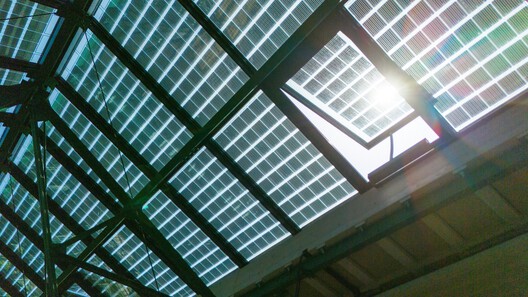
This integration allows the roof surface to function simultaneously as an element of natural lighting and on-site energy generation. Transparency levels, cell spacing, and glazing specifications can be adjusted according to project requirements, balancing daylight penetration, solar control, and energy yield.
Formal Flexibility and System Integration
To be widely used, the system needs formal versatility. The roof can take on a variety of geometries, including gabled roofs, pyramids, domes, or free-form shapes, responding both to new buildings and to interventions in retrofit and rehabilitation contexts. This flexibility is particularly relevant in projects where the roof plays a dominant spatial role, such as large-span structures, public buildings, sports facilities, and cultural venues.
Beyond geometric flexibility, the system supports the integration of multiple functional components within the same assembly. Natural ventilation devices, smoke and heat exhaust systems (SHEVS), and hybrid ventilation strategies can be incorporated directly into the glazed roof. As a result, the roof operates as a coordinated environmental system in which daylighting, ventilation, safety, and energy generation are resolved together, avoiding technical overlap while preserving architectural clarity.
From a thermal perspective, the PR60 system with integrated photovoltaics offers high levels of insulation and airtightness, supported by engineered sealing, drainage, and condensation-management strategies. These performance characteristics enable compliance with demanding energy-efficiency standards, including configurations approaching the Passivhaus level. By concentrating multiple environmental functions within a single building component, the system reduces the need for additional layers and reinforces the logic of a simpler, more efficient, and more legible architectural envelope.
Case Study: Eggenhalle Munich-Pasing
The architectural and technical potential of glass roofs with integrated photovoltaics can be seen in the rehabilitation of the Eggenhalle in Munich-Pasing, designed by Behnisch Architekten. As a former industrial hall, the building was transformed into a contemporary space dedicated to action sports while preserving its original steel structure and overall spatial character. The project incorporates a gabled glass roof covering 229 square meters, composed of PR60 elements with integrated photovoltaics. In total, 136 photovoltaic modules are embedded within the glazing, achieving an installed capacity of 25.13 kWp. The photovoltaic surface follows the original roof geometry and structural rhythm, integrating seamlessly with the existing framework while improving energy performance without altering the building's architectural identity.
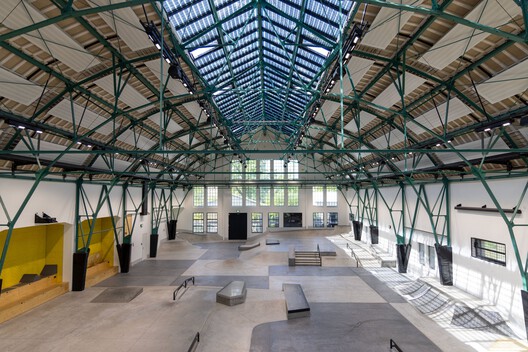
Within this context, the roof plays a central role in the spatial experience. In addition to providing abundant and evenly distributed natural daylight, it contributes actively to on-site energy generation and environmental control. Integrated ventilation and smoke-exhaust elements support natural airflow and safety requirements, reinforcing the roof's role as an environmental interface rather than a single-purpose enclosure. The integration of photovoltaics aligns with the industrial logic of the original structure, demonstrating how retrofit projects can simultaneously address preservation, environmental performance, and contemporary architectural expression.
This integrated approach was recently recognized with the German Design Award 2026 Gold in the category Building and Elements. The jury highlighted the system's ability to make energy production legible without compromising the architectural reading of the roof, acknowledging its construction quality, formal adaptability, and contribution to contemporary sustainable building strategies. The recognition reflects a broader understanding of design in which technology, materiality, and architectural expression operate together, and photovoltaics cease to function as external or visually dominant additions, becoming instead the material surface of the roof itself.
When energy generation is integrated directly into fundamental architectural elements such as glass roofs, it ceases to be a purely technical obligation and begins to shape spatial, constructive, and formal decisions. And within this approach, the roof is no longer a passive enclosure but asserts itself as an active architectural component, capable of articulating light, space, and energy within a single, coherent design strategy.
