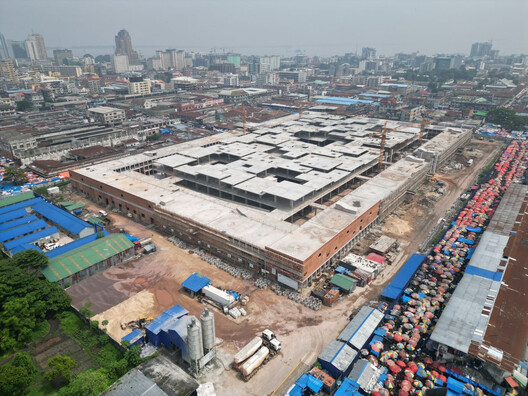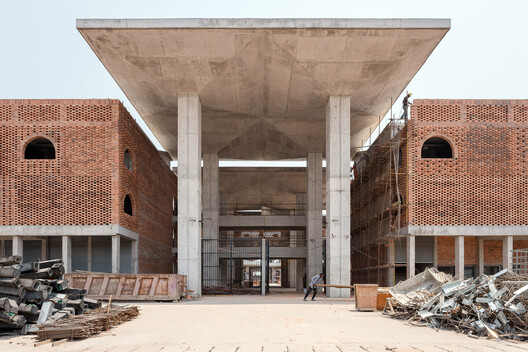
The Zando Central Market redevelopment in Kinshasa, Democratic Republic of the Congo, designed by THINK TANK architecture, has been selected among the 20 winning projects of the 2025 Holcim Foundation Awards in the Middle East and Africa region. Originally designed for 3,500 traders and now accommodating more than 20,000 vendors, the market has long operated under conditions of severe overcrowding and infrastructural strain. The project stands out for its large-scale public ambition, its reliance on locally available materials and skills, and its capacity to accommodate both formal and informal economies within a rapidly transforming urban context.
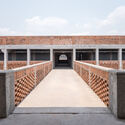
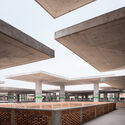
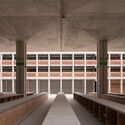
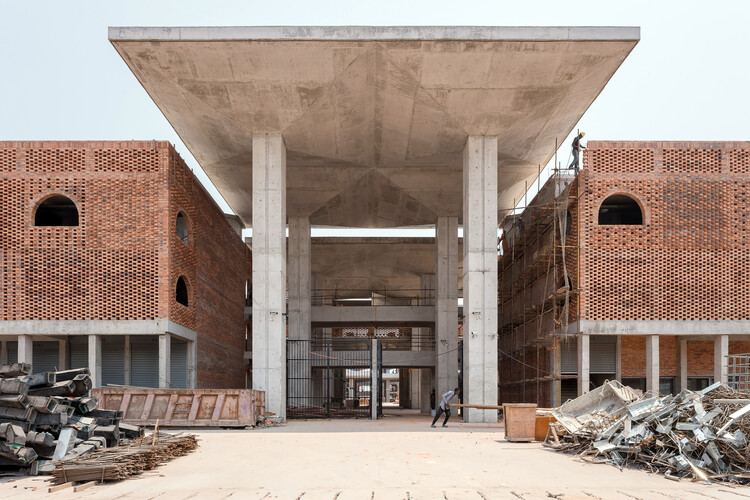
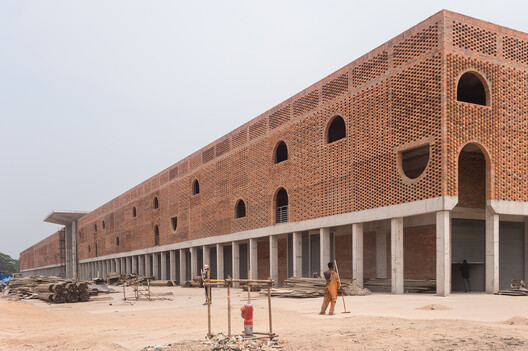
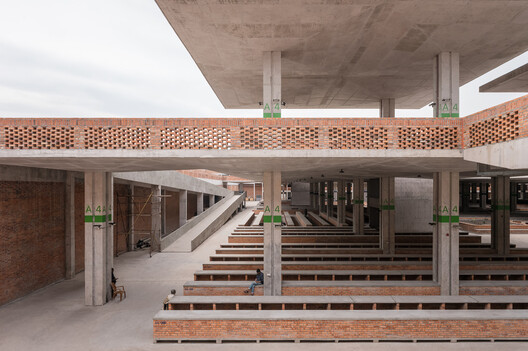
The redevelopment repositions the market as a climate-responsive civic infrastructure, combining open concrete structures with locally produced terracotta bricks to limit reliance on imported systems. Patterned brick façades, inspired by Congolese textiles, function as moucharabieh screens that provide ventilation and shading, while "mushroom"-shaped concrete slabs reference the historic market structure and enhance stack ventilation. The Holcim Awards jury praised the project's structural clarity and contextual sensitivity, highlighting the expressive concrete system and terracotta façades, as well as the project's material restraint, using only two primary materials to achieve what the jury described as a brutalist yet emotionally resonant architecture suited to Kinshasa.
Developed through extensive dialogue with local authorities, vendors, and stakeholders, the project reflects THINK TANK architecture's self-described role as a collaborative "reservoir of ideas," combining international expertise with local production, craftsmanship, and everyday practices. In the interview that follows, Marine De La Guerrande, Associate Partner at THINK TANK architecture, discusses the process behind the project, the challenges of working across geographies, and how Zando Market negotiates scale, informality, and social responsibility in a contemporary African urban setting.
Related Article
Holcim Foundation for Sustainable Construction Reveals 20 Winning Projects of the 2025 Holcim Awards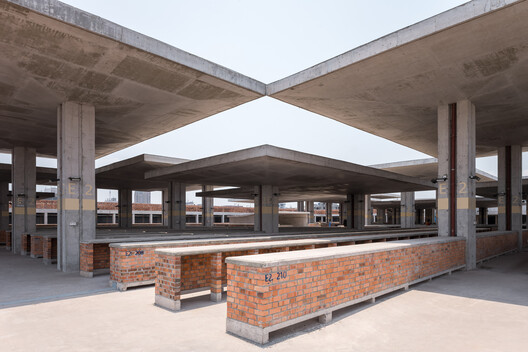
ArchDaily: THINK TANK architecture describes itself as a collaborative "reservoir of ideas," bringing together diverse expertise to serve the public good. How does the reconstruction of Kinshasa's Zando–Central Market embody this approach, and what does receiving the Holcim Award signify for the project and its impact on the city?
Marine De La Guerrande: Well, first, we had a lot of discussions around the exchanges. The brief itself was quite short and very synthetic. Through workshops, discussions, and meetings with local authorities, politicians, vendors, representatives of the vendors, and firemen, everyone who could have a connection to the project, we were able to refine it. In fact, we completely adjusted the program together with our engineers, because, as you know, in architecture we never work alone. It is very important that each constraint becomes more of an opportunity. The earlier these indications are identified, the better it is for us in the design process.
As for the award, it is a wonderful recognition. It is our first project abroad, so it is really significant and meaningful for the office, personally speaking. It also brings international recognition. And I think that in a time when many countries seem focused on their own limits, cultures, and frontiers, this project is an example of what we can bring and achieve together when we follow the same goal. Client funding, materials, workers, and contractors are African; the architects, engineers, and urban designers are French; the main contractor is Chinese; and the management and consultancy for the client during construction was Tunisian. So, I think it is a kind of message of hope, in fact.
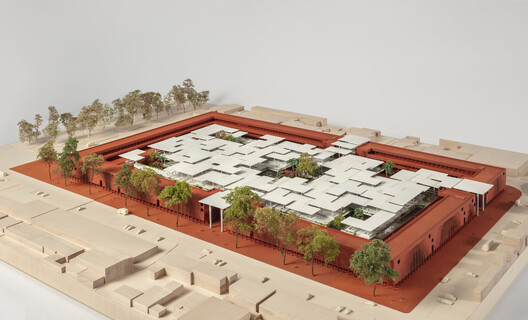
It was a wonderful experience and also a total example of what you could imagine. To be honest, we could not have secured this kind of commission in France, because we are a small, medium-small office, between six and ten people. Yet the project covers 82,000 square meters, which is huge. In France, neither public nor private clients would likely trust us with a project of that scale.
Secondly, the client had not made his career in real estate; it was his first project. So there were many firsts. When we were asked to work in Kinshasa, we did not know the city or the country; we had never visited and had no acquaintances there. So, in fact, it was really a question of feeling. You know when you instantly click with someone, when you trust them, and it goes both ways. In that sense, it was quite wonderful, because you already become a team.
When we were in Kinshasa, we spent all our days with the client, from breakfast to dinner. We discussed a lot, not only about the project, but also about food, culture, our families, how we were raised, what it means to encounter new cultures, and things like that. We really learned to know each other, and in this way, it became easier to understand one another. It was the first time we had shared so much time with a client, so much time, and also perhaps such an intimate kind of time. When you spend the entire day together, you end up talking about everything.
So we worked from Paris. We had many video calls and discussions. Adri and I went to Kinshasa several times, but not very often, and not during the construction phase. That was one of the main challenges: how do you design a project when you know you will not be there to oversee it during what is perhaps the most important and impactful phase? So, we decided to go further into the level of detail than we usually do, in order to be precise about everything. We produced very pedagogical documents, because on a construction site, plans are usually pinned on the walls, and even if you can talk or exchange things, the drawings need to be quite obvious. So we thought about the construction phase already during the design process, and we also left space for human error. Given the scale of the project, the fact that we were not on site, and the realities of craftsmanship and skills, mistakes are allowed. If two patterns are off over 250 meters, what does it really matter?
For us, it was another way of working. We felt freer, and sometimes even more useful, free from the perfectionism of the industry. It felt acceptable to loosen certain constraints. In a way, we were freer from some regulations that, in France, can be very restrictive, sometimes even contradictory. There, you often have to fight for everything, which can be quite heavy.
We were also very lucky to meet this client. He trusted us; he truly trusted us. For him, this project was the investment of his life. He had to justify everything to the political authorities of his country, and he wanted to give something back to the local population. And yet, he trusted us. That trust is quite moving, but it also comes with a very heavy responsibility.
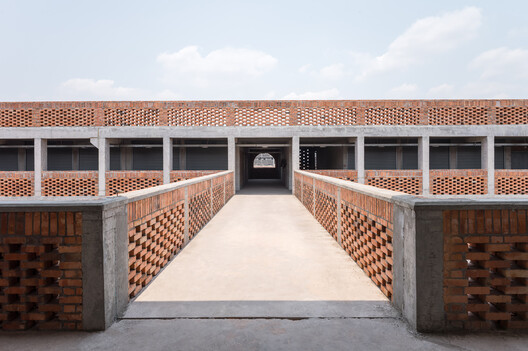
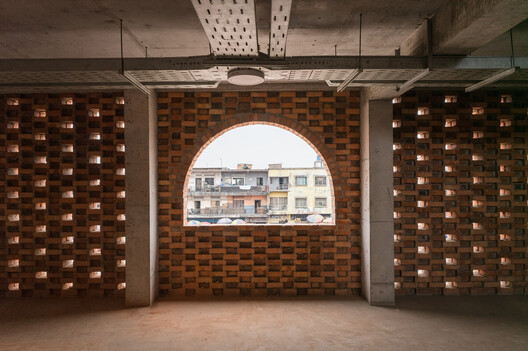
AD: So let's talk a bit more about the project itself, the architecture. Zando Market relies on terracotta bricks, mashrabiya façades, and concrete structures that draw from local craftsmanship and production. How can large-scale public projects strengthen local industries instead of relying on imported systems?
MDLG: First, we chose concrete and terracotta bricks because there are many available. So for us, it was really important not to import skills or materials from abroad. It also means preserving local skills, and it is very important for us that the local population can appropriate and empower the project during the construction phase.
With the terracotta bricks, for example, we reactivated three different factories located less than 60 kilometers from the site, specifically for this project, because we needed a huge number of bricks. What is interesting is that these three factories do not use exactly the same clay. As a result, there are variations in color and sometimes in the finishes. They are not industrial bricks; there are variations in the brick lines and production. This gives the project a very local image, because it matches the colors of Kinshasa, but also a timeless one. When you see the project, you do not know if it is brand new or if it has been there for a long time.
For us, it was important for us that finally this, I don't know if I can use this expression, but a quite low-profile approach gives more space to the population of Kinshasa to appropriate the project. One of the best compliments we can see is on social media, when people say, "Wow, this is a real African market."
Kinshasa is undergoing rapid urban transformation, and the market supports more than 20,000 vendors operating in extremely complex conditions. But these are the registered vendors; there are many more who rent shops or stalls by the linear meter. In the project, because one particularity of African contexts is that there is no empty space, if there is a space, it immediately becomes an informal market, we wanted to preserve this condition and keep these areas open and accessible to everyone. For example, between the perimeter of the building and the open market, there is an inner, open street, between 10 and 13 meters wide. These spaces allow more modest vendors to rent very small areas, sometimes just part of a square meter. The terrace roofs are also open to this kind of informal market.
AD: So here architecture plays a role, and there's a responsibility of preserving the local culture and the local heritage of the region. How do you think architects today are responsible and maintain economic, social, and climatic responsibilities?
MDLG: We are building by responding to short-term demands, whether through new construction, refurbishment, or renewal, but we always have to keep the future in mind. For example, questions of materials, craftsmanship, scale, and the technical systems you include in a project, as well as the way you design in relation to climate, orientation, geographic context, water systems, and biodiversity protection, all of these aspects matter. In each of these fields, as architects, we have a voice, and this is part of our social responsibility: to preserve a place where we, as humans, can live, and that we can leave to our children without being too ashamed of what we have done.
I do not want to say that we are responsible for everything. Depending on the context, the program, the timeframe, and economic feasibility, we have to make choices. But it is always a question of balance. We do not approach sustainability in a dogmatic way of thinking. What matters is to keep this awareness present, to constantly seek the best possible balance at a given moment.