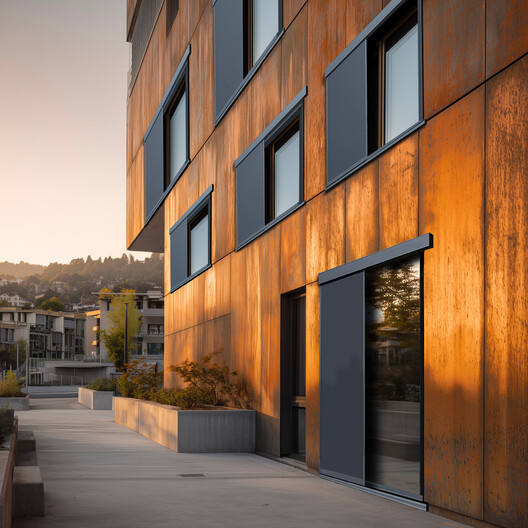
As the primary interface between interior spaces and the external environment, facades play a central role in both the performance and architectural expression of buildings. Increasingly, they are no longer seen as static envelopes, but as active mediators between climate, energy, use, and aesthetic. In dense urban contexts, however, they are also gaining relevance for another reason: while roof surfaces are often limited, fragmented, or already occupied by technical equipment, vertical envelopes remain largely underutilized in terms of energy production.
Continuously exposed to solar radiation and often exceeding the area of rooftops, facades have also become a key field for building-integrated photovoltaics, integrating renewable systems without increasing envelope complexity. Such systems are evolving from strictly technical solutions toward design-driven systems that embed energy production within the constructive and compositional logic of architecture. Within this framework, colored photovoltaic shutters represent a significant step forward. By integrating solar cells into movable shading elements, systems such as SolarSlide by EHRET combine daylight control, solar protection, and energy generation within a single façade component, producing electricity without adding extra layers to the envelope.
Integrating Energy Generation into the Facade
Shutters and external solar protection systems play a key role in regulating solar exposure for openings, particularly in residential and mixed-use buildings, being elements that mitigate heat and glare through simple sliding movements while maintaining natural ventilation and visual privacy. Their position can change throughout the day and across seasons in response to climatic conditions and user needs, allowing facades to operate as dynamic environmental systems. In doing so, they continuously adjust shading levels while generating electricity whenever they are exposed to sunlight.
Conventional photovoltaic panels also often present a clearly technical appearance, with visible solar cells that can conflict with architectural intent, especially in residential or heritage-sensitive contexts. SolarSlide by EHRET addresses this challenge by concealing photovoltaic cells within glass-glass modules with a uniform finish, allowing the system to remain visually discreet and fully integrated into the facade composition. The modules are framed by powder-coated aluminum profiles, whose color can be coordinated with the photovoltaic surface to reinforce visual continuity across the facade.
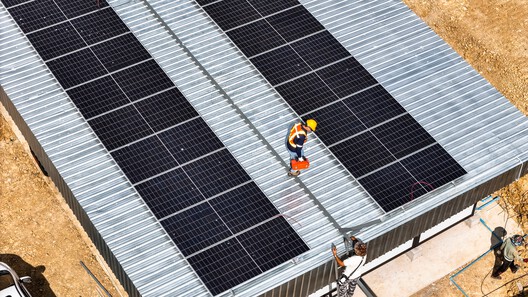
Beyond energy production, sliding photovoltaic shutters continue to fulfill their primary architectural role. When closed, they provide effective protection against overheating and glare; when partially opened or repositioned, they allow filtered daylight into interior spaces. The system can be operated manually or through motorized solutions, increasing its adaptability across different building typologies, scales, and levels of automation. Depending on the configuration, the panels may be opaque or partially translucent, enabling a carefully balanced relationship between shading, natural light, and visual connection to the exterior.
From a construction standpoint, the shutters consist of modules made of two layers of ESG safety glass, each approximately 4 millimeters thick, encapsulating high-efficiency monocrystalline photovoltaic cells. Panels can reach up to 1.50 meters in width and 2.80 meters in height per leaf, with each shutter achieving outputs of around 500 watt-peak and efficiencies between 20 and 22 percent, even when color is applied through screen printing. Darker tones such as anthracite result in minimal efficiency losses, while lighter colors allow greater light transmission.
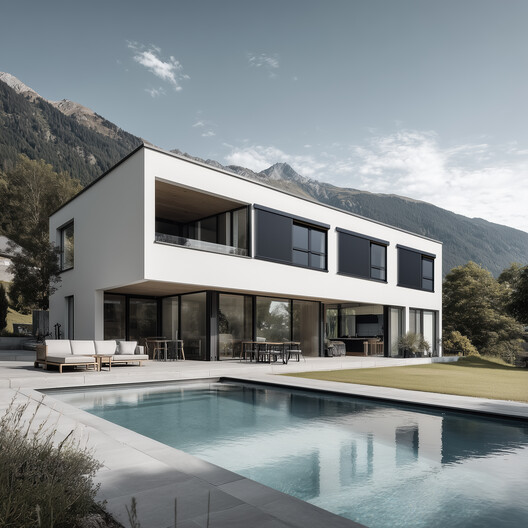
The availability of eight standard colors, combined with finishes such as satin, glossy, or textured, expands design freedom. That means, rather than appearing as an additional technical layer, the system becomes part of the architectural composition itself and color shifts from a purely aesthetic choice to a design tool that mediates energy performance, formal expression, and cultural acceptance of solar technologies. With an average weight of approximately 22.5 kilograms per square meter, the shutters can be integrated into both new construction and retrofit projects, provided structural considerations are addressed during facade design.
Beyond the standard configuration, SolarSlide is conceived as a modular system. In addition to the base version, EHRET offers SolarSlide Pro, a variant designed for connection to building-side inverters and on-site energy storage systems, allowing photovoltaic shutters to be integrated into broader energy concepts, supporting higher outputs, self-consumption strategies, and increased operational autonomy.
Productive Facades in Practice: Widnau, Switzerland
This potential is demonstrated by a multifamily residential building in Widnau, Switzerland, designed by Valley Architekten. Conceived as a low-impact project, the building combines reversible construction systems with biogenic materials, including a timber structure, hemp concrete infill, and mineral-based renders, alongside an intelligent energy management system. The objective was to achieve energy-positive operation, producing more energy annually than the building consumes.
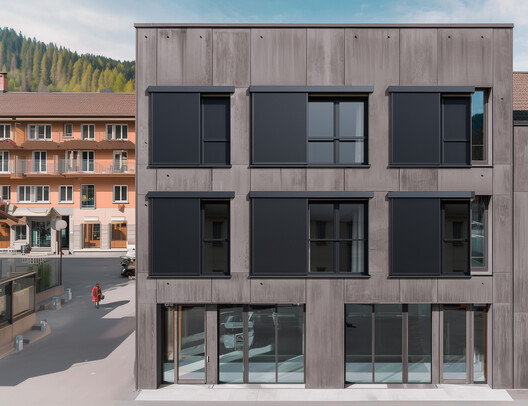
Although the building includes a photovoltaic system integrated into the south-facing metal roof, its urban configuration and roof geometry limited the energy that could be generated from this horizontal surface alone. Approximately 167.9 square meters of rooftop panels provided an installed capacity of around 31 kilowatt-peak, which proved insufficient to meet the project's energy targets. Instead of applying conventional photovoltaic panels to the facade, sliding photovoltaic shutters SolarSlide by EHRET were integrated into the south facade. In total, 21 elements were installed, each with approximately 3 square meters of photovoltaic surface and an output of around 500 watt-peak. This strategy increased the installed photovoltaic capacity by approximately 24.5 percent, raising the system to around 41 kilowatt-peak and enabling an estimated annual production of 38,500 kilowatt-hours.
The broader relevance of photovoltaic shutters lies in their architectural versatility. By replacing conventional façade elements rather than adding new layers to the envelope, these systems reduce constructive complexity while expanding functionality. Their adaptability makes them suitable for a wide range of project types, supporting incremental and scalable strategies. By integrating energy generation, environmental control, and formal expression within a single architectural component, photovoltaic shutters demonstrate how renewable technologies can become more and more part of contemporary architectural language.


