

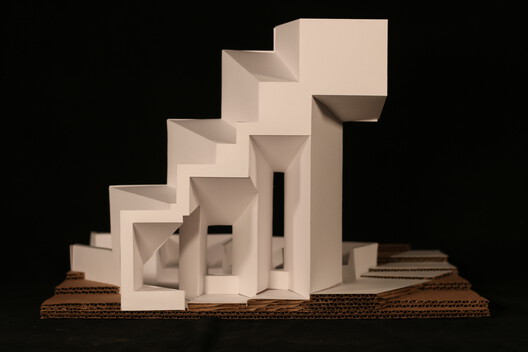
Today, interdisciplinary learning and exchange are more important than ever in addressing increasingly complex environmental, social, and urban challenges.
Each summer, the University of California, Berkeley's College of Environmental Design (CED) becomes an intensive laboratory for architectural, landscape, and urban exploration. Through two complementary programs—Design + Innovation for Sustainable Cities (DISC) and the Summer Institutes—Berkeley offers an immersive curriculum grounded in disciplinary rigor, intentional exchange, and a shared institutional culture. Together, these programs reflect CED's long-standing multidisciplinary structure, with architecture, landscape architecture, city planning, and urban design thriving and collaborating under one roof.
Across all summer programs, successful students earn college credit at the nation's top public university, build a high-quality portfolio for graduate school or professional applications, and gain fundamental skills in design and planning. Whether participants are exploring design for the first time or building on prior experience, the summer programs emphasize both skill-building and critical thinking within a collaborative academic environment.
DISC: Interdisciplinary by Design
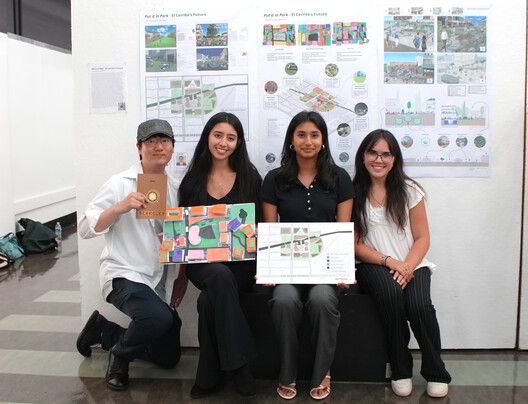
DISC (Design + Innovation for Sustainable Cities) is intentionally and fully interdisciplinary. College students from diverse backgrounds—architecture, engineering, policy, history, arts, and beyond—are brought together in mixed teams to address complex urban sustainability challenges.
DISC's curriculum is interdisciplinary by design. Urban sustainability is treated as a multiscalar and multidimensional challenge in which spatial design, environmental systems, social equity, and governance intersect. Projects are structured so that no single discipline can "solve" the problem alone. Instead, students learn to communicate across areas of expertise, negotiate priorities, and synthesize different ways of thinking into coherent design proposals.
The result is a learning experience that closely mirrors contemporary professional practice, where urban challenges demand integrated and collaborative approaches.
Summer Institutes: Distinct Studios with Shared Moments of Exchange
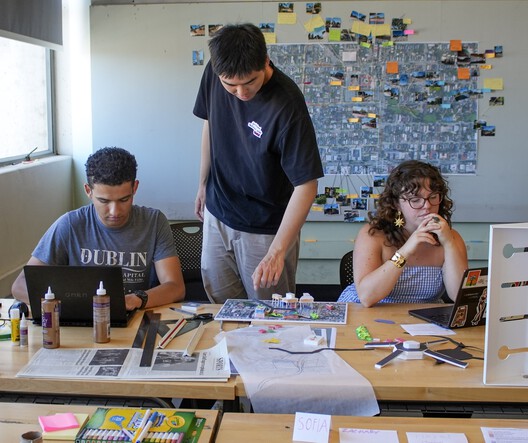
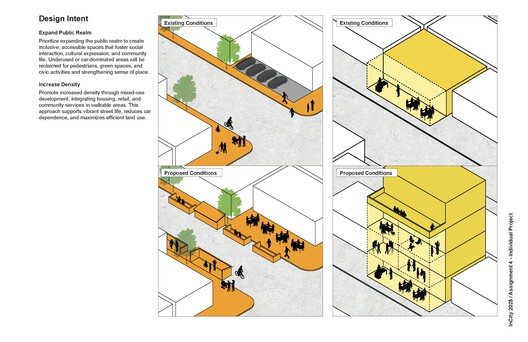
In contrast, the Summer Institutes are designed for students who already hold a college degree and are primarily focused on a single discipline—INARCH for architecture, INLAND for landscape architecture, and INCITY for city planning and urban design. Each cohort has its own dedicated faculty, methods, and studio culture. Architecture students focus on architectural design and representation; landscape architecture students engage with concepts of ecology, public space, community, and sustainability; and city planning and urban design students address housing, transportation, and environmental justice.
While each cohort is deeply grounded in its own discipline, the program intentionally enables and supports cross-pollination and exchange among cohorts, a feature that distinguishes the three Summer Institutes from other university courses in related fields.
Moments of Exchange: Expanding Awareness
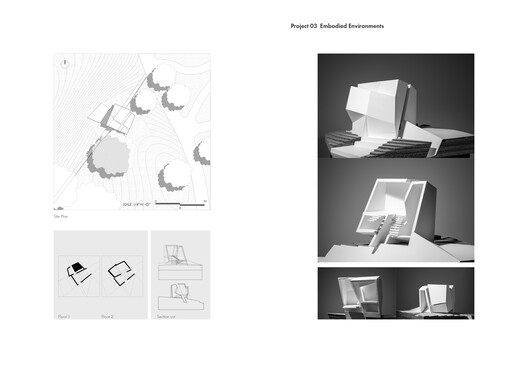
Summer Institute instructors are often educated in more than one discipline, enabling them to teach from multiple perspectives. Students also broaden their understanding of adjacent fields by participating in joint events across cohorts, including guest lectures, open reviews, site visits, and informal gatherings such as happy hours. These events create opportunities for cross-pollination—allowing students to listen, engage with one another, and observe how different disciplines frame questions and evaluate work.
A joint lecture may prompt architecture students to consider territorial or policy implications, while planners and landscape architects may reflect on spatial or material consequences. Shared site visits become collective acts of reading a place through multiple lenses.
These exchanges are ultimately about expanding awareness: learning enough about adjacent fields to ask better questions, communicate more effectively, and situate one's own work within a broader disciplinary ecosystem.
A Living Expression of CED's Foundation
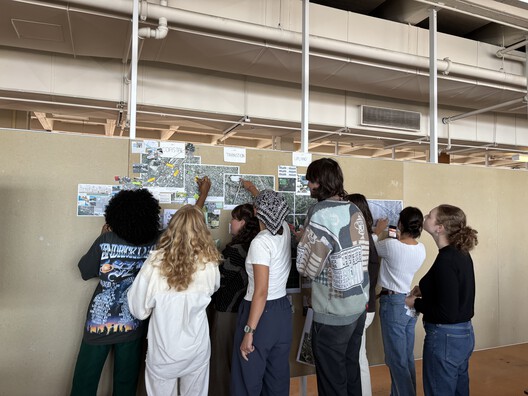
DISC and the Summer Institutes exemplify CED's historic commitment to proximity without homogenization. Students may choose to work interdisciplinarily or to remain deeply rooted in their chosen field, while being surrounded by peers doing the same and engaging with shared themes, sites, and global challenges. The result is an educational environment that values both specialization and integration, preparing students to communicate and collaborate across disciplines while remaining grounded in their own.
Students in CED's DISC and Summer Institutes have an unparalleled opportunity to benefit from the college's unique interdisciplinary culture by immersing themselves in one of four distinct, full-time environmental design programs offered over five or six weeks.
The application for the summer programs 2026 is open until May 18. For more information and to apply, visit the UC Berkeley College of Environmental Design's Summer Programs website.


