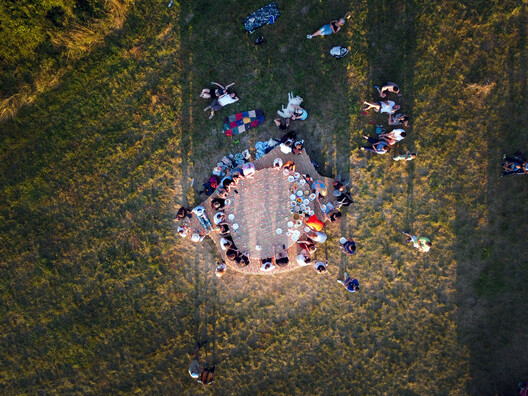
In recent years, food has taken on a renewed role within architecture, not simply as a program or typology, but as a shared spatial practice. Beyond restaurants or dining design, communal eating spaces are increasingly understood as environments where presence, ritual, and time intersect, allowing people to gather, stay, and coexist. In these settings, eating does not just happen within space; it actively shapes it, temporarily transforming ordinary, borrowed, or improvised environments into places of exchange.
This shift is visible across a wide range of built projects, installations, and community spaces that use shared meals as a way of bringing people together. Initiatives such as Fondo Supper Club frame dining as a social platform, using food to connect artists, designers, and local communities through conversation and collaboration. Similarly, sit.feast, presented during Milan Design Week 2024, approached the table as a spatial installation, one where sitting and eating together became the primary means of collectively producing space.
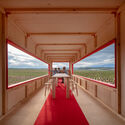
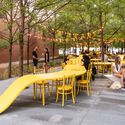
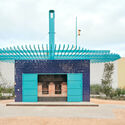
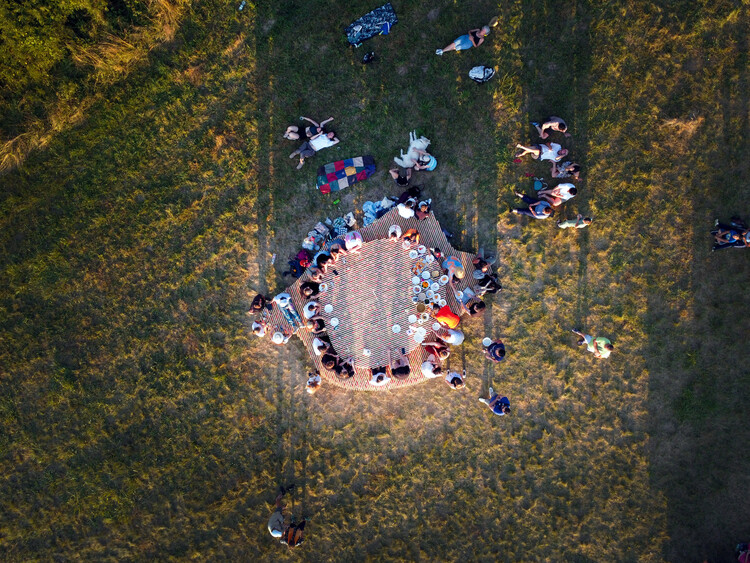
Rather than relying on fixed programs or defined interactions, these spaces operate through simple, recognizable gestures: sitting, waiting, sharing, and staying. Tables, kitchens, markets, and shared surfaces become points of convergence where collective life unfolds through everyday use. The following selection brings together projects that explore how architecture supports communal eating across different contexts, revealing how shared meals continue to shape social relations and togetherness in the built environment.
Tables That Organize Gathering
Across these projects, the table operates as more than a functional element. Its form, placement, and scale help organize how people come together, shaping where bodies gather, how they face one another, and how long they remain in place. Rather than acting as a neutral support, the table becomes a spatial anchor that structures proximity and shared presence within a collective setting.
This approach is evident in projects where geometry plays a key role in shaping interaction. Circular and linear arrangements, as seen in 100x Round Table and TULIP – Your Place at the Table, reduce hierarchy by allowing participants to occupy the same spatial condition. Here, sitting becomes a shared spatial action, guided by form rather than by assigned roles or programs.
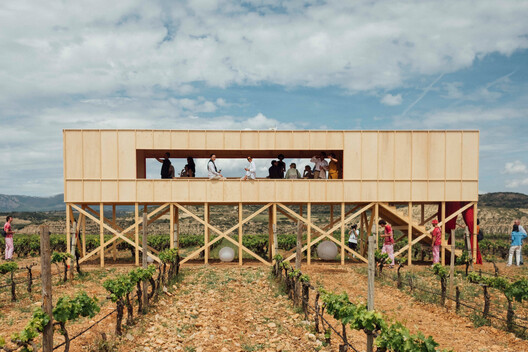
Other projects expand the role of the table by rethinking its relationship to ground, enclosure, and movement. A Table Elevated in the Landscape frames eating as a moment suspended between body and landscape, while The Dining Room Installation and San Michele Bar Installation reinterpret the table as a continuous surface or spatial threshold. In these cases, the table influences not only where people sit, but how they move through and occupy space together, showing how minimal architectural elements can support collective environments through simple, repeatable gestures.
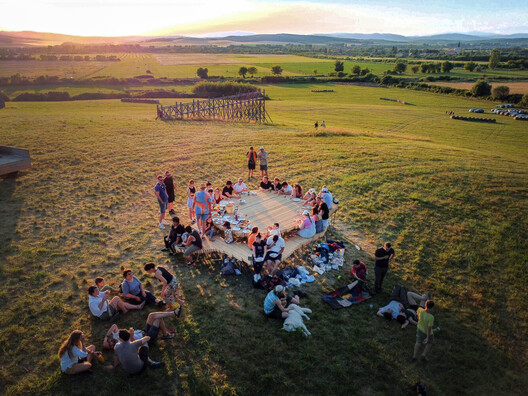
100x Round Table / Atelier Széchenyi István University for Field of Sparks
TULIP – Your place at the table / ADHOC architectes
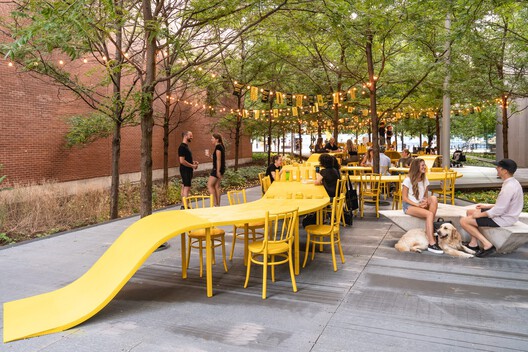
A Table Elevated in the Landscape / J-AF Architecture + González Serrano Studio+
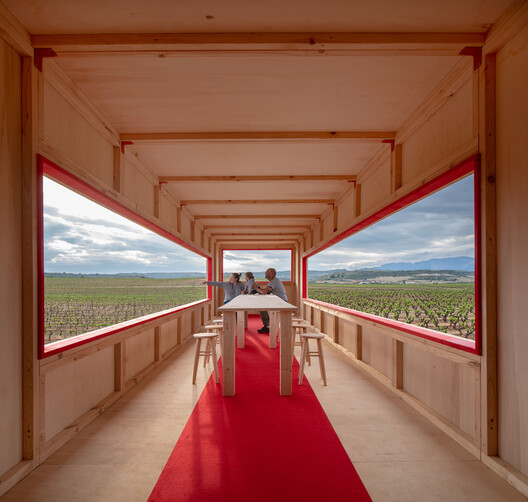
The Dining Room Installation / i/thee
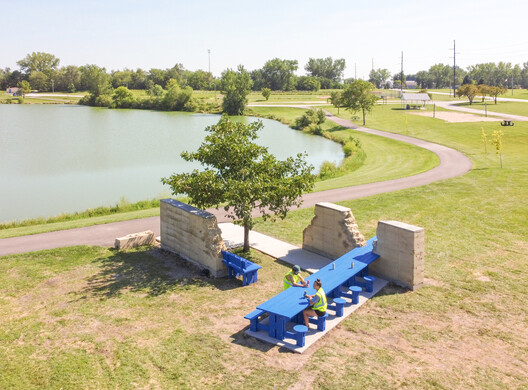
San Michele Bar Installation / Trewhela Williams
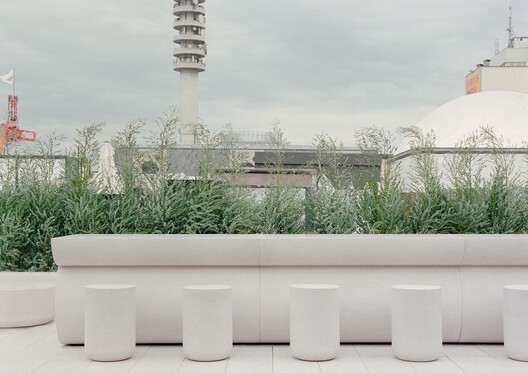
Spaces Shaped by Eating
In these projects, architecture is shaped by the temporal rhythms of eating rather than by form alone. Cooking, serving, and remaining together define spatial conditions that unfold over time, allowing architecture to appear gradually through use. The meal introduces a sequence, before, during, and after, that structures space as an event rather than a fixed moment.
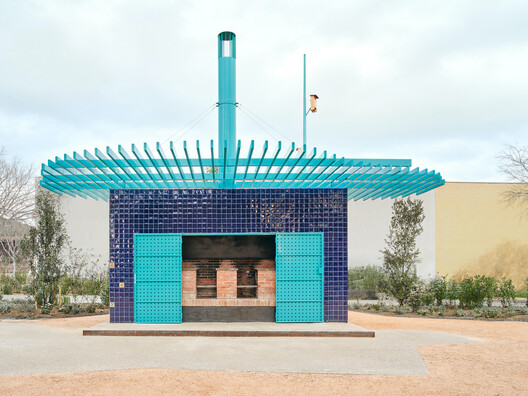
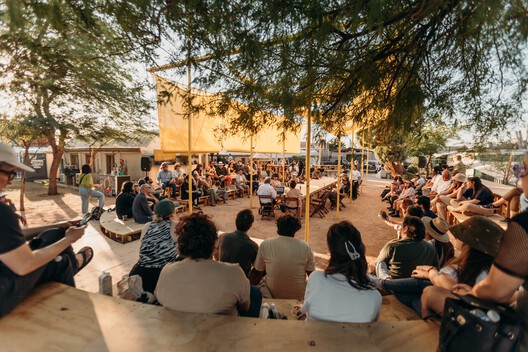
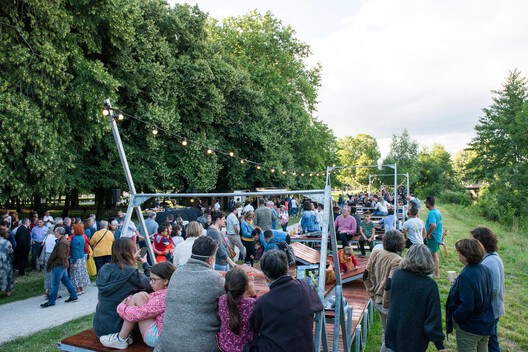
Projects such as The Communal Barbecue and Situaciones de Estar Pavilion illustrate how built elements operate as anchors within a broader temporal experience. The structures themselves remain relatively simple, while the architectural richness emerges through routine and shared duration. Eating gives these spaces meaning, allowing built structures to become places shaped by shared presence and repeated use. A similar logic operates in Summer Shores Installations, where seasonal gatherings transform coastal sites through recurring acts of eating and meeting.
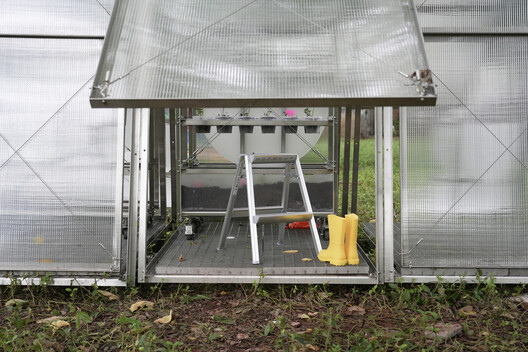
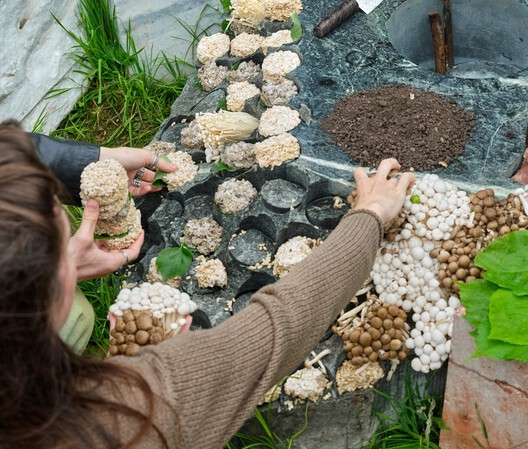
Other projects extend this temporal reading by connecting food to processes that unfold beyond the moment of the meal. Your Greenhouse is Your Kitchen expands architecture across production, preparation, and consumption, framing eating as part of a continuous spatial sequence rather than a single event. In Transspecies Kitchen, shared meals introduce overlapping social, political, and ecological temporalities, where architecture operates through relationships and care rather than enclosure. Across these examples, eating functions as a time-based architectural practice, producing collective environments defined less by permanence than by duration, repetition, and shared use.
The Communal Barbecue / h3o architects
Situaciones de Estar Pavilion / Veintedoce Arquitectura
Your Greenhouse is Your Kitchen / Office for Roundtable + JXY Studio
Summer Shores Installations / Vous Architecture & Design
Transspecies Kitchen / Andrés Jaque / Office for Political Innovation
Spaces Where Food Sustains Community
The act of sharing, rather than food itself, becomes the primary driver of collective life in these spaces. Meals operate as recurring social moments that bring people together in shared environments, creating rhythms of encounter that shape how communities relate to one another. Architecture supports this by providing accessible settings where gathering, conversation, and collective presence can unfold as part of everyday life.
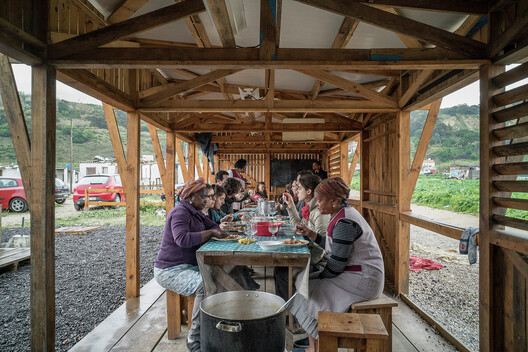
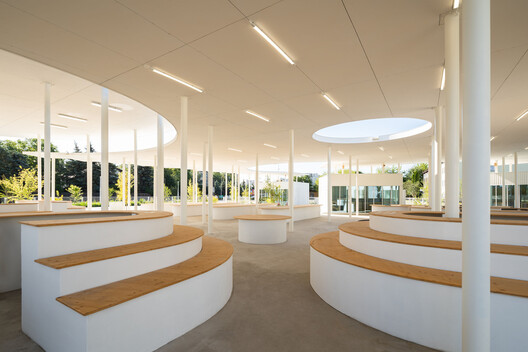
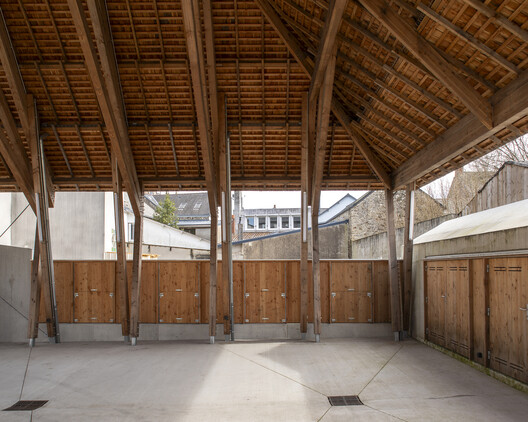
This is evident in the Community Kitchen of Terras da Costa, where communal cooking and eating reinforce social bonds through daily use. The kitchen functions as a shared platform for meeting, learning, and mutual support, embedding togetherness into routine practices. Similarly, Targ Błonie Market and Missillac Market Hall frame food exchange as a civic condition, supporting repeated encounters that take place alongside daily activities.
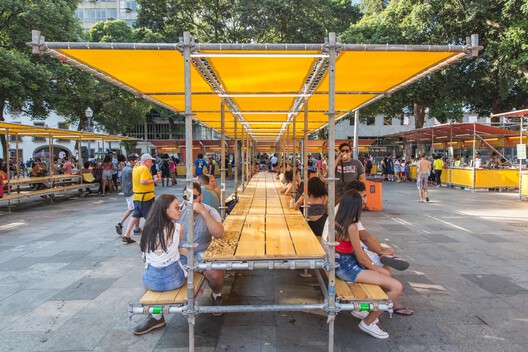
A more experimental approach appears in Conexidade Installation, where shared meals temporarily reorganize social relations within the city. Here, gathering around a table becomes a way to create connection and visibility, even if only for a limited time. Rather than presenting eating as an event, these projects show how food can sustain community through regular presence, shared use, and simple acts of being together.
Community Kitchen of Terras da Costa / ateliermob + Colectivo Warehouse
Targ Blonie Market / Aleksandra Wasilkowska Architectural Studio
Conexidade Installation / Estúdio Chão
Missillac Market Hall / LAUS architectes
Together, these projects illustrate how communal eating continues to shape shared space across different contexts and scales. Whether through tables, kitchens, markets, or temporary installations, architecture supports togetherness by making room for people to gather, stay, and return over time. Rather than focusing on food as an object or event, these spaces emphasize the act of eating together as a way of sustaining collective life, showing how everyday gestures like sitting, sharing, and remaining can quietly produce meaningful environments of coexistence.
This article is part of the ArchDaily Topic: Coming Together and the Making of Place. Every month we explore a topic in-depth through articles, interviews, news, and architecture projects. We invite you to learn more about our ArchDaily Topics. And, as always, at ArchDaily we welcome the contributions of our readers; if you want to submit an article or project, contact us.