Leisure spaces are often where different generations cross paths. Without formal programs or assigned roles, they allow people to move, pause, and remain together, each engaging space in their own way. In a built environment increasingly shaped by specialization and separation, these shared spatial grounds have become less common, giving leisure-oriented architecture a renewed relevance.
Discussions around public space have repeatedly pointed to the value of openness and flexibility in supporting collective life. Reflecting on how people read, inhabit, and adapt space, Architect Herman Hertzberger speaks of architecture not as a set of instructions, but as a framework of possibilities—one that invites interpretation rather than prescribing behavior. As he puts it, "what we should make in architecture is something like competence, possibility – something that people can freely handle in their own way." Rather than attempting to create interaction, architecture shapes the conditions that make togetherness possible.
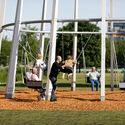
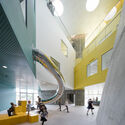
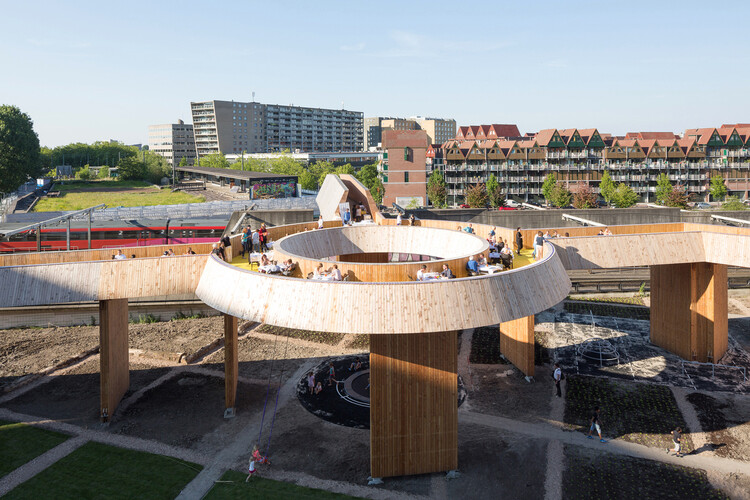
Through movement, play, and moments of pause, architecture frames conditions where encounters unfold informally, allowing multigenerational users to occupy the same environment through shared spatial experience.
The following projects explore how leisure becomes a spatial language in architecture, one that supports coexistence across ages through everyday gestures rather than programmed interactions.
Leisure as Movement: Architecture That Activates the Body
In these projects, leisure is structured through bodily movement rather than static occupation. Architecture is experienced as a sequence of physical actions such as walking, climbing, swinging, or crossing, where circulation becomes an active social condition. Ramps, elevated paths, and continuous routes blur the line between movement and use, allowing bodies to engage space dynamically.
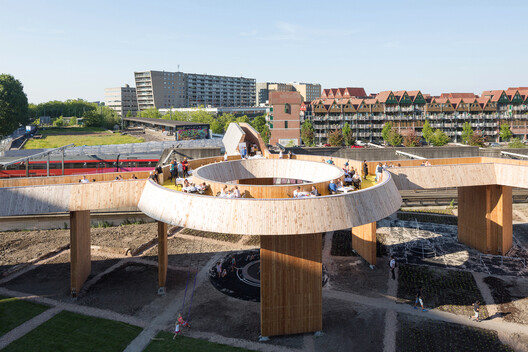
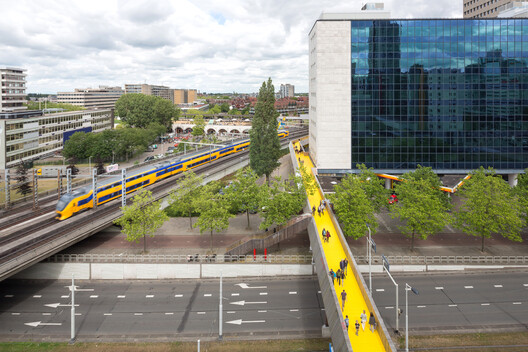
Projects such as Ku.Be House of Culture in Movement and The Luchtsingel demonstrate how movement can operate as an organizing principle across different scales. In Ku.Be, interior routes and vertical connections transform circulation into a shared spatial experience, while the Luchtsingel reframes everyday walking as a collective act, turning walking and passage into moments of togetherness. In both cases, architecture invites users to experience space through motion, accommodating multiple rhythms simultaneously.
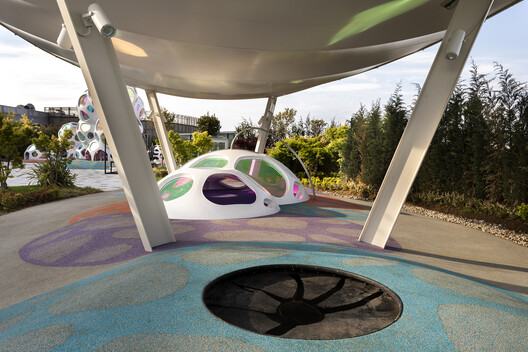
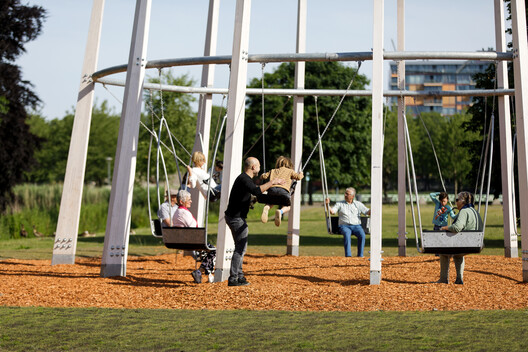
A similar logic appears in projects where play and movement overlap. Battery Playscape, Ring of Swings, and Marmara Forum Cloud Playground activate the body through topography, suspended elements, and large-scale structures that invite climbing, swinging, and exploration. Rather than assigning activities, these environments allow different forms of movement to coexist alongside one another. In these works, leisure emerges through shared physical engagement, where moving through space becomes a common language that connects users.
Ku.Be House of Culture in Movement / MVRDV + ADEPT
Battery Playscape / BKSK Architects + Starr Whitehouse Landscape Architects and Planners
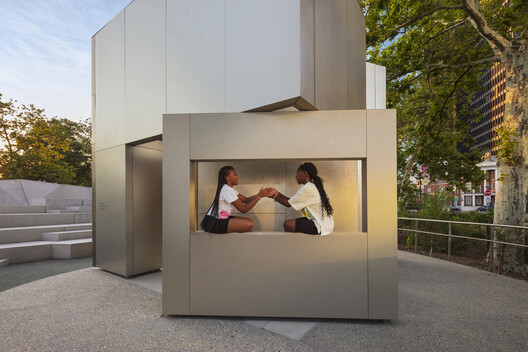
Marmara Forum Cloud Playground / Carve
Ring of Swings / IND [Inter.National.Design] + Studio ID Eddy
The Luchtsingel / ZUS
Intergenerational Play: Shared Spaces for Collective Use
In many public and community spaces, play emerges not from objects or designated programs, but from how architecture allows people to share space. When surfaces, routes, and structures remain open to interpretation, leisure becomes a collective condition. In these projects, architecture frames conditions that allow different generations to inhabit the same environment at once, engaging space through parallel and overlapping uses.
This approach is evident in projects such as Park 'n' Play and BLOX Playground, where infrastructural and urban elements are transformed into shared spatial devices. Structural grids, stairs, handrails, and open frames are reinterpreted as opportunities for engagement, allowing play, exercise, circulation, and pause to coexist. Rather than separating leisure from everyday movement, these projects embed play directly into architectural structure, dissolving distinctions between playground, public space, and infrastructure.
A similar spatial openness defines Skakkeringen Public Square and Kovo 11 Park, where open layouts and minimal zoning support continuous public use. By remaining accessible throughout the day and avoiding age-specific areas, these spaces encourage spontaneous occupation, from children playing, adults resting, and groups gathering side by side. Play operates here as a shared spatial condition, guided by surface treatments and modest interventions.
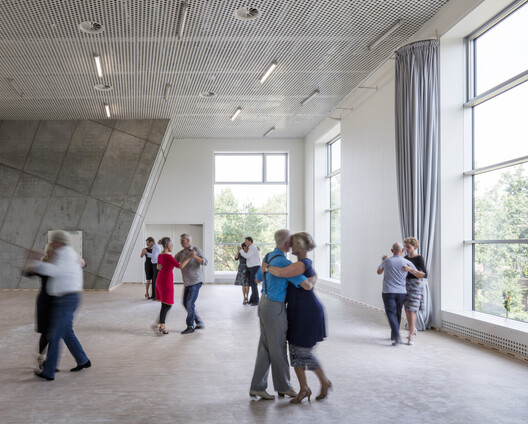
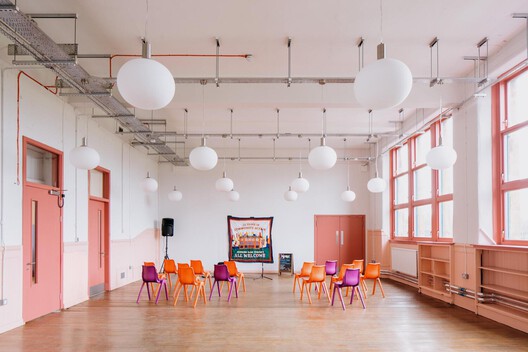
At the scale of a community building, Kinning Park Complex extends this logic indoors. Through flexible interiors and shared circulation spaces, the project supports creative, social, and recreational activities that evolve through daily occupation. In these projects, intergenerational play is enabled through architectural ambiguity: by resisting prescriptive layouts and age-based separation, these projects allow leisure to function as a shared spatial language shaped by everyday use.
Park 'n' Play / JAJA Architects
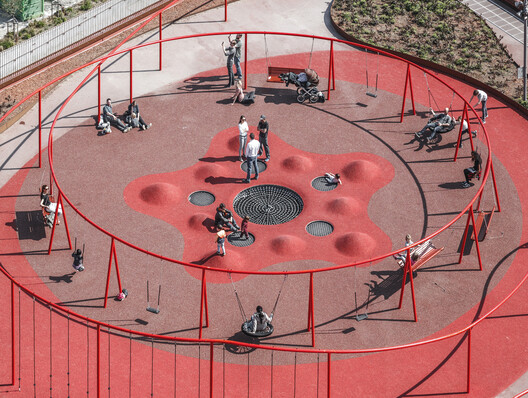
Skakkeringen Public Square / locallll + PIR2
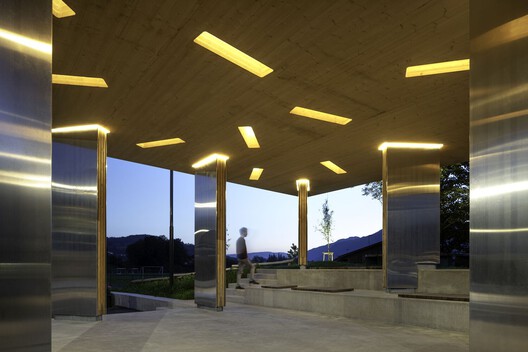
Kovo 11 Park / Inout.designstudio
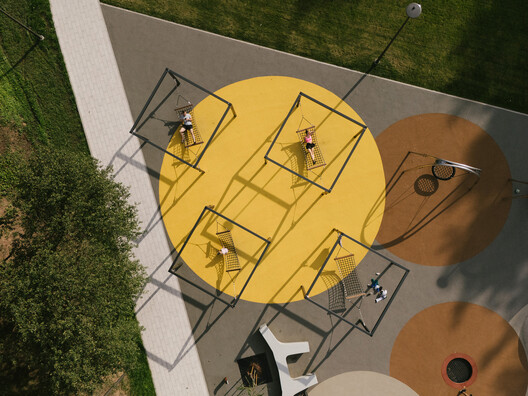
BLOX Playground / Carve
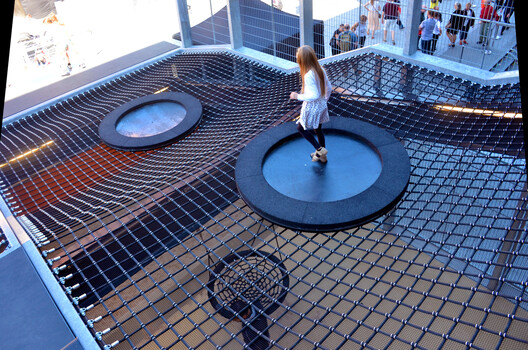
Kinning Park Complex / New Practice Studio
Leisure as Presence: Architecture for Coexistence
Not all forms of leisure rely on activity or movement. In some spaces, togetherness emerges simply through the possibility of being present, of occupying the same environment without the need for participation, performance, or coordination. In these projects, architecture does not prompt interaction, but creates conditions where coexistence can unfold naturally, allowing different users to remain together while engaging space in quiet, informal ways.
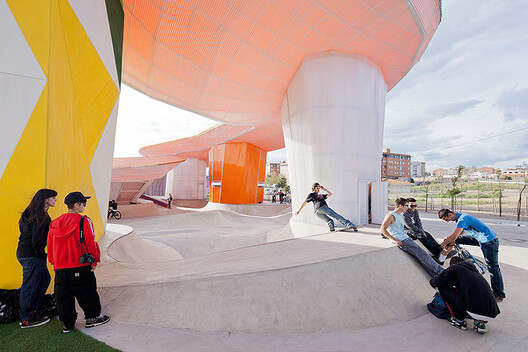
This approach is central to Mérida Factory Youth Movement, where architecture is conceived as an open canopy rather than a bounded building. By remaining accessible and undefined in use, the structure accommodates a wide range of activities and users without filtering. Leisure here is understood as openness itself: a shared spatial ground that invites presence without prescribing how that presence should take shape.
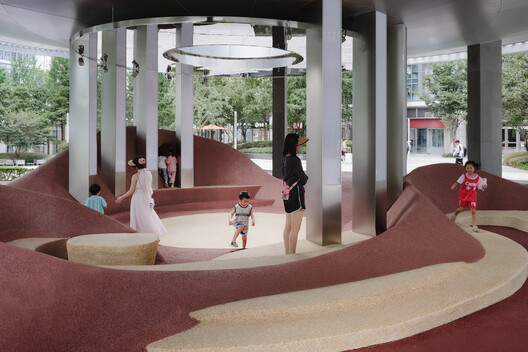
A similar approach appears in Wave Pavilion, where a small-scale intervention transforms a residual urban site into an experiential landscape. Rather than introducing programmed functions, the pavilion relies on subtle changes in ground, enclosure, and scale to support gathering, rest, and quiet encounters. The architecture encourages people to linger, sit, and share space, framing leisure as an atmospheric condition rooted in proximity.
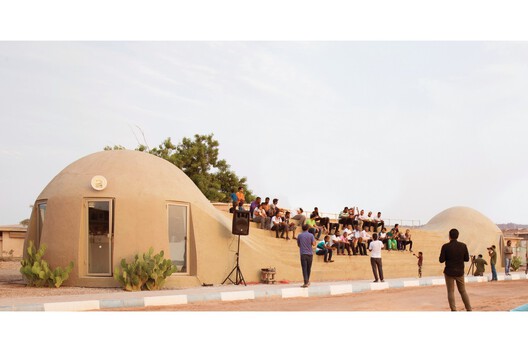
This logic is taken even further in Presence in Hormoz, where architecture offers only minimal cues and remains fully accessible. With no fixed functions or assigned programs, the space allows coexistence to happen naturally. Across these examples, leisure is defined not by what people do, but by the simple possibility of being together, showing how architecture can support collective life by simply coexisting.
Merida Factory Youth Movement / Selgascano
Wave Pavilion, Urban Micro-Space Regeneration Plan / Moguang Studio
Presence in Hormoz / ZAV Architects
Across these projects, leisure emerges as a spatial quality embedded in how architecture is shaped and used. Whether activated through movement, play, or simple presence, these spaces show how design can support shared experience without relying on strict functions or age-based separation.
Taken together, the projects highlight leisure as a way of occupying space rather than a defined activity. By allowing different rhythms and forms of use to coexist, they demonstrate how architecture can sustain collective life not through specific programming, but through openness to everyday coexistence.
This article is part of the ArchDaily Topic: Coming Together and the Making of Place. Every month we explore a topic in-depth through articles, interviews, news, and architecture projects. We invite you to learn more about our ArchDaily Topics. And, as always, at ArchDaily we welcome the contributions of our readers; if you want to submit an article or project, contact us.