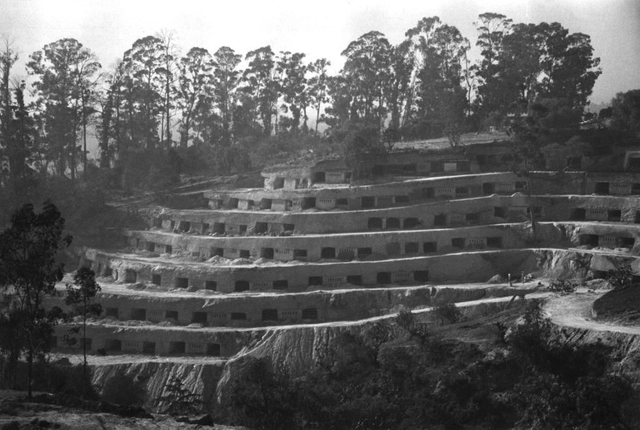
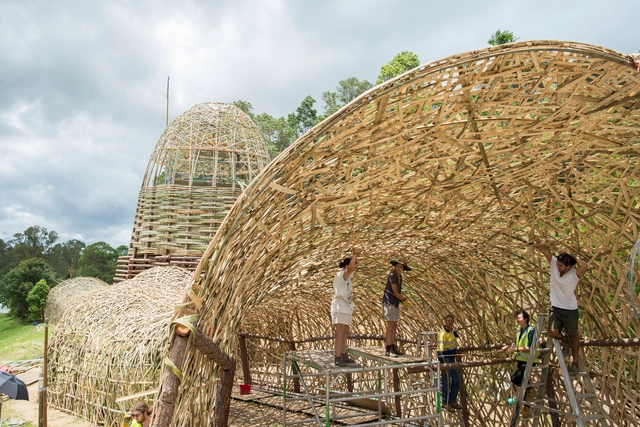
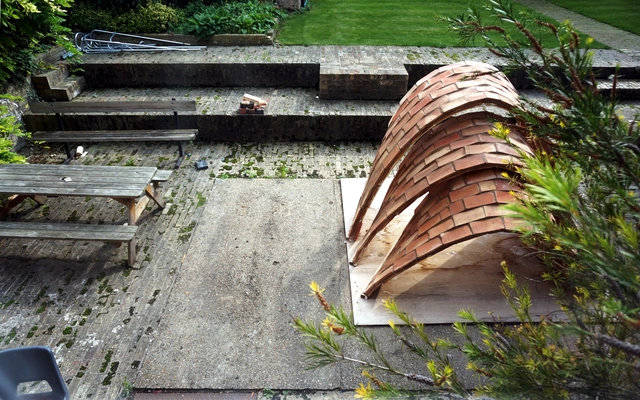
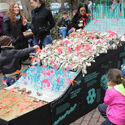
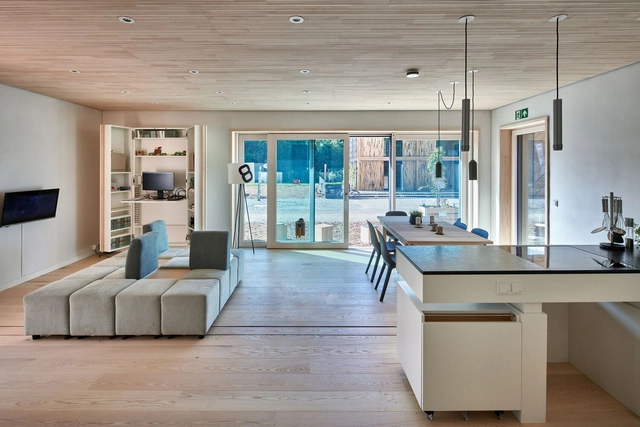
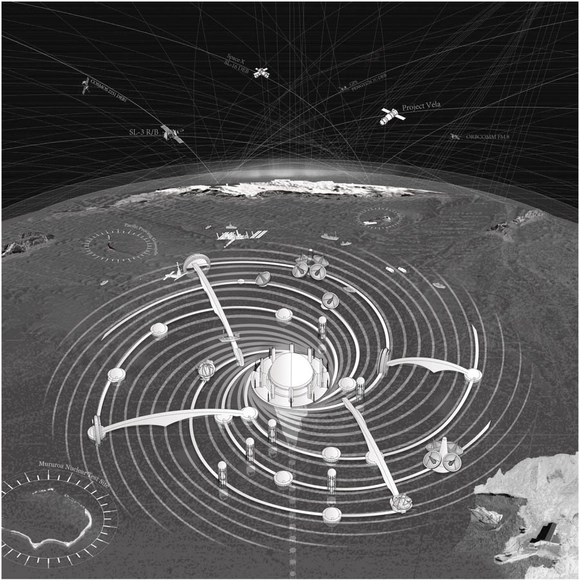
Mexican architect Carlos Lazo's Cuevas Civilizadas project in Mexico City. Image Courtesy of The Isamu Noguchi Foundation and Garden Museum
Contemporary architecture's approach to space is fairly linear: enveloping a specified volume within some form of material construct. But if we take a look at humanity's first intentional dwellings, it becomes clear that they were much less premeditated.
Rather than manmade areas to be furnished with pride, our earliest homes were naturally occurring cave lairs that offered hunter-gatherers temporary protection from the elements and potential predators. It wasn't until the appearance of agriculture that our ancestors took permanent, built residences. To this day, troglodytism — or cave living — continues to be connected to ideas of societal disassociation and a hermetic desire to exist outside of orthodox architectural norms. And yet, from Northern China to Western France and Central Turkey, hundreds of millions of people still choose to spend their lives at least partially underground.
In this third feature, we met with co-chairs of Design for Resilient CommunitiesAnna Rubbo, Senior Researcher, Center for Sustainable Urban Development (CSUD), The Climate School, Columbia University, and Juan Du, Professor and Dean of the John H. Daniels Faculty of Architecture, Landscape and Design, University of Toronto.
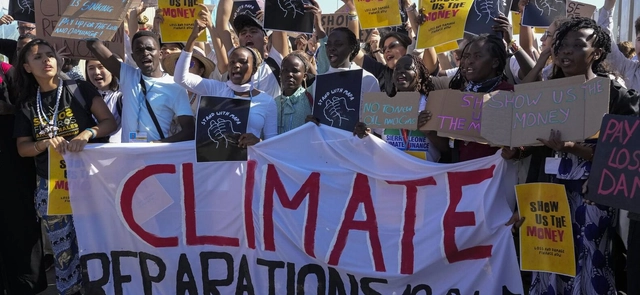
Last November, the annual climate conference COP 27 came to a close in Sharm el-Sheikh with a tentative agreement, reached at the last moment, to set up a “loss and damage” climate fund for Africa and other developing countries. For Africans, this was cause for muted celebration, because for generations the continent has built its climate change agenda almost exclusively around the pursuit of climate justice, a desire to enforce liability on the industrialized nations responsible for the bulk of global carbon emissions. All of this has unfolded, in a sort of willful blindness, while a majority of Africans struggled with the most prosaic challenges: inefficient urban sanitation; poor stormwater management; a paucity of water, sanitation, and hygiene facilities; willful and unabated deforestation; and environmental degradation.
https://www.archdaily.com/996301/its-time-for-africa-to-chart-its-own-climate-change-agendaMathias Agbo, Jr.
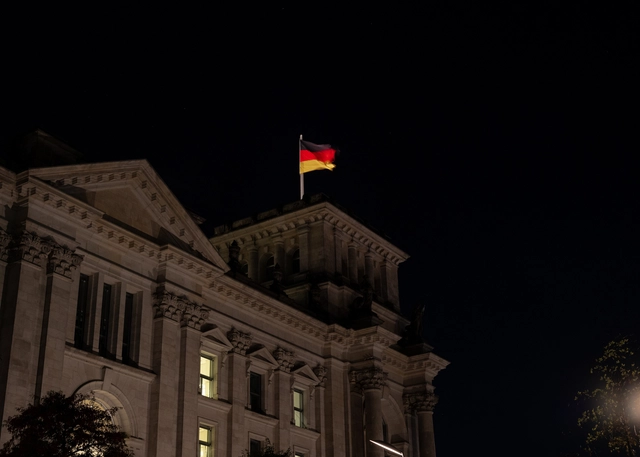
When capital cities like Paris and Berlin resolved to switch off lighting for public buildings and landmarks in July 2022 in order to save energy in the context of the Russian invasion of Ukraine, the cities created a ripple effect throughout central Europe. Images of dark iconic landmarks swept through the media and allowed politicians a momentary act of environmental demonstration. However, designers have started to question the sustainability of this ad hoc step. Seen from a broader perspective the impression arises that this alleged radical action has been part of a rather media-savvy campaign with small effect in cities at night. Further steps are necessary to reassess urban lighting that may have a major impact on energy saving and sustainability.
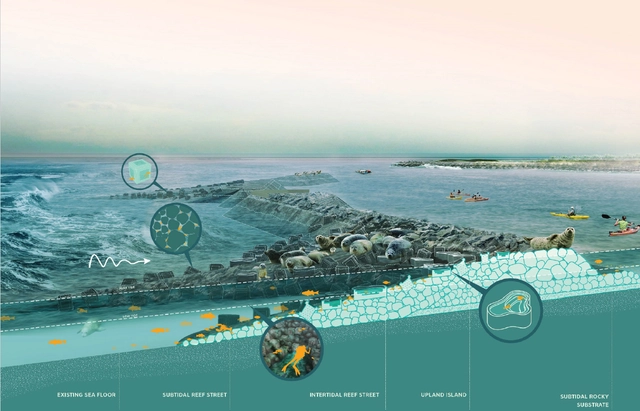
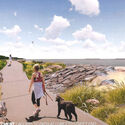
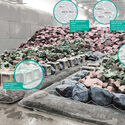
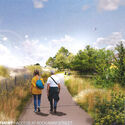
Living Breakwaters, Staten Island, NYC. Image Courtesy of SCRAPE
“Superstorm Sandy in 2012 was a wake-up call for NYC and made the city realize it needed to better prepare for climate change,” said Adrian Smith, FASLA, vice president at ASLA and team leader of Staten Island capital projects with NYC Parks. Due to storm surges from Sandy, “several people in Staten Island perished, and millions in property damage were sustained.”
On the 10th anniversary of Sandy, Smith, along with Pippa Brashear, ASLA, principal at SCAPE, and Donna Walcavage, FASLA, principal at Stantec, explained how designing with nature can lead to more resilient shoreline communities. During Climate Week NYC, they walked an online crowd of hundreds through two interconnected projects on the southwestern end of the island: Living Breakwaters and its companion on land — the Tottenville Shoreline Protection Project.
The motto of the Solar Decathlon Europe 21/22 was to convert and expand rather than to demolish and reconstruct. Recycling windows, using biodegradable materials for luminaires and connecting light with sensors represented just some innovative examples of the international university-level student competition in Wuppertal, Germany. For the first time, the competition presented an award for sustainable architectural lighting. This was a question of quality as much as quantity, and that applies equally to daylight and artificial light.
Agriculture and the food industry seem to have little in common with architecture, but it is precisely the overlap of these three areas that interests Ghanaian-Filipino scientist and architect Mae-ling Lokko, founder of Willow Technologies based in Accra, Ghana. Working with recycling agricultural waste and biopolymer materials, Lokko searches for ways to transform the so-called agrowaste into building materials.
By digitizing architecture services, German firm baupal seeks to democratize sustainable and customized architecture, making design, energy assessments, permitting and cost evaluations more accessible and straightforward for private builders and smaller construction projects. Baupal is an online building application service that takes advantage of digital processes and efficient team structures to streamline design, planning and permitting processes for a range of small-scale projects.
Selected as one of Archdaily's Best New Practices of 2021, Baupal is a Berlin-based start-up co-founded in 2020 by Constantin Schmidt-Thomé, Justus Menten, and Max Schroeren with the purpose of "simplifying design and building application for everyday homeowners and their contractors. "With backgrounds in finance, entrepreneurship and architecture, the team set out to transform the design and planning approval process into a customer experience through digital and transparent workflows. The firm specializes in conversions, extensions and new single-family houses, while also providing building application services to construction companies.
With buildings glazed on all sides and very brightly as well as monotonously lit rooms, it's no surprise that we long for indoor and outdoor retreats that are less bright. Places with shade from glaring sun, dimmed rooms and exciting contrasts act on the eyes like a welcome oasis. High energy consumption and globally increasing light pollution show how acute the problem of too much light is and the alarming rate of contribution toward climate change. For a better future, it is imperative to explore ways in which we can design and focus on using darkness.
The Thermal Energy Center at Microsoft’s headquarters in Redmond, Washington, powers the campus almost entirely through electricity provided by geothermal energy exchanges. The project acts as a pilot program for the Embodied Carbon in Construction Calculator (EC3), a free database of construction EPDs and matching building impact calculator.. Image Courtesy of NBBJ
The growing consumer demand for transparency—especially around sustainability and environmental practices—has implications for industries from apparel to healthcare products. Mars Inc. recently released a cocoa sourcing map to tackle deforestation and increase accountability, and the Fashion Transparency Index pushes apparel companies to be more forthcoming about their social and environmental efforts.
Now it’s time for the building industry, characterized by a lack of information around the materials and practices used in construction and throughout a building’s lifecycle, to catch up. The cost of inaction is too high to ignore. That’s because buildings account for 39 percent of total global carbon emissions. Traditionally, most carbon reduction efforts in the building sector focus on operational carbon—a building’s everyday energy use, which accounts for roughly 28 percent of emissions. The remaining 11 percent comes from what is often ignored: embodied carbon.
https://www.archdaily.com/976015/strategies-to-reduce-embodied-carbon-in-the-built-environmentPeter Alspach, Margaret Montgomery
Architect Cino Zucchi (b. 1955) grew up and practices in Milan, Italy. He was trained at MIT in Cambridge and the Politecnico di Milano, but claims to be largely self-taught, although influenced by such of his countrymen as Aldo Rossi and Manfredo Tafuri. He is internationally known for diverse projects across Europe. Many are both abstracted and contextual residential complexes in Italy, particularly in Milan, Bologna, Parma, Ravenna, and, most notably, in Venice. Zucchi’s D residential building in Giudecca, attracted international attention and praise when it was completed in 2003. I met Cino Zucchi last year during the Venice Architecture Biennale; that meeting led to an extensive interview that we recently engaged in over Zoom between New York and the architect’s sunlight and books-filled Milan studio.
Sustainable design in the United States is for many a sort of Rorschach test. The construction industry is either making steady progress toward the ultimate goal of a carbon-free building sector, or it’s moving entirely too slowly, missing key targets as the ecological clock keeps ticking. The perplexing truth to all of this is: both are ostensibly true. In recent decades the industry has become significantly more energy efficient. We’ve added building stock but flattened the energy curve. The cost of renewables continues to drop. But way more is required, much more quickly. At the same time, huge hurdles remain. Without a renewable grid and stringent energy codes, it’s hard to see how we can fully decarbonize the building sector in even 20 years, let alone at the timeline suggested by increasingly worried climate scientists. It’s the classic good news/bad news scenario (or vice-versa, depending on your mood).
There’s nothing green about your back-up generator. Manufacturing it released tons of CO2 into the atmosphere; so did shipping it from the factory to the dealership to your backyard. There it will sit, idle, waiting to be deployed only when the much cleaner—but underfunded—public infrastructure fails. At that point, it will fill the air with additional pollutants. There may be perfectly good reasons to buy an emergency generator but being green—that is, protecting the environment—isn’t one of them.
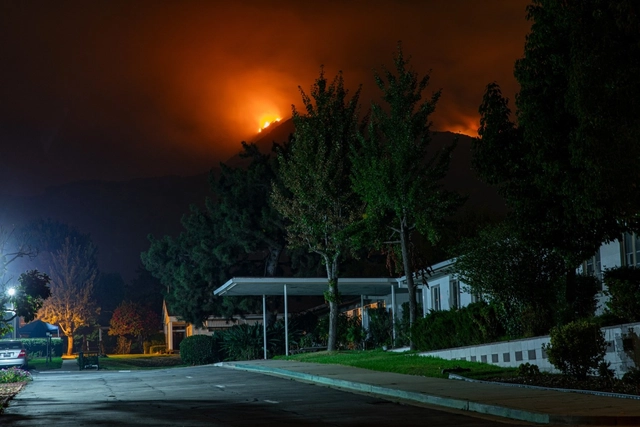
This August, as hundreds of wildfires darkened the sky above my home in Corte Madera, California, thousands of miles away in Florida, my family braced for wind and flooding as two hurricanes barreled towards the Gulf of Mexico. We all hunkered down, anxiously, as climate change-fueled disasters wreaked havoc. For weeks, the air quality in California was too hazardous for us to open our windows or go outside. In Pensacola, the Gulf storm surge was several feet deep around my family’s home and the powerful winds downed mature oak trees in their yard.
Architects and designers of the built environment are often conceptualized in popular culture as progressive change agents whose canvas of steel and glass brings light to the public realm. At least one global survey of the public’s trust in various professions places architects in a top-ranked cohort that includes medical professionals and first responders. But in the United States, the architecture profession is surprisingly older and much less progressive than one might imagine.
https://www.archdaily.com/945591/the-drawdown-review-suggests-that-architects-move-toward-scalable-climate-solutionsJesse M. Keenan
Cosmorama, a part of the U.S. pavilion at the Venice Biennale in 2018, comprised three sets of illustrated geographic stories: Mining the Sky, Planetary Ark, and Pacific Cemetery (a portion of which is pictured above). Courtesy Design Earth
I can’t stop thinking about refugia. In the years, months, and days before the COVID-19 pandemic, the term was confined to the literature and philosophy of climate crisis, referring to pockets of life that through geographic isolation or species resilience manage to hang on in spite of the environmental forces against them. Think of clusters of Pacific Northwest barnacles nestled high on coastal outcroppings to avoid falling prey to sea snails. Or old-growth forests insulated from rising temperatures in cool mountain valleys.
As self-quarantine set in earlier this spring, the word refugia, at least for me, expanded in definition from specific ecological condition to conceptual touchstone—a necessary leap to metaphor when faced with planetary crisis. The magnitude of this pandemic falls outside human comprehension, but for the luckiest of us, refuge is manageable: a place of relative safety, of sourdough starters and online Jazzercise classes.
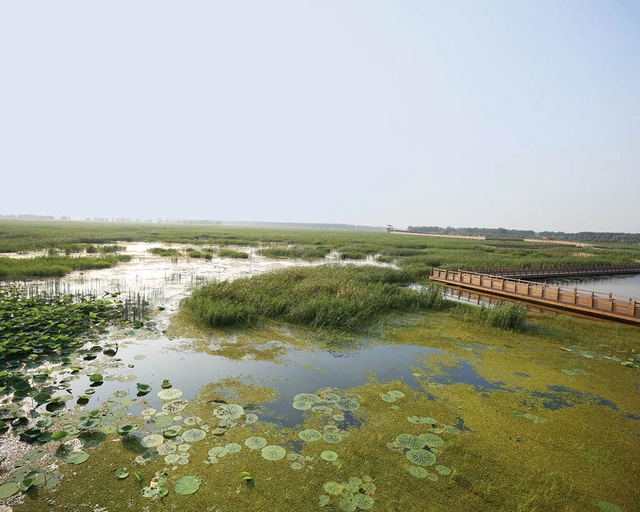
Design With Nature Now revisits Ian McHarg’s eponymous 1969 book and takes stock of current practices and projects of resilience in landscape design the world over, such as AECOM’s Weishan Lake National Wetland Park in Shandong, China. Courtesy AECOM
Moving away from its early exclusive focus on natural disasters, resilient architecture and design tackles the much tougher challenge of helping ecosystems regenerate.
Thirty years ago, as a high school student at the Cranbrook boarding school in suburban Detroit, I wrote a research-based investigative report on the environmental crisis for the student newspaper. I had been encouraged to do so by a faculty adviser, David Watson, who lived a double life as a radical environmentalist writing under the pseudonym George Bradford for the anarchist tabloid Fifth Estate. His diatribe How Deep Is Deep Ecology? questioned a recurring bit of cant from the radical environmental movement: Leaders of groups like Earth First! frequently disparaged the value of human life in favor of protecting nature.