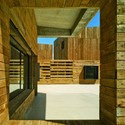
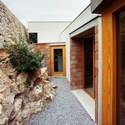
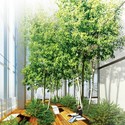
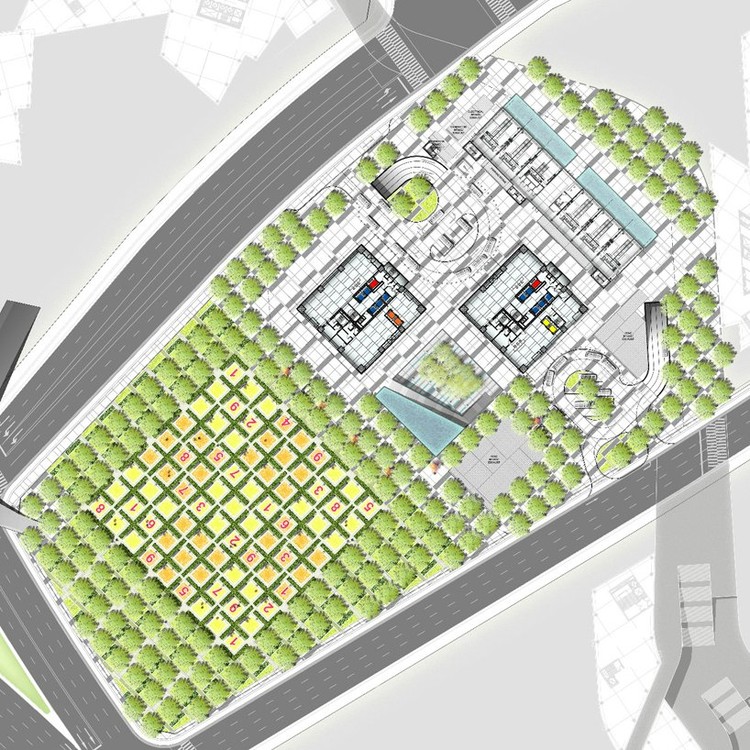
Designed by Tokamarch Architects, the XishuangbanNa Residence deals mainly with the relationship between the modern building and local natural environment. The traditional “Dai” village keeps a great balance with the natural environment in XiShuangBanNa. The boundary of every family is divided by bamboo fences or green plants. Luxuriant and multi-layered primitive woods have brought people a green and lively village, The relationship between the living space and the natural environment is in a harmonous compatible symbiosis. More images and architects’ description after the break.
Recently, we shared ODA’s honorable mention proposal for the National Library of Israel which fosters an open haven for learning and activity. The New-York based firm is also working on projects a bit closer to home in Manhattan that approach zoning restrictions with an air of optimism. ODA explained, “We embrace those parameters (zoning ordinances) and use them as the DNA of our buildings. If carefully studied, NYC’s zoning allows for many interpretations that follows logical principals.”
Located in a land about 80 hectares in Tehran, the design for the Army Residential Complex by Hootanpei was chosen in an architectural competition. With the contractor’s demand of 28-30 towers with 20-30 floors, the most important factor of design was minimum interference between pathways and driving ways and also suitable green places to create comfort and welfare for residents. More images and architects’ description after the break.
Anupama Kundoo‘s Wall House, originally built in Auroville, India in 2000, will be partially reconstructed at a 1:1 scale at the Venice Biennale this year for the theme of “Common Ground” by director David Chipperfield. This portion of the exhibition is supported by the University of Queensland, whose students and staff will assist with the construction of the replica alongside Indian craftspeople and Italian builders. The house has been described as a testing ground for spatial and technological innovation. In its debut at the Venice Biennale, it will afford Kundoo the opportunity to further explore these experiments.
Follow us after the break to see the innovations behind this widely acknowledged piece of architecture.
The Hegeman, designed by Cook + Fox Architects, is a residential community in Brownsville, Brooklyn that provides housing for low-income and formerly homeless individuals. Developed by Common Ground Community – an innovative non-profit whose mission is to end homelessness – the Hegeman Residence will also provide a range of on-site social services in a model known as supportive housing. For a little bit of context, Brownsville has the highest concentration of NYCHA (New York City Housing Authority) developments in New York City. A wave of arson in the 1970s destroyed most of the residential structures; Brownsville is just one of the many neighborhoods that were affected. The urban renewal that followed rebuilt many homes and designated them as low-income housing. The community has had many problems since associated with poverty, including crime and drug addiction, as well as low test scores and high truancy rates in the education system.
This year’s Venice Biennale will kick off on August 29th and run through November 25th and for the first time, the Institut Ramon Llull will be presenting an exhibition dedicated to Catalan and Balearic architecture entitled “Vogadors”, featuring nine projects from nine different architects that epitomize the contemporary and avant-garde works from the regions. The exhibition is inspired by the Mediterranean Sea, which is the main geographical feature of the regions, and by the words of Jorge Oteiza, “He who forges ahead creating something new does so like an oarsman, moving forward but back-paddling, looking behind him, towards the past, towards what exists, so as to be able to reinvent its underpinnings.”
Follow us after the break to see the projects to be featured at the exhibit.
Journey through the flawless space of the Daeyang Gallery & House in South Korea and learn about the ideas behind the design from the legendary architect himself, Steven Holl.
Created by the architectural filmmakers from Spirit of Space, the first video takes you on a tour through the “miniature utopia” of the Daeyang Gallery & House. Although the notion of music plays as an underlining theme throughout the design, Holl encourages visitors to focus on the feelings that arise as the body moves through the space. He believes that “architecture can change the way you feel, like music… it can bring you into another world.”
The AIA’s Home Design Trends Survey for the first quarter of 2012 reports an optimistic outlook for residential architectural firms. Key aspects of the survey attempt to illustrate the trending situations compared with previous quarterly surveys. Perhaps the most enlightening aspect prevalent throughout the majority of the survey topics is that growth is beginning to shake off the declines of the housing downturn. More details after the break.
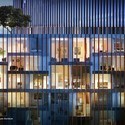
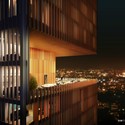
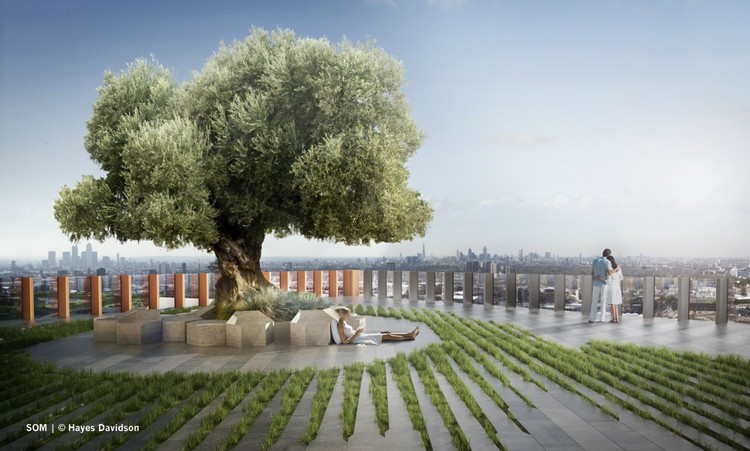
A triple height entrance lobby will welcome visitors to a world-class hotel, two restaurants, three sky gardens and a 248 unit residential tower, all with stunning views over Olympic Park. These are some of the key features offered in the newly unveiled plan for the 42-storey Manhattan Loft Gardens in London, designed by Skidmore, Owings & Merrill (SOM). It is planned to be built near the Stratford International Station – the gateway to the 2012 London Olympics. Completion is scheduled for 2014.
Safdie Architects was recently selected to design a new mixed-use development in Colombo, Sri Lanka. The 69-storey mixed-use project will be the first for Moshe Safdie in Sri Lanka, and is expected to be the tallest residential building in Colombo when it is completed. The design includes expansive family and community space amenities such as community gardens, shared outdoor spaces within the upper levels of the building, and individual roof gardens or terraces for every residence, a hallmark of Safdie’s design philosophy to provide access to outdoor spaces in high density urban housing. More images and architects’ description after the break.
Chicago-based architects Murphy/Jahn have unveiled their design for a 320-meter-tall skyscraper in the Yongsan International Business District of Seoul. Designed as two-towers under one roof, the steel and glass lattice structure is one of fifteen skyscrapers planned for the global city that was master planned by Daniel Libeskind and commissioned by South Korean developer DreamHub. Consisting of mostly high end residential units, the two Pentominium towers will provide residents with exclusive city views and four-storey skyparks, while attempting to recreate the spacious and private feel often associated with detached housing.
Continue reading after the break for the architects’ description.
Defined by a continuous volume snaking around two semipublic courtyards, the Connecting Riads residential complex by AQSO Arquitectos adapts to the different conditions of the plot to combine a domestic and urban appearance. Its simple gesture is defined by the particular context of each side of the site in a way that the different heights of the elevations become a contemporary and expressive form to which the roof is formed by staircase shaped green terraces. More images and architects’ description after the break.
Danish architects BIG have just shared with us the Cross # Towers, their latest project in Seoul. BIG’s residential towers in the Yongsan International Business District revitalize the Han riverfront into a new commercial and residential center for the citizens of Seoul. More images and information after the break.
The HA Tower, designed by Frontoffice + Francois Blanciak, proposes a hybrid model for urban life that embraces the city, pulling it in the heart of the units, while still offering large open spaces that otherwise are only available on the urban fringe. Located in Higashi-Azabu, within walking distance of a cluster of rail lines, Shiba Park, and the iconic Tokyo Tower, the corner site is small, covering only 130 square meters and is constrained by a floor area ratio that limits construction to 8 floors. More images and architects’ description after the break.
Buro Ole Scheeren, the architect behind one of the most iconic buildings of the 21st century, the CCTV headquarters in Beijing, recently revealed his design for a new landmark tower in the heart of Kuala Lumpur. The 268 meter tall tower, Angkasa Raya, was unveiled today at an official ceremony in the capital of Malaysia. Now, the country will once again appear on the world stage with a stunning new piece of architecture that alters the perception of what a skyscraper can be and how it connects to the city by inviting life into its balancing heights and visually projecting it back into the urban landscape as a symbol of the multi-cultural society. More images and architects’ description after the break.
This residential project in Ahmedabad, India by Vatsu Shilpa Consultantsfollows the metamorphosis of an old vacant rowhouse into a renovated townhouse into a final fusion with the adjoining building. The project began in 2004 and went through several modifications and additions. By 2010, the adjoining house was purchased and 56+55 Sumeru was created.
Chicago based Saltans Architects_Intl., ltd (SA_I) and Shenzhen basedJaeger and Partner Architects, Ltd. design collaboration was recently selected for the second stage international design competition for the Skolkovo Technopark District D2 Residential Area. Their master plan design envisions the “concept of the city at human scale with a strong relationship with nature”. Five distinct Districts comprising this planning strategy are separated and linked by natural landscapes, while each District’s master plan is designed specifically for function. More images and architects’ description after the break.
Designed for the Boral Brick Awards 2011-2012, ‘The Urban Cloak’ proposal by Jonathan Gibb is an addition to an existing inner city 2 storey brick building, to adapt and add a multi-levelled apartment building. A cloaked figure; standing amongst the debris of style, industry and waste: veiled by a multiplicity of individual bricks, reading as one. At once a sun and rain screen, and veiling against on-lookers sight. The existing building is left, but affected by the new. Its old roof is discarded and the paint of the facade shed, revealing the identity of the brick. More images and architects’ description after the break.