Ned Thomas, dean of the George R. Brown School of Engineering at Rice and a materials scientist, holds a polyurethane disk with the bullets it stopped and sealed inside. Image Courtesy of Tommy LaVergne
The following six "miracle" materials could be headed straight into your home, office, car and more. Dina Spector at Business Insider recently rounded up the six most promising materials. As of now, their potential applications have just scratched the surface, but the possibilities are endless. Presented by AD Materials.
https://www.archdaily.com/508576/six-miracle-materials-that-will-change-their-industriesDina Spector, Business Insider
Material Minds, presented by ArchDaily Materials, is our new series of short interviews with architects, designers, scientists, and others who use architectural materials in innovative ways. Enjoy!
Although office design has dramatically and drastically changed over the course of the 20th century, we aren't finished yet. San Francisco firmO+A is actively searching for today's optimal office design, designing work spaces to encourage both concentration and collaboration by merging elements from the cubicle-style office with those popularized by Steve Jobs. In this article, originally published by Metropolis Magazine as “Noises Off,” Eva Hagberg takes a look at some of their built works.
The following article is presented by ArchDaily Materials. In this article, originally published by Metropolis Magazine, Lara Kristin Herndon and Derrick Mead explore seven innovative architectural materials and the designers behind them. Some materials are byproducts, some will help buildings breathe and one is making the leap from 3D printing to 4D printing.
Andrew Carnegie once said, “Aim for the highest.” He followed his own advice. The powerful 19th century steel magnate had the foresight to build a bridge spanning the Mississippi river, a total of 6442 feet. In 1874, the primary structural material was iron — steel was the new kid on the block. People were wary of steel, scared of it even. It was an unproven alloy.
Latrobe City Council is pushing an initiative that would put “wood first.” If implemented, the “Wood Encouragement Policy” would educate architects and industry professionals about the structural and environmental benefits of wood in an effort to promote the local timber industry and use of sustainable building materials. Following the lead of the United States and New Zealand, both of which recently established “wood encouragement” policies, the council hopes that this will set a precedent that can be applied throughout the rest of Australia.
https://www.archdaily.com/499157/wood-encouragement-policy-coming-to-australiaStephen Stanley
Videos
" Lillian Lin had no fewer than six steps for turning artist’s gel into the skin of her jacket. She colored the clear gel with fabric paint, spread it on a sheet, scored lines on the surface, dried it, wove the gel into strips, then ironed them flat before shaping her front, back and sleeve pieces". Image Courtesy of University of South California Flickr Page
A few months ago, fourteen 5th-year architecture students at the University of Southern California (USC) were given an unusual challenge: select two materials, and two only, to design and construct... a Mao jacket.
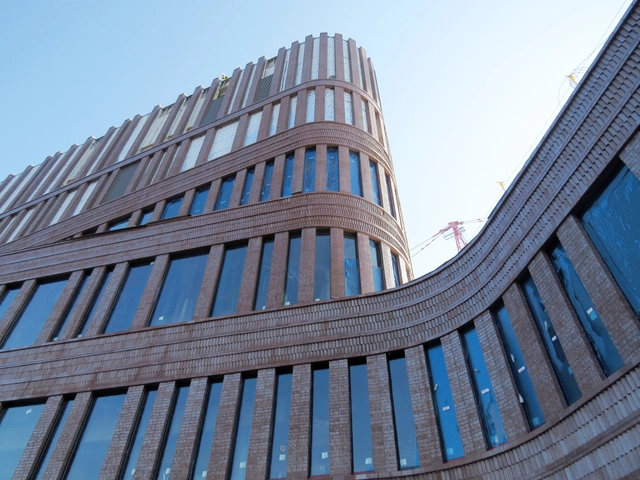
Our friends at Mecanoo have shared a fascinating mini-documentary exploring the complex brickwork on display in their latest project in Boston's Dudley Square, the Dudley Municipal Center (nearing completion).
The following is the first article of Material Substance, a column, penned by Christopher Brenny and presented by AD Materials, which investigates the innovative applications of materials in architecture.
In case you missed it, we’re re-publishing this popular post for your material pleasure. Enjoy!
Continuing with our materials-themed posts celebrating the launch of AD Materials(our US product catalog), we decided to round-up eight materials/products (from a light fixture made from woven irrigation hoses - really - to a wall made from shoeboxes) that make their interiors truly ingenious. Enjoy!
In case you missed it, we're re-publishing this popular post for your material pleasure. Enjoy!
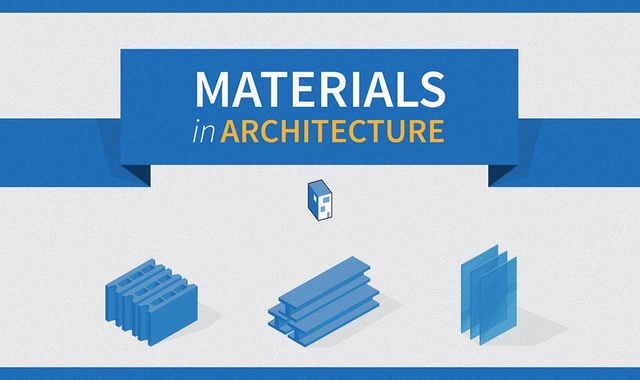
To celebrate AD Materials turning two three (months that is), we decided to dig a bit deeper into the materials we know and love. What's their history? When did they first come to use - and where? How? If you want to know more about the lives - past and present - of concrete, glass, steel, and more, check out our fantastic new infographic after the break!
In case you missed them, we've rounded up our four popular "Material Inspiration" posts, which celebrated the launch of our new US product catalog, ArchDaily Materials. Check them out below!
Kaap Skil, Maritime and Beachcombers’ Museum, Winner of the Daylight Award 2012. Image Courtesy of Mecanoo Architecten
Daylight is a highly cost-effective means of reducing the energy for electrical lighting and cooling. But architectural education often reduces the aspect of daylight to eye-catching effects on facades and scarcely discusses its potential effects - not just on cost, but on health, well-being and energy.
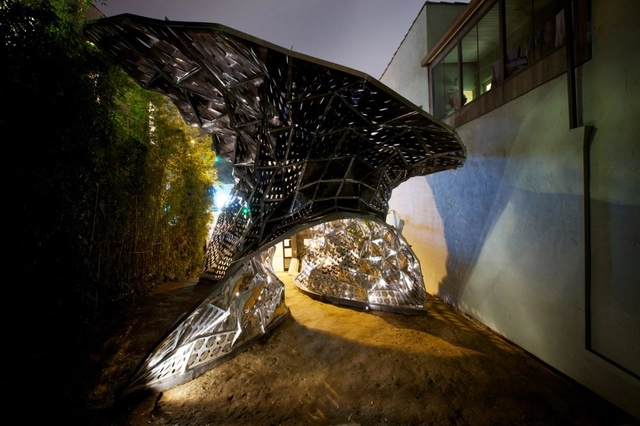
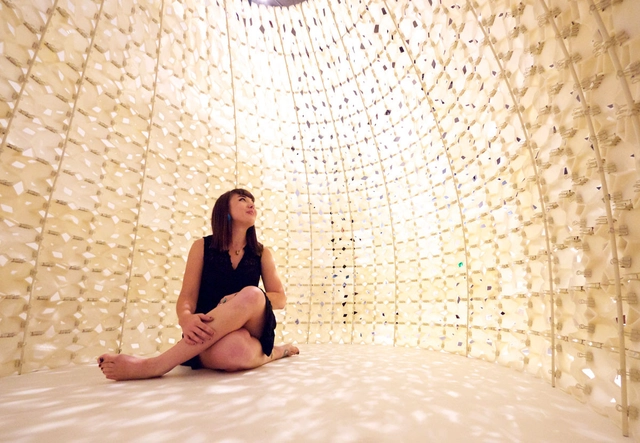
Biology student turn architect, Doris Kim Sung has dedicated her studies to the infinite possibilities of thermobimetals, smart materials that respond dynamically to temperature change. As tested with DO|SU Studio Architecture’s recent installation “Bloom”, whose surface is completely fabricated with thermobimetal, these smart materials are capable of relieving our dependence on energy-inefficient mechanical systems with their self-shading and self-ventilating properties.
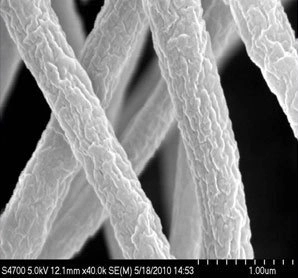
Micrograph picture of cellulose nanocrystals combined with PMMA fibers. Courtesy of U.S. Forest Service
A wood-based nanomaterial composed of cellulose nanocrystals and cellulose nanofibrils is being evaluated at the Forest Products Laboratory, in support of a project at the Army Research Laboratory in Aberdeen, Maryland. The material, presumably stronger than Kevlar, is being produced to create clear composites as reinforced glass for clear applications. US Forest Services has opened a $1.7 million pilot plant in Wisconsin to develop the wood-based nanomaterial, whose future applications may include windshield and high performance glass.
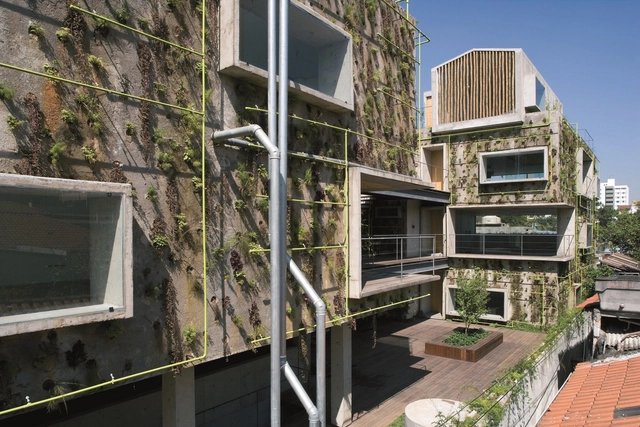
The project in Harmonia Street is located in a neighborhood in the west side of São Paulo, where artistic life and creativity penetrates easily, where galleries and walls are mixed up, functioning as a stage for new expression forms. The alley in front of the building is an example - its graffiti present a concept of experimentation that flows out from the street into the construction.
Wall house innovates on house design, through a sustainable soft skin. This house was awarded the 2007 AR Emerging Awards and selected as one of the 2008 Record Houses by Architectural Record.






.jpg?1386258546&format=webp&width=640&height=580)