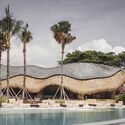
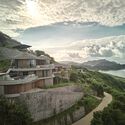
Transcending their role as mere infrastructure, bridges have long served as powerful architectural statements. This expressive potential is now being explored with renewed vigor across South-East Asia, where a growing number of architects are re-evaluating traditional materials. By championing wood and bamboo, these designers are creating distinctive structures that integrate local craftsmanship with contemporary needs, resulting in landmarks that are both functional and deeply rooted in their landscape.
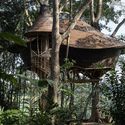
Despite their whimsical appearance, treehouses offer a unique platform for structural innovations and design explorations. Traditional treehouses rely on the trunks of trees for structural support, but, in order to ease the load supported by the tree, contemporary projects often introduce additional systems, such as stilts to maintain the image while offering additional support. One of the key advantages of elevating them in this way is the reduced environmental footprint. Treehouses can be designed to leave the forest floor untouched, preserving small-scale ecosystems. By freeing up the ground below, they minimize disruptions to native flora and fauna, allowing nature to thrive undisturbed. Similarly, many architects use the local topography to create seamless connections, incorporating ramps, stairs, or bridges that integrate with the landscape. These solutions not only improve accessibility but also enhance the overall experience creating an architectural promenade that moves between the treehouse and its surroundings.
"This sensitivity to the environment is reflected not only in the structural design but also in the careful selection of materials. The use of natural materials like wood, also helps the structure blend with its environment. Some designers have gone further by employing alternative materials such as mirrored panels to reflect the surrounding forest and mask the treehouse's presence entirely, demonstrating that the choice of material can contribute to creating a project that feels like an extension of its setting rather than an imposition on it. This collection highlights notable examples from Sweden, Denmark, Indonesia, and France, showcasing their diverse approaches.
Bali might most commonly be associated with its beaches and leisure sector. Rightfully so, since the Indonesian province received more than 2.9 tourists this year alone. Along with the temporary visitors, Bali also houses some longer-term inhabitants and digital nomads, which contributed to its fast population increase. This has naturally affected its urban density and its need for additional accommodation and services, offering opportunities for some creative architecture and materials exploration.
This often appears through the many bamboo-built projects, with the island being the stage for some of the oldest and most intricate bamboo vernacular construction. This knowledge can be transmitted to willing architects and professionals from all around the globe who seek to understand how this versatile material can be applied in their own countries. Many renowned global and local practices, such as IBUKU, and Bamboo U, have championed this ecologically aware architecture through their projects, which are always focused on nature preservation and the revival/ optimization of traditional building techniques.
Los Manantiales by Felix Candela. Image Courtesy of Alexander Eisenschmid
Architecture is often an ambitious profession, with many architects hoping to positively contribute to the social life of the communities, create emotional responses, and add moments of delight and solace to our daily experiences. However, market forces have a way of applying constant pressure on this field, often being the deciding factor in many design choices. Costs and economic value are generally a good indicator of how, when, and to what extent certain materials are being used: the standard rule is the cheaper, the better. But materials are only part of the equation. Site labor, management, and design costs are also considered, depicting a complex picture of the balance between the cost of materials and the cost of labor and its effect on the architectural product.
Originating in ancient India and verbally transmitted through the ages, Yoga has become a widespread and popular practice that engages the body and the spirit into reaching a stillness of the mind and a clear self-consciousness. There are varied schools of Yoga that reflect different origins and types of practices, however, they all require a combination the physical movement with mental, and spiritual awareness. The physical and mental health benefits that a regular practice can generate, despite turbulent or hard times, were recognized by the United Nations on the 21st of June 2022 Yoga day with the theme of Yoga for Humanity.